

Moisture on greenboard & studs causing mold inside cabinet in bathroom
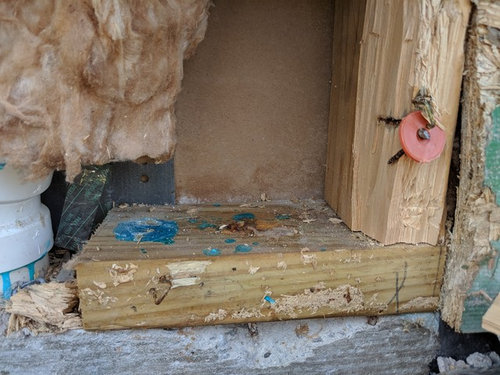
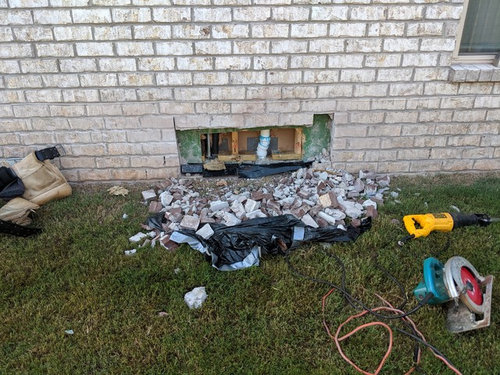
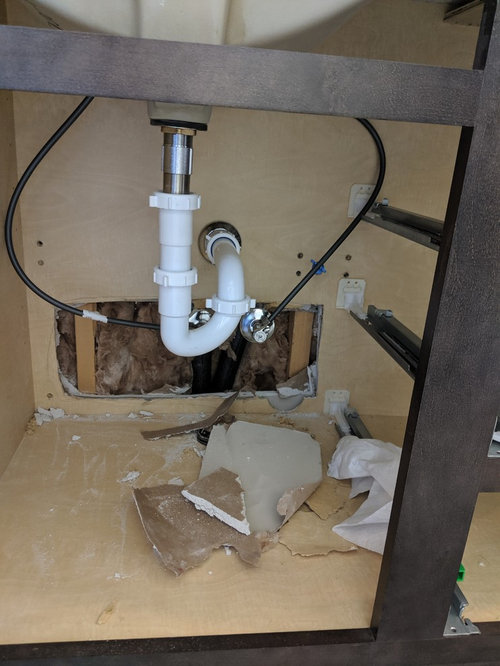
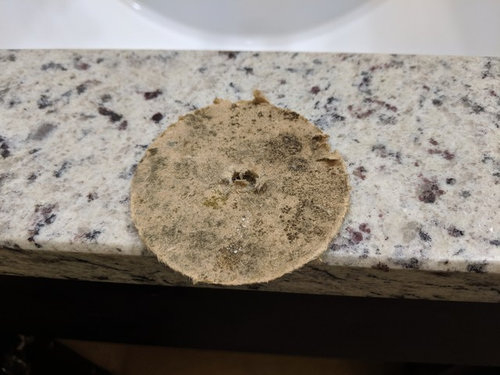
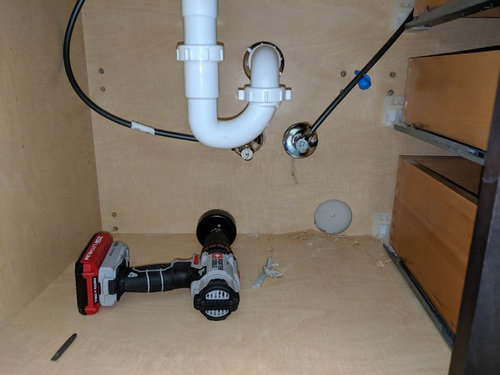
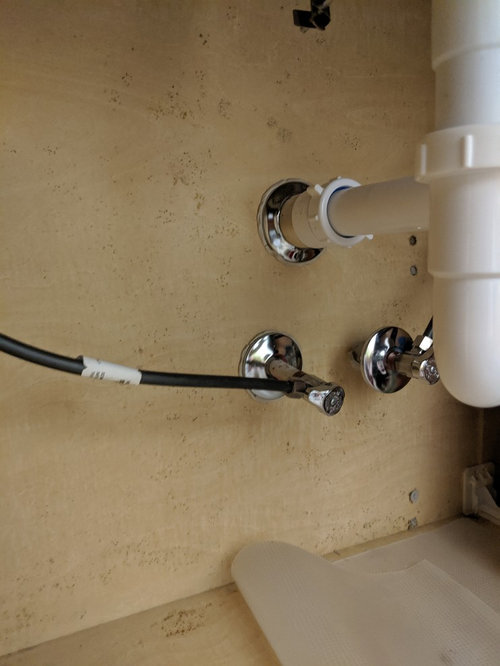
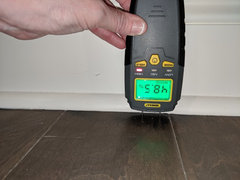
Okay I need any advice here. We live in Northern AL, closed on our newly constructed home in Nov and about 3 weeks ago found mold inside of the spare bathroom cabinets. The cabinets are on an outside wall. the builder said it was from closing the bathroom door causing improper ventilation. After much arguing we got the builder to remove a square piece in the back of the bathroom vanity to prove mold as covering the back of the cabinet. Moisture was found on the studs, it was at 18-20% but the drywall piece had no mold on it. The builder then went to the outside of the home and cut into our brick to expose the Greenboard. He said see, no mold, it came from inside moisture. My husband looked closer and the Greenboard had a moisture reading of 32%, the drywall on the bottom looked as if it had water damage spots and the studs from the outside were dark on top as if they had been wet. The builder still has the hole cut out of our home ( I can see the sun shining thru back of cabinet) he is wanting to bring in an engineer to find out how water/moisture is getting into the walls. He is still standing by the bathroom didn't get ventilation answer. Any idea on how the moisture can be in the walls, the Greenboard and some area of studs with no moisture on drywall against the bathroom cabinet yet the hidden backside of the cabinet has mold all over and the inside of the cabinet has mold growing.The other problem is the bedroom next to this bathroom. When you use a moisture meter on the wood floor next to the wall, it comes up 30%, if you go 12" into the center of the room it goes down to 9%. It's like this all along the floorboards on the right side of the home. Any ideas on how that is possible?
Comments (78)
 PRO7 years ago
I think the engineer is wrong. I'll bet the moisture is coming from improper brick detailing. The mold growth isn't consistent with his theory. You're pulling more air through brick, insulation, drywall, and cabinet than you are from the door perimeter? Please.
 7 years agolast modified: 7 years ago
Presumably - the negative pressure in that bathroom is higher than the rest of the house. Air infiltration is probably super common in Alabama and the mold is not.
Worthy is talking Canada, but it is not common in NC to have ERV or HRVs or any part of balanced ventilation. And Alabama is even less likely. I would not be surprised if your local HVAC person looks at you like you have 2 heads if you bring up balanced ventilation.
Not saying it isn't a good idea but just not common in the South. Infiltration estimates in my last house were $10 a year for a/c and it was not a tight house.(Energy rater doing cost estimates and they estimated infiltration by typical new construction)
Related Professionals
Minneapolis General Contractors · Laconia General Contractors · Augusta Bathroom Remodelers · Fayetteville Kitchen & Bathroom Designers · Huron Kitchen & Bathroom Designers · Aiken Bathroom Remodelers · Winona Bathroom Remodelers · Muskegon Tile and Stone Contractors · Chula Vista Tile and Stone Contractors · Salina Architects & Building Designers · Ashland Design-Build Firms · Lawton Design-Build Firms · Palm Desert Design-Build Firms · Rapid City Design-Build Firms · Fresno Home BuildersF. Slate
Original Author7 years agoI'm curious to find out what the HVAC and Plumbers say. Of course since it's the 4th we are on hold until Monday to even schedule the workers to come out. The builder was upset since he said the State made him put in the Constant Fans when he hadn't had this problem previously. I really don't understand the negative and positive pressure or how they plan on fixing this issue. My husband was guessing they will have to put in more vents.
 PRO7 years ago
If you have exhaust fans running constantly with inadequate or no make up air (i.e., a lack of balanced ventilation) then you have a mechanical driving force for air infiltration in addition to stack effect.
One other possibility to investigate is the design and operation of the HVAC system. If the air conditioning system is oversized, you get shorter run times and less opportunity to dehumidify the air. You can purchase a digital hygrometer for around $20 and use it to monitor indoor R.H.
If your system won't maintain relative humidity at less than 60%, you can add a dehumidifier to your HVAC system. It will provide dehumidification even when the indoor air temperature is not calling for cooling. Reducing indoor humidity will reduce the potential for mold/mildew growth and improve the comfort level in your home, too. If I lived in the deep south, I'd definitely have one.
- 7 years agolast modified: 7 years ago
Is the bathroom even getting adequate cool air and how near is the outlet to the exhaust fan? Locate them on the plan.
We still don’t know how big the undercut is at the 2 bathroom doors.
What was the reason a constant exhaust was required? Do you have them in other bathrooms?  PRO7 years ago
Normally we put our continuous exhaust in the utility, but it draws from room to room via the HVAC ducts & the undercuts.
I would suspect another source of water. Kids flooding counters? Something from above? Broken/cracked pvc drain pipe.
 7 years agolast modified: 7 years ago
If I had to bet on it, I’d say the problems you’re experiencing are more likely due to poor construction methods, most notably the way the wall was constructed (lack of/improperly executed flashing/waterproofing/weeps at the wall base, ZIP tape improperly applied at seams, etc.), rather than how much your bathroom door is undercut or the continuous operation of the exhaust fan.
- 7 years ago
Charles - humidity problems are from infiltration and oversizing. Putting a dehumidifier in the mix just adds another point of failure, is not particularly efficient and is putting a bandaid on a problem. No one around me has a dehumidifier outside of a basement and that is a whole different issue. My last house built in 2009 with not great ACH numbers and oversized units typically hit mid 40's in RH.
My current setup is a mini in the master bedroom set at 67 - runs all the time. Humidity levels are fine by my comfort meter (and I am used to mid 40s). Even in a 4 month old house built on a slab.
So recommending a dehumidifier (IMHO) is generally bad advice.
Build tight, don't oversize etc. But this problem is not HVAC or air infiltration related (again IMHO).
(humidity is far worse in August through October - typically not a problem in the 1 st half of the year. Temps cool in August and humidity rises setting up short cycles and humidity increases based on infiltration) - PRO7 years ago
@David,
Diagnosing the root cause of a mold and mildew problem remotely with piece meal evidence is certainly challenging. Keep in mind that once established, mold and mildew can thrive at relative humidity levels above 60% so, space conditioning should always be considered even if it wasn't the root cause of the mold/mildew.
Our coastal Virginia (mixed-humid) climate isn't that much different in summer from states in the deep south (yesterday I was reminded what it felt like when I lived in south Texas.)
Two weeks ago I got called out to diagnose humidity problems on the 2nd floor of a 20-year old home (not one we had built.) The homeowner had gone through a total of six different HVAC contractors and at least as many prescriptions for fixing the problem. Their HVAC system looked like a Rube Goldberg contraption. The 2nd floor A/C system (single-stage compressor and fixed speed air handler) was maintaining 72F , but the indoor R.H. was 60% and it was clammy. We got their (non-working) dehumidifier operating and the R.H. dropped to a comfortable 51% within an hour at the same 72F indoor temperature.
EPA's Building America program recommends supplemental dehumidification in hot-humid climates. I have come to believe that for both occupant comfort and to minimize cupping of hardwood floors in the summer, that a ducted dehumidifier-- integrated with the HVAC system-- should be standard here in coastal Virginia, too. Mini splits might be an alternative, but our custom home clients won't allow them in their homes based on aesthetics.
If you'd like somebody else's take on dehumidifiers, Matt Risinger penned a piece that's a consumer-friendly read:
https://www.finehomebuilding.com/2014/03/08/revolutionary-new-hvac-equipment-a-split-dehumidifier
- 7 years ago
The engineer today stated that the cause of moisture buildup is due to the Constant Fan they put in above the toilet.
What’s the name of this engineer?
- 7 years ago
I think it’s safe to say there has not been enough information presented for anyone to solve this problem as is the case for so many threads on the forum.
F. Slate
Original Author7 years agoWell, that's true. It's hard to give enough information that professionals know to look for when you aren't quite sure about those details as a homeowner.
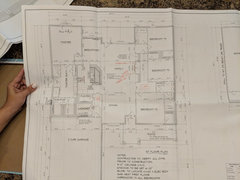
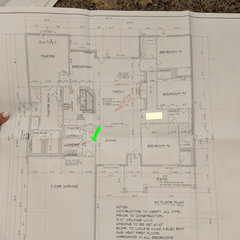
Here is the image of the door with measurement. The other picture shows the house plans. On this you can see the front right side (when looking down at the drawing)bathroom with toilet, shower and constant fan, also has a window above the toilet with a small storage closet. It should also show where the HVAC return is.
Is this room cooled? Yeah, but it's hard because we have been running the dehumidifier non-stop since we still have a holen in the wall in he room with cabinets and mold that is in question, so the room with the cabinets is pretty warm. Doors were always left open so I would have thought that the house would get good circulation, but I'm learning thru this forum that, that isn't true.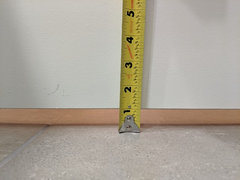
F. Slate
Original Author7 years agoNo constant fan in the other bathrooms, the builder said the State made it a requirement for him to have it in that bathroom to help circulate air.
F. Slate
Original Author7 years agoI just noticed this drawing had two possible HVAC locations at the time. This image shows where the actual HVAC return is in our home with the green check mark
- 7 years ago
F - many codes now require a minimum of fresh air ventilation. We didn't but Energy Star requirements had us do it. The cheapest and easiest way is a bath fan left on all the time or some minimum percentage. It is not to circulate air - it is to provide fresh air for the house. It exhausts air and then air is sucked in through leaks in the envelope. It isn't ideal but it works and satisfies code.
Generally one bath fan does it - doesn't matter which one although ES recommends one per floor. That isn't required in my area.
The door undercut is fine and adequate for the needs (IMO).
Common sense doesn't always work but in this case, the air is going to come from the path of least resistance. The undercut in the door should be way easier for air to travel then through the cabinet doors and through the holes around plumbing penetrations etc. Which is what I suspected.
On dehumidifiers and the EPA. First - the EPA is not generally the source I would listen to. Not that it is horribly wrong, I would just not consider them "best" by any means. I have been on the EPA's site and the tendency to be conventional and compromising based on cost is significant.
A dehumidifier can be helpful in many situations - limited solar gain, lots of plants, indoor pool, oversized HVAC, and big air infiltration. Again - just not the best answer.
And we have a ducted mini - which means there is zero aesthetic issues. Is it perfect? No - but it is a great way to keep the humidity down.
But to your house with the high humidity - why not cut the tonnage in 1/2 and put a stat on it that will limit the short cycling?
Lastly, my experience on the NC coast - renters want to hear the ocean so air infiltration is the real problem. Otherwise our humidity stays low. Now come October, perhaps a dehumidifier would be helpful....but pointless when people can't close windows.... sorry, rant off.
F. Slate
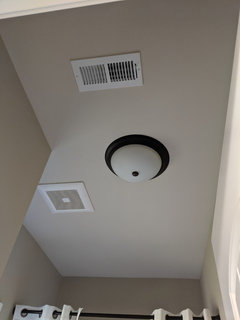
Original Author7 years agothe square is the continuous fan, then the air vent is about 20" from door on ceiling.
- 7 years ago
Is there a supply air grille in the vanity room ceiling too? If not, the exhaust is pulling the dry conditioned air out of the shower room and preventing it from getting to the vanity room.
- PRO7 years ago
@David,
My bad. I got my government bureaucracies mixed up. Building America is a DOE initiative, not EPA.
It may not be perfect, but the Building America program had wide stakeholder input, credible (and credentialed) technical professionals, credible, peer-reviewed research and recommendations based on real-world results. I think it provides sound, practical solutions for anyone who wants to apply building science research already paid for with their tax dollars. Alternatively, they can crowd source "expertise" here on houzz.com
As far as the home with the 2nd floor humidity problem, it has a fairly new (less than two years old) HVAC system which includes a new, ducted, Honeywell dehumidifier that wasn't operational. The ductwork, insulation, by-pass humidifier, dehumidifier, and controls looked like they had been configured by a bunch of different contractors, which was, in fact, the case. Getting it operational and configuring the controls properly was something we did in less than an hour at minimal cost. The improvement in comfort level was appreciably and validated by relative humidity data.
Your disdain for supplemental dehumidification is noted, however, replacing a two-year old HVAC system with a more appropriately sized system doesn't make economic sense when the quickest, least-cost solution is simply to get a piece of equipment that's already installed and paid for to operate properly.
Back to the problem at hand....
Infiltration of moist air occurs naturally due to stack effect. Here in coastal Virginia, it's fairly common to see mold/mildew growing on the bottom rail of windows due to stack effect. It's also common to see mold/mildew around HVAC supply grills and drywall when ductwork is run in an attic and the supply grills are in the ceiling.
The OP's Alabama home is a one-story with (I assume) a conventional, vented attic above the 1st floor living area. With little in the way of air sealing and pipes in an exterior wall, I suspect there's not much air sealing of penetrations in the bath ceiling either. Accordingly, I would expect some level of infiltration due to stack effect. Infiltration could be increased due to the bath fan if it's not part of a balanced ventilation system. Infiltration is easy to test for with a smoke pencil (hopefully their consulting engineer did so.) If infiltration is not contributing to the problem, that assumption can be quickly eliminated which moves the troubleshooting exercise and remediation forward.
- 7 years agolast modified: 7 years ago
Makes total sense. Broken dehumidifier - fix it. The scenario makes a good point - eliminating a point of failure. That article from finebuilding was talking about a vacation house that is empty often. That makes a strong argument for the dehumidifier. Their recommendation - set the stat on 92 when unoccupied - not a normal situation. Sound argument in that specific situation.
Is it a ranch with vented attic? Do we know that for sure?
Simple simple test - change the always running bath fan to another bathroom and check RH. If the fan is the culprit, then the room with the fan will show high RH.
Would be very interesting if that is the case. Maybe a result of a huge air leak from the attic down. But - isn't that the opposite of stack effect?
While I realize stack effect always occurs, isn't it a bigger winter problem? In the summer, it just provides some natural air infiltration. Sure - bad for humidity, but similar to what a continuous bath fan does. And unlikely to cause bath mold in one room.
F. Slate
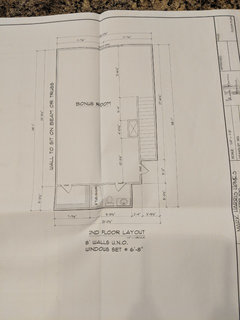
Original Author7 years agoIt's a two story home here is the plans for the upstairs. The constant fan doesn't go into the attic, it goes straight out the roof.
- PRO7 years ago
@David,
The OPs problem--at least for the moment--is a localized growth of mold/mildew, so investigation of localized conditions is more relevant than general conditions in the home.
We know is that there is piping in an exterior wall behind the vanity, poor air sealing (fiberglass insulation vs. spray foam) interior sources of moisture (e.g., the shower,) penetrations in the ceiling plane, and a continuously operating vent fan. We also know that the local conditions are favorable for growth of mold mildew, i.e., the dark, poorly-vented interior of the sink base cabinet.
The consulting engineer has determined the cause to be the continuously operating vent fan pulling air from around the pipes behind the vanity. I infer from that, the root cause is infiltration of humid Alabama summer air condensing-or at least elevating the relative humidity level in the sink base cabinet to the level needed to support mold growth. I'd take advantage of the open wall to install spray foam insulation all around the pipes.
The OP also noted localized elevated moisture readings in the hardwood floor along the exterior wall of the adjacent bedroom. I might have missed it, but I didn't see the engineer's diagnosis for this condition. F. Slate
Original Author7 years agoCharles Ross Homes, he stated that the moisture along that side of the house is all from the same issue. The fan.
 7 years ago
He's full of s**t. Pay someone now for an independent inspection and figure out what is wrong before your warranty runs out and you have a mold and rot mess.
- PRO7 years ago
I think that infiltration is a plausible explanation for the mildew in the bathroom vanity, but I'm not convinced it's the root cause of the flooring moisture issue in the adjacent bedroom. It could be, but it's more likely to be the result of bulk water intrusion or moisture in the slab perimeter.
I'd invest in a good moisture meter and check the flooring moisture content over time.
In either case, I agree with millworkman about the importance of getting the problem properly diagnosed and remedied within the home builder's warranty period.
- 7 years agolast modified: 7 years ago
I think we probably all agree for a second opinion from another engineer.
OP reminder - the fan requirement is probably new in Al. The builder may not be used to it so he may have a tendency to blame the fan. He probably wants you to disconnect the fan and call it a day which is a really cheap solution (that I don't think will work).
To the fan issue - directed at Charles Ross. You see the door undercuts - that should be a way bigger hole than the cabinet door leaves. But I agree with you that it is possible - just not sure it is at all likely.
OP - do you notice air flow under the door when closed and fan running?
Also - in my area, we don't terminate bath fans out a roof. You stated yours does - and doesn't go through an attic. That is only possible if you have a cathedral ceiling in the bathroom or a flat roof - neither of which seem likely. Those roof penetrations are more expensive than eaves openings and are infinitely greater likelihood of leaking. All probably irrelevant to the problem here. Just pointing it out.
I still vote for bulk water intrusion. But if it were me I might accept sprayfoam on that wall that has been opened with a written agreement that moisture will be checked over the next several months in the problem areas.
- PRO7 years ago
I would agree on a second independent opinion, but from a proven expert, engineer or not.
- PRO7 years ago
@David,
There are a number of different mechanisms for moisture transfer including intrusion of bulk water, capillary suction, air movement, and vapor diffusion. Any or all of these may be contributing to the OP's issues. Determining which one(s) is the troubleshooting exercise, which is best done on site.
That said, let the wild speculation begin....
I think that bulk water intrusion around the exterior wall or capillary suction in the perimeter of the slab is the more likely root cause of the higher moisture in the hardwood floor than the continuously operated bath vent fan. If either is at play, the floor moisture issue may exist around the entire perimeter of the home.
I think that movement of high humidity air is the likely root cause of the mold issue in the area of the bath vanity. This could be due to infiltration/exfiltration, duct leakage or excessive ventilation. While the continuously operating fan may contribute to the problem, there are other suspects, too, including potentially leaky supply ducts in the attic space which can depressurize the conditioned space and cause infiltration of humid outside air (most homes operate at negative pressure.) Piping and penetrations in the building envelope behind the vanity facilitate the air movement. Again, bulk water intrusion and capillary suction may be contributing to the problem as well.
The engineer troubleshooting this problem should issue a report complete with color photos and a discussion of how he/she determined the bath fan is the culprit.
- PRO7 years ago
I know a sure-fire low-tech non-engineer way to prove whether or not it's improper detailing/water intrusion or vent fan. Bust out a few more brick around the house that are in rooms without fans and check the walls. What's another couple holes at this stage? He's gotta mix mud anyway.
- PRO7 years ago
Hi, Joe,
Demolition is sometimes the fastest and least expensive way to permit a good and thorough visual inspection of existing conditions. Removing drywall to verify the dimensions of beams and columns is one example where there's no substitute for demolition.
In this case, except for allowing visual inspection of sheathing and flashing, demolition of the brick veneer changes the status quo in a way that limits the type of tests that can be conducted. With one area already opened up, I'd suggest a minimally-invasive approach for others. For example, using a garden hose, the brick wall and soil around the slab foundation can be wetted and interior moisture readings of flooring, trim and drywall can be obtained. What's happening inside the wall cavity during (and for a time after) the test can be inferred using an IR camera (non-invasive) or a fiber optic camera with only a small hole in the drywall to patch. Ditto for the air space between the brick veneer and sheathing with only a small hole in the mortar to patch.
You can purchase a fiber optic cable that works with your smart phone for less than $50 or a dedicated fiber optic camera like Ridgid's borescope with a 36" cable for around $100. It's one of the best investigative tools we have in our tool box.
You can also turn your smart phone into an IR camera with any number of aftermarket accessories. I will admit that doing so might tempt you to use the phone as a hammer (I know I've been tempted to) which brings us back to where we started....
 PRO7 years ago
Sorry to the OP, these problems are more fun to armchair diagnose than actually deal with. A good thread to point to regarding poor weatherization practices that accompanies most masonry workmanship these days. I'm thinking better air-sealing and brick veneer best practices, as mentioned by RES, would have resulted in better durability and commend the many other excellent posts here.
Interesting details from Huber regarding brick over Zip R-sheathing. The polyiso and fiberglass facing decreases permeability compared to regular Zip and agree with RES that a Peel-and-stick membrane on bottom course or two would be a worthy upgrade, especially sections exposed to rain and sun. I don't trust the Zip-system-only as WRB in this scenario without a healthy overhang, well drained veneer cavity and protection from capillary action of the ground.
I think the vent fan could easily be contributing to the problem. Even a slight airflow from a moist veneer cavity could lead to those problems. If the wall faces the sun or prevailing winds, those forces could also be enough to drive moisture inward.
Some of the confusion here with mechanical ventilation is why I prefer the term outdoor air ventilation in regards to supplying outdoor air to a home. In that blog post I try to explain why balanced systems are best and this thread is an example of why exhaust-only systems can be troublesome.F. Slate
Original Author7 years agoThe builder stated that the Engineer never gave a written report when I asked for one. I will be making some calls to get someone out here to give their opinion on the constant fan and the moisture in the flooring next to that outside wall. I just have to research who is best to call. On another note, the builder has decided against having an HVAC come in to create positive airflow in the home, he has chosen to have an electrician come in to put in an on & off switch to the constant fan. I have issues with this because to me, how would I know when I'm suppose to have it run and for how long? Also, if I do run it, will this problem be created all over again? If it isn't running, then how do I create the positive airflow that the engineer said our home was lacking? Many questions, but your theories and thoughts have been beyond helpful and I'm grateful you each took the time out to comment.
- PRO7 years ago
I recommend you seek the help of a forensic engineer or a building science consultant.
Good luck and please report back the findings.
- 7 years agolast modified: 7 years ago
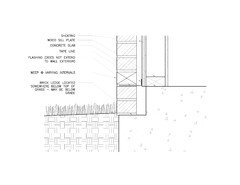
Slate, In addition to the weeps appearing to not be in the correct course of brick, if you have managed to find the only weeps in that section of wall and there aren't others clogged with mortar, etc, then they are also much too far apart. Good practice places a weep every 16-24", that is in every second or third joint. The two that you have indicated are a full 8'-8" apart. It may turn out that the masonry and wall detailing is not the cause of the current issue, but there are enough questionable detailing to take a full review of the exterior wall construction. If it's not a problem yet, it may be down the road.
- 7 years ago
Slate, I just looked at all of your photos again in as much detailing as I can. It looks like the sheathing ends at the bottom of the stud wall. That's all good. The weeps are even with the bottom of the stud wall and the taped on flashing extends through brick in the mortar joint immediately below the weeps. This is not so good. While it does appear that the brick extends down to a brick ledge that is at least 2 bricks below the floor slab, unless there are more weeps at the bottom you have at least two rows with out any drainage, and the bottom of those rows may be below grade. Plus you have your flashing level right at your floor level, so if there is any failure in the flashing, water can back up right into the sill plate of the stud framing. It also doesn't appear that your flashing extends up the wall any distance at all. It's taped on to the sheathing right at the mortar joint that it extends through, so it's essentially just a horizontal sheet of plastic.
Does this description seem to match what you are seeing in person?
- 7 years agolast modified: 7 years ago
For clarification, this is what I am seeing in the photos (plus wall insulation of course):
- 7 years ago
This link might be helpful to check your construction against.
https://donan.com/article/preventing-water-intrusion-with-through-wall-flashing/ - 7 years ago
The detail looks correct. The flashing looks like a plastic garbage bag and was probably taped to the face of the sheathing with Zip Tape. I would have used Grace (now GCP Applied Technologies) Perm-A-Barrier Self-Adhesive, Rubberized Asphalt/Polyethylene through-wall flashing. Its made for masonry cavity walls.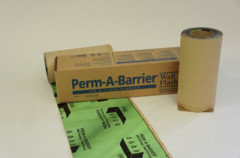
F. Slate
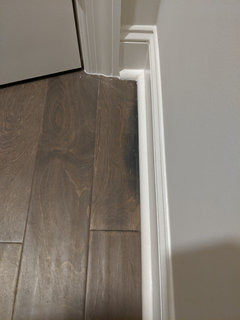
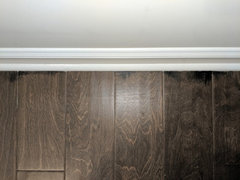
Original Author7 years agoJust wanted to give an update on this since so many of you had ideas on what the issue could be. Since the last post we just last week had the drywall removed, new drywall installed, a new cabinet and hooked everything back up. It was under the builders impression that the issue was still caused by the constant fan. However, shortly after the last post we discovered that our Septic Tank was never turned on. It began overflowing into the backyard, which is right behind the side of the home with the moisture issue. We were concerned about why the septic pump alarm never went off and that was because it was never connected by the electrician. We moved in last November so it was off for that whole time. We never noticed back up toilets or any odors or even the toilets making bubbly noises. We got that hooked up correctly and it started working. Last night when I was cleaning my sons room I noticed the edge of the wall on the hardwood flooring had water stains that were solid black. We have the Chesapeake Bay Gray Fog Engineered Hardwood flooring thru-out our whole first floor except for the wet areas where we have tile. The black spots we noticed are the same spots that had high moisture readings when we noticed the mold issue. The builder said the two issues werent related and that we would deal with the moisture after we took care of the mold issue. Since I have looked into all of these possible solutions, my only idea of what could have caused all this is the flashing on the home. It looked correct when they removed the brick on the side of the home but it has to have gaps in places that allowed water to leak in. the water spots are about every two feet away from each other in my youngest sons room and we found one spot in the dining area which is on the front of the home and then in the bedroom next to the bathroom that had the mold. Thank you for all of your help researching and figuring it all out.
F. Slate
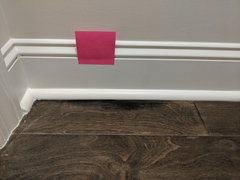
Original Author7 years agoThe builder now has removed two places of drywall and trim to see if water was in the walls, which it was not. Evidence of moisture behind the baseboard with more mold was visible. He said he had never seen anything like this and said now we have to wait to call in the Manufacturer of the Engineered Hardwood Floor Company. These moisture areas are on the left side and the front of the home. However when he started reading moisture levels in the center of the rooms they were even high now. We have no active water leak and no water damage signs anywhere but along the edge.
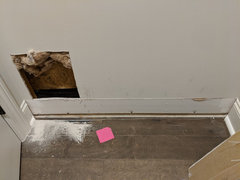
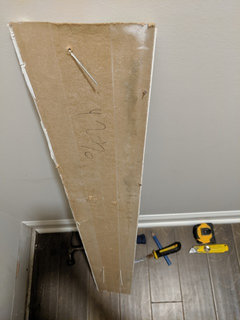
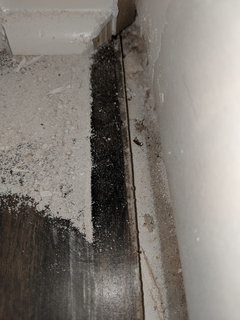
- PRO7 years ago
Hi, F. Slate,
A couple of questions: Does your home have gutters and downspouts? If so, do the downspouts extend to direct storm water well away from the foundation? Is the grade established such that there is at least 6" of slope away from your home within 10 ft? F. Slate
Original Author6 years agoYes to gutters and downspouts. It does direct storm water away from the foundation. 10 ft of a slope away from the home? No
- PRO6 years ago
The code requires that the finished grade have a fall of 6" measured at a distance 10 ft from the home (i.e., 5%.) The gutters should direct storm water well away from the foundation. If they do, and the wall cavity doesn't show evidence of intrusion of bulk water, then the source of moisture is most likely moisture in the soil being transported by capillary suction. Here's a link to additional information:
- PRO6 years ago
Your problem is the the fact that the brick is below grade; the bottom of the brick should be at least a couple inches above grade. There is no way the weep hloes are allowing drainage of water difusing through the brick and the fact that the brick, which is very porous, is sitting in the wet dirt, is causing the moisture content to be extremely elevated. This is a landscaping issue.
F. Slate
Original Author6 years agoWe hired an attorney to help us solve this issue. He had us take out areas of drywall, insulation & greenboard on opposite sides of the home, so that the mortar and brick was exposed from the inside. What we found was that the mortar had been pushed in when the brickers were bricking the home. Any water that got between the brick and the greenboard had no way to get to the weep holes since the mortar was blocking the areas above the weep holes. We currently still have the floor damage, mold and now new issues with water /moisture on drywall & baseboards. Im very happy to have finally found the reason for all of these problems.
- PRO6 years ago
Back at the beginning I'm looking at the brick sills at the windows and I can't tell if they are sloped or not, and whether window weep holes are clear.
- 2 years ago
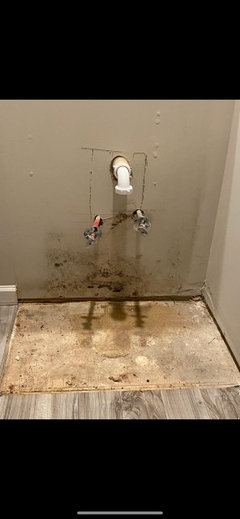
F. Slate is there a way for you to reach out to me directly? I’m 3 years into a new construction home also in N. AL. During the first year we had mold
in a bathroom cabinet and in the wall. the builder ”fixed” the issue during our one year warranty and yet it has come back. I’d love to know what professionals helped you.












Charles Ross Homes