Software
Houzz Logo Print
travis_smith71

Thyme not growing

7 years ago
Hello,

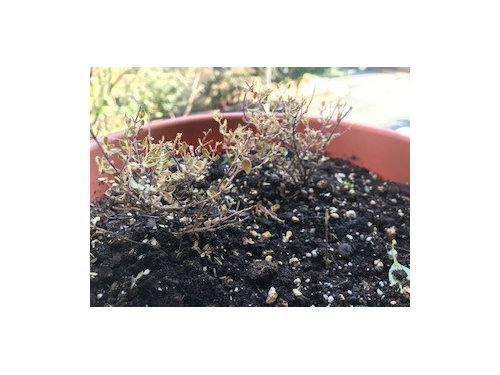
I am having a terrible time trying to keep my thyme alive. The first 2 plants I bought are now extremely brown and I can’t seem to figure out what I did wrong. I left them in a sunny location and made sure to water them when the soil got too dry every stem ended up woody and brittle. I have a picture of them to show what they look like that may help in diagnosing the issue. I have 2 new plants in potting soil made for cactus/succulents and they too seem to be turning very woody and showing no signs of growth. Please help!

Thank you


Comments (20)

  • 7 years ago

    The soil looks too wet to me. Thyme have very shallow root and like the soil to be very very well draining. Store bough cacti/succulent mix is not even appropriate for regular cactus and succulents. It seems lot of succulent growers amend that 50/50 with perlite, lava rock, etc. I would suggest gritty mix. If you search for it in container forum you will find many articles.

    Second, after transplanting water well and put the pot in open/bright shade for a week. This will allow the plant get used to in the new environment before moving it to full Sun. If it is hot water more frequently to let it establish. A well draining mix will have no trouble handling frequent watering without saturating.

  • 7 years ago

    This is great information and makes sense. Thank you! If I take my new plants out of the soil they are in, mix in some perlite/lava rock, and plant back in the container, will I still need to let it adjust by putting it in shade or do I keep it in full sun? They have been in full sun for almost a week now. Also if I mix the 50/50 mixture should I also add rocks in the bottom for extra drainage or would that be too much?

  • 7 years ago

    How big is the pot compared to the two plants?

  • 7 years ago

    No rocks in the bottom - it does not help anything. I may put a small pile of rocks around the drain hole to prevent it from clogging but with a very well draining mix it is not required.

    With a well draining mix size of the pot does not mater as far as root rot is concerned. A large pot has the advantage that it will not heat/cool as fast outdoors as would a small pot.

  • 7 years ago

    I understand about the size of pot with well-draining mix, but I'm thinking that with the current soil mix, the additional volume of soil in what looks like (though I can't be sure) a larger pot may have contributed to the demise of the original two plants. Just trying to help the OP understand what happened initially.

  • 7 years ago

    beckysharp: understood and a good point.

  • 7 years ago

    Like most Mediterranean herbs, thyme would prefer a very lean, fast draining soil mix, little to no fertilizer and only enough water to keep it alive. The gritty soil mix or a good cactus blend with almost no organic material if growing in a container is ideal.

    btw, culinary thyme is really a woody based subshrub. Developing woody stems or base is common.

  • 7 years ago

    I grow Thyme always. I have found that Thyme likes a shallow pot with reasonably good soil with a thin layer of small pebbles covering the surface. At first a rest in the shade would be good to get started, but then a sunny spot, but not cooking-hot, would be nice. Right now my one-year old Thyme plant has totally taken over the whole 12" bowl it use to share with the Nastys and some Chives. It is in the side-yard garden not on the concrete patio.

  • 7 years ago

    Keep in mind that shallow pots are harder to grow in because they support a higher % of perched water. Example: If a soil holds 4" of perched water and you use a pot 4" deep, after a thorough watering the soil will be 100% saturated - bad form. A 12" deep pot (filled with soil) will have 4" of saturated soil at the bottom of the pot, and 8" of soil with air spaces between soil particles. Obviously, since thyme abhors wet feet, use of shallow pots should be coupled with use of media that hold no or precious little perched water. I've had thyme growing in tiny pockets (about the size of a filbert nut with the hull on, or a regular size marble) in black rocks in full sun for many years, and I've never once even splashed a little water on them to slake what has to be a powerful thirst in summer.

    Al

  • 7 years ago

    Never heard of "perched water" in a pot with a good-sized drainage hole. But then I'm in dry California so maybe the water doesn't have time to 'perch' before getting evaporated.

  • 7 years ago

    Never heard of "perched water" in a pot with a good-sized drainage hole. I'm sorry to learn that because it puts you at a disadvantage.


    That water perches in soils (used in conventional container culture) based on large fractions (more than 15-20%) of fine ingredients like peat, coir, compost or composted forest products, sand, topsoil, .... is dictated by the laws of physics. The only impact weather has on perched water is in the fact that 'dry and windy' might to some degree work in favor of those using media that supports perched water by causing a more rapid rate of evaporation. Still, while the perched water remains in the pot, it works to limit root function and increases the likelihood of root diseases. Technically, a pot w/o a drain hole can't be the cause of perched water, any more than a layer of clay beneath a layer of sand/gravel causes perched water, though it's obvious that no drain hole = a significant increase in the probability/potential of limitations associated with an excess of water in the soil.

    Al

  • 7 years ago

    Where are you growing the Thyme? What climate?

    I live in Florida and they sizzle this time of year.

    I grow mine in a raised bed, vegetable garden and if I don't start them in February, they cannot take the high heat and humidity in July.

    In NY, I had no problem growing them with other herbs in large pots on my deck. They did very well.

    Please give your location.


    Jane

  • 7 years ago
    last modified: 7 years ago

    I live in Arlington, VA. I took the thyme and rosemary out of the pot, placed shards over the drainage holes to make sure soil does not clog them, and re-planted in a 50/50 mix of potting soil made for cacti/succulents and perlite with the pot being a few inches taller than my plants. I am hoping this gives a much better drainage system as well as my careful watering plans. If this is wrong I welcome any criticisms as it will only help me.

  • 7 years ago

    Yep, In my zone I’d stick those in the ground somewhere and say good luck. Start with new plants.

  • 7 years ago

    Oh sorry I didn’t mention these are brand new plants. I got new ones and had them in just the potting mix for a couple days and then after reading this thread re-planted them!

  • 7 years ago

    Travis - you actually took a backward step. I'll explain.


    Perlite has no internal porosity, and thyme does not like compacted media. Start with your cactus blend, say a pint jar full. Add a handful of perlite, bark, or other coarse component. Has the porosity gone up or down? It went down, because a particle of perlite or a piece of bark has less porosity than the same volume of your cactus blend. Now imagine your 50/50 mix. Obviously, there is enough fine material in the cactus mix to fill in every air space between the perlite particles, and then some. Roots cannot colonize the space occupied by perlite - it has no internal porosity, so roots are forced to grow around it. This means the only space roots can colonize in your 50/50 mix is the cactus soil between the perlite particles. So, you decreased o/a soil porosity and by a significant measure and reduced the volume of soil available for root colonization. That's a step backward. The worst soil you can grow in would be a mix of fine and coarse materials with exactly enough fine material to fill all of what would be air spaces between the coarse materials.

    If you have in hand a medium you feel is too water retentive, you cannot effectively "amend" it by adding perlite, unless the volume of perlite (and/or other coarse ingredients) in the mix is large enough that the volume of fine material is such that there is not enough finer material to clog all the large air pores between the perlite particles. This "threshold" ratio of ingredients is a key factor in whether or not you'll be able to take advantage of the added aeration and reduced water retention large fractions of coarse materials in container media can offer. You're actually better off to grow in the water-retentive media and reduce the amount of perched water a medium can hold to nearly none by the use ballast. And, that's essentially what perlite is, it's just not as effective as other types of ballast. The coarse fraction of a medium a grower assembles specifically for sharper drainage and increased aeration would include >80% coarse material (bark, perlite, Haydite, Turface, calcined DE, grit, peanut hulls, lava rock, et al) and <20% fine materials as listed above.

    Perlite takes up space that might otherwise be occupied by excess (perched) water near the bottom of the pot. That is a step in the right direction, but when perlite occupies space above the maximum ht of the perched water table, it's counter-productive because all it's doing is taking up space, and reducing the volume of soil roots can occupy.

    To use perlite most effectively:

    * Figure out the ht of the perched water table the cactus mix supports - very easy - 10 min

    * mix enough perlite and cactus mix at 4 parts perlite: 1 part cactus soil to fill whatever pot you're using to the maximum ht of the PWT the soil supports.

    * Fill the rest of the pot with cactus mix straight from the bag & establish your planting.


    Adding perlite to an otherwise poor medium is a small step in the right direction because it marginally reduces the volume of perched water an excessively water-retentive soil can hold. This decreases o/a aeration.


    Better than above, would be to use the poor soil as it comes from the bag, but reduce the volume of perched water the soil can hold by use of ballast. You cannot eliminate 100% of perched water with ballast, but you CAN eliminate 99% of it. Unfortunately, this does nothing for aeration.


    Ideally, you would be using a soil that supports little to no perched water, which would be a soil based on a very large fraction of coarse particles ( more than 80% larger than 1/10"), and enough fine material to increase water retention to a level the grower can tolerate. Keep in mind that a plant normally loves being in a medium that requires frequent watering, even if the grower doesn't.


    I think the message here is, if you have a poor (water-retentive) medium and start adding coarse materials to amend it for drainage and aeration, you'll make the soil much worse before it starts to get better. Once your mix has a large enough ratio of coarse: fine materials to have passed the "threshold" where there is exactly enough fines to fill the would be air spaces between the coarse material, it gets much better very quickly.


    Al


  • 7 years ago

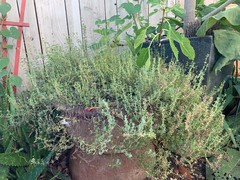
    You might have the Thyme planted too deep in the pot. Try raising the soil level to at least one-inch below the rim. If in the garden, your Thyme will like to sort-of lay on the ground and travel across it. Photo of my Thyme plant which is in an 8" deep x 12" wide pot which is actually sitting on top of another up-side-down pot :

  • 6 years ago

    Actually the soil seems snoggy, excessive water supply can cause root rot. Please check thislink for more information.


  • 5 months ago

    ok

    this is how to growing plant fort then one seed and water soil