Software
Houzz Logo Print
marissa_brown50

Help! Mold on Floors!

7 years ago

We picked up our rug in the living room today to find our wood veneer floor is covered in black mold - yuck! I dragged the rug outside and cleaned the mold with vinegar, but it has eaten away the veneer in many places. I can't get all the mold off no matter what I do. There is also a hump in the floor around this spot - which was there 1.5 years ago when we bought. We were told it was just settling at the time - the house was built in 1979. So, now I know things need to be fixed, but I don't know what professional to even call! Plumber? Flooring? - please help!

Comments (15)

  • 7 years ago
    last modified: 7 years ago

    What’s under the house? Crawl space? Concrete slab? You have a moisture issue, for sure. But this to be diagnosed in person.

  • 7 years ago

    We have a concrete slab - Insure hope it isn't a slab leak. That will be ridiculously expensive! I guess we should call a plumber.

  • 7 years ago

    Your house was built in 1979. That means there is no moisture barrier underneath the slab. We will need photos to see what is going on with the flooring where the rug was sitting before we can comment on where the problem is.


    If the mold is ONLY in the area where the rug was sitting it is probably NOT a plumbing leak. It wouldn't make sense. The 'hump' in the floor should be investigated...that's for sure. But I would hazard a guess that the moisture is a continuous issue with a slab from 1979.


    And to be clear, you will need to throw out the rug. There is no amount of vinegar that will deal with the mold. You could send it out for professional 'remediation' cleaning (from a company that specifically cleans up flood areas/houses/basements etc). If the rug isn't worth the few hundred dollars it costs to clean, then I recommend you chuck it. Don't even let it back into the house. Mold moves via airborne spores. These become airborne when DRY...sigh. Don't even store it in the garage. You want it double bagged and sent to the local landfill.


    To really assess what is going on, you will need to have the flooring pulled up in the area you are seeing the mold. Again, photos of the issue before you pull the flooring will help. Photos done AFTER you pull the flooring would also be interesting for us to see.

  • 7 years ago

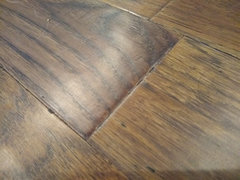
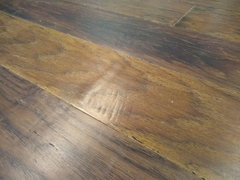
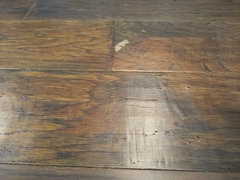
    Here are some pictures. It's very difficult to capture because I cleaned off most of the mold with vinegar - the black stuff you see is the mold I have not been able to remove. I also tried to capture the lifted edges and waviness in the planks.

  • 7 years ago

    I wonder if you can go after the PO since the hump was there 1 1/2 years ago when you bought. The PO had to sign a disclosure form correct? If they didn't note it, that sounds like fraud?

  • 7 years ago

    Well, you'd have to prove that the PO knew there was a leak. The hump being there doesn't mean a lot if they never bothered to investigate it.

  • 7 years ago

    Well, we are waiting for someone to come out right now actually. We recently had our roof replaced due to leaks following a hail storm and we are hoping it has to do with that somehow - then we could add it to our existing insurance claim. We do not believe any water is leaking because the water meter did not move when we were not using water.

    The house was actually an estate that was flipped - so there was not much of a disclosure. Being a flip, we have been aware that things like this might happen - we had been lucky so far lol.

  • 7 years ago

    So, the professional came and said... he didn't know lol. He recommended using an engineer since it is (kinda) near our atrium and patio. We are now between paying an engineer $450 for a look at the water patterns/foundation or paying a plumber to run a hydrostatic test for $350. But, we are wary to do either because it could also be that no proper moisture barrier was installed under the wood.

  • PRO
    7 years ago
    last modified: 7 years ago

    As Johnson suggested, take several readings to pin point source of the problem. Have a flooring contractor take the readings with a species specific dual depth meter to make sure the floor boards are within normal range. Other types of meters are set for general building materials, the readings will be different. It can be up to 5% different, possibly more.

  • 7 years ago

    Thank you - I am trying to find someone with this to help us out!

  • 7 years ago

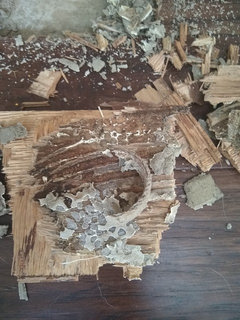
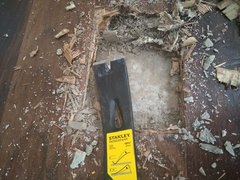
    So, we have a structural engineer coming out to see what the problem is (best guess is that we have an atrium, the water is getting beneath the house and coming up from there) - but we knew the floor was ruined anyway so we pulled some up. Can anyone tell if we have underlayment/moisture barrier under this floor? It was definitely glue down and definitely wet.

  • 7 years ago

    If done properly, the glue was supposed to be the moisture barrier. If the wrong glue was used or the wrong application or the wrong spread rate or the wrong amount of coverage (on the back of the wood) was applied then the glue won't be able to do its second job = moisture barrier.


    For old slabs (poured before the mid-80's or even 90's) it is best to float a floor. These slabs are almost always problematic.

  • PRO
    7 years ago

    No moisture barrier used here and the glue does not have 100% coverage. You would need to find out what type of glue was used. Not all adhesives are designed to function as a moisture barrier. It's possible your product needed a moisture barrier to properly perform.


    Avoid being dependent on one product to do the entire job. It's best to have several layers of prevention, compared to having just one. If, one layer fails, there is always a back-up. Use a roll on moisture barrier combined with a 3 in 1 adhesive for maximum protection. It's going to cost you a bit more, but it will allow you to sleep at night. Don't let the pricing manipulate you into making the wrong investment. As it has done to many others.

  • 6 years ago

    Thank you all so much for the advice. We finally are getting out structural problem addressed (yay for the atrium and massive amounts of rain in a run off area lol) and will be moving on to the floor soon. We are actually going to patch the floor with wood we have until we are able to save up for new floors throughout. The floor people we have called have recommended a moisture barrier with a different adhesive to patch with. They will use a moisture meter to see how much floor needs to come up. Fingers crossed, this will get us through 5 years or so until we can put something else down lol. I'm not a huge fan of our engineered flooring - it has chipped and faded so much in our 2 years here.