Software
Houzz Logo Print
popmama

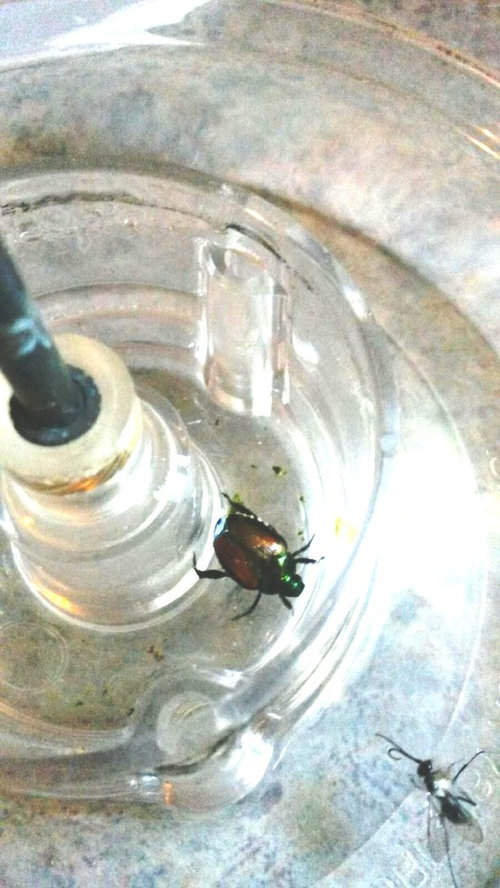
First Japanese Beetle

I knew the day would come. But up until today, I had never seen one in my yard. I've seen zillions in my mom's yard in Southeast Denver, my aunt's yard in Aurora, and the yard of a friend in Littleton. But somehow, my area had so far been spared. But here it is. Found it today in the center of the hummingbird feeder. So it begins.


Comments (31)

  • 7 years ago

    For geographical reference, I live in east Arvada. My area of Arvada is Adams county very close to where old Westminster begins. I've lived here 20 years and never seen one until today. To say the least, I am not excited.

  • 7 years ago

    Sorry to hear it. We didn't have any until a few years ago.

  • 7 years ago

    I'd never seen a Japanese Beetle until 2 years ago when they were chowing down on the ripe(r) tomatoes. One tomato had at least 10 inside, leaving only the skin. I haven't seen any yet this year, though most of the insects seem to be far and few.

  • 7 years ago

    Tomatoz1, you have few and far insects? Wow what a difference! My yard is the total opposite. I have an over-abundance of insects, primarily earwigs and mosquitos are brutal.

  • 7 years ago

    popmama, we have ladybugs, a few small grasshoppers, and lots of dragonflies sweeping the tops of the garden. We also have a few garter smakes that slither around, but usually stay around the flowers. We are very lucky this year with fewer bugs.


    I'm waiting for the onslaught of blister beetles that inundate all of my pasque flowers, as they have for years. I've sprayed with Neem and even dusted with kaolin clay, but they still return. No mosquitos yet.

  • 7 years ago
    last modified: 7 years ago

    Still have not seen any in Aurora or Westminster gardens but certainly won't be long. The traps are not very helpful unless you can get everyone in your neighborhood to use them and even then questionable help. Seems the most effective thing is hand picking and dunking in soapy water. They are also nematodes or milky spore you can treat your lawn with. We used to have them by the hundreds or even thousands on our property on Long Island back in the 1960s.

  • 7 years ago

    No Japanese Beetles yet, but the dreaded blister beetles have returned, chomping on my Pasque flowers. Now that I know they are here, I’ll keep a watch out for them.

  • 7 years ago

    Good find, gjcore. I'd never be able to tell those from other flies but I guess it does support the "live and let live" philosophy. Next time I see a fly I won't immediately try to kill it. I will hope it is a tachinid fly!

  • 7 years ago

    First Japanese beetle here in Aurora. Looks like they been munching on the grape leaves.

  • 7 years ago
    last modified: 7 years ago

    Did not see any. I do read nurseries have high penalties selling any plant with these 1000 per sold plant.

    I have predatory flies and chickens that patrol the property and dig for any grub or anything moving in the gardens, I do autumn garden clean up when I do not feed chickens and set them on property so they are hungry in the morning and go dig and dig and clean. the do not cover entire acreage so, I let them feed in evening but no free feed because I want them to go after the bugs and grabs and other things they can clean up.

    How do you know on swaps who has these and who does not? esp at autumn swap (contamination through the soil and eggs and grabs, grabs will be seeing next year, so mostly grabs)?

  • 7 years ago

    " How do you know on swaps who has these and who does not?"


    I believe it really doesn't matter now because the Japanese beetle is now widespread throughout the metro areas of eastern Colorado.

    popmama (Colorado, USDA z5) thanked gjcore
  • 7 years ago

    Grubs are mainly in turfgrass as they feed on the grass roots. I suppose the eggs could be anywhere nearby if you have garden near grass. They will be 1-3 inches underground. I think the only way to be sure would be to remove all dirt from the roots of the plants and wash thoroughly before transplanting. Basically bareroot.

  • 7 years ago

    My neighbor just returned from vacation in a panic. She said the housesitter said the Mexican beetles were all over her beans. I just checked out the beans and sure enough, she has Japanese beetles. I'm going to be checking my garden every day now. So far, so good for the time being. However, the blister beetles have dessicated by pasque flowers. Maybe it's for the good, but don't know what else they eat.

  • 7 years ago

    Are you saying the neighbor misidentified the beetle or she has both Japanese and Mexican beetles?

  • 7 years ago

    The neighbor's housesitter ID'd them as bean beetles. I only found the Japanese beetles all over her beans. Flipped many of the bean leaves - no egg clusters found. She just texted and said the Japanese beetles were ALL OVER her plum tree.

    Great. An arborist is coming tomorrow to hopefully eliminate the adults for now, and mostly likely will need another check in 7 days when their grubs/eggs may be around.


    I'm just waiting for the grasshoppers from Las Vegas! NOT!

  • 7 years ago

    Ack...those Japanese beetles are voracious. I didn't know they like plum tree too! Nothing is safe I guess.

  • 7 years ago

    Tomatoz1 I now have blister beetles all over my Pasque plants too. I have read that their larvae eat grasshopper eggs. I have tons of grasshoppers so I am torn about which is the lesser evil. Have you found the blister beetles do permanent damage to the plant for the next year?


    I have not seen Japanese beetles where I live yet but wish everyone the best in dealing with them.

  • 7 years ago
    last modified: 7 years ago

    Maribeth, I have had the blister beetles consume all of my Pasque flowers for the past 5+ years and the flowers always return. I wonder if it's like using a fire to burn the weeds and have the vegetation underneath return the next year.

    Whatever it is, I have tried to eliminate the blister beetles to no avail.


    And . . . I now have the Japanese beetles in my yard. Today I removed 3 from my hyssop plant.

  • 7 years ago

    Thank you for the very helpful information. The Pasque plants are in my pollinator garden and I didn't want to try and treat them but I am very fond of the Pasque flowers each spring. I think I will let nature take its course and hope for the best.

    I'm very sorry to hear about your hyssop plant. I hope you don't have too much damage.

  • 7 years ago

    Removed one munching on a petunia today. I have designated a special bucket with soapy water outside for them now.

    My mom said that they have decimated her roses and appear to be moving on to her hardy hibiscus. She has decided to dust them. I am really hoping they don't start eating my hibiscus. I really don't want to use any dust or other pesticides. Ugh.

  • 7 years ago

    I use a powder that I use for the flea beetles on my tomatoes. Add it to water, spray on the leaves, and it works well for keeping most of the flea beetles away. It is not a pesticide, just a deterrent clay. Don’t know about using it elsewhere, but it might work (?). It is called SurroundWP.

    popmama (Colorado, USDA z5) thanked tomatoz1
  • 7 years ago

    Thanks tomatoz1. I think we need to experiment to see if it will work! It seems like the downside about using powders is the side-effect on the appearance of the foliage and blooms. At least that powder doesn't seem harmful to other insects.

  • 7 years ago

    Yes, the white color stays for about a week, even in the rain. I usually have to re-apply about every week to the tomatoes. For flowers, which is worse - white leaves or holey leaves!? I also get leaf miners on the few roses I have. They usually aren't deterred by anything I do.

  • 7 years ago

    Those darn JB just destroyed the top layer of leaves on my Weeping Pussywillow Tree. I was picking them off an squishing them and then found out that is worse because it releases the JB pheromone and then more come! Duh....lol

    popmama (Colorado, USDA z5) thanked djacob Z6a SE WI
  • 7 years ago

    They are really doing a number on my grass, the grubs. I tried nematodes and I don't think they worked, maybe their were DOA. I'm going to try milky spore too, even though the CSU extension does not recommend it, as it takes up to 3 years to work. It's strange though, they are not eating the blue grama grass, only the other turfgrasses.


    My mom lives nearby, and they have literally destroyed her grass. And the adults did a huge number on her virginia creeper, hollyhocks, and roses.

  • 7 years ago

    I feel like we are in a horror film waiting for the invasion to hit. There was a story on the KDVR news about them the other night. I also recently read an interesting article about how Palisade was able to eradicate them. But it won't come easy. And sadly, most of the current methods are either dangerous to or have unknown consequences to other organisms.

  • 7 years ago

    CSU is working on a fly, and a wasp, which are both JB predators. I can try to find the link tomorrow, they have released them in several test areas in Denver. Hopefully that will work! They have a great JB fact sheet also, https://extension.colostate.edu/topic-areas/insects/japanese-beetle-5-601/

  • 7 years ago

    Heidi, I know there is already a fly that lays its eggs on JBs. I decided not to hate flies anymore in case they are the ones that do. But I really don't want a whole slew of them either. Same goes for wasps.

  • 7 years ago

    I think I am going to try intervals of milky spore and hope for the best. CSU says that they do not like to lay eggs in tall grasses, so I now have an excuse to not mow my tiny lawn! I will report back next year if I have any success.

  • 7 years ago

    Yes that article seemed to indicate that mowing your grass at a taller height was good all around because the grass will better be able to withstand root invasion as well. The person who mows my lawn is a fan of "taller mow". I don't love the look, but I just let him do whatever he thinks best.

    Keep us posted on your milky spore experiment.