Software
Houzz Logo Print
flowers_galore

Hedges for zone 8a

7 years ago

Hi all,

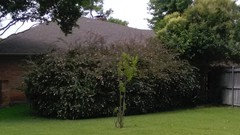
looking for suggestions for relatively fast growing hedges in 8a around the house ..

Flowering and non flowering.. Thank you

Comments (19)

  • PRO
    7 years ago

    Hedges come in all sizes. What is being hedged here and how tall does it need to be?

    "Fast growing" usually mean s BIG, and plenty of annual trimming. You're good with that?

  • 7 years ago

    for 6-8 feet tall perrenials, around the perimeter of the property, for fence and privacy. Thank you

  • PRO
    7 years ago
    last modified: 7 years ago

    Near what city? Zone 8 California plants are different from zone 8 Georgia.

  • 7 years ago
    last modified: 7 years ago

    This is cross posted to the Texas Gardening forum so a not unreasonable assumption that this is a zone 8a in TX.

  • 7 years ago

    I have variegated ligustrum in Central Texas: pretty, evergreen in 8B zone, fast grower (2-3’/yr), fragrant blooms in spring and drought resistant once established.


    Omar

  • 7 years ago

    Thank you, It is Texas..

  • PRO
    7 years ago

    In general, I don't think it's very hard to make most common landscape plants grow quickly. Just don't starve them of water or fertilizer and they will kick butt. If I wanted a hedge only 6 or 8 feet tall, I would not want something that grows 2 or 3 feet per year. That's a lot to trim off. I don't know specifically what plants grow in your area, but look into some of the shrub hollies for one possibility, dwarf 'Burford' for example. (Whatever the stated height and spread for a plant is, in reality it is common for it to become 50% - 100% larger.) for something flowering, look into one of the panicle hydrangeas if those grow there and you have room for a sprawling, unclipped hedge.

  • 7 years ago

    blakrab,


    I know that ligustrum has a bad reputation but, in my garden they have behaved very well. Not even one volunteer In 12 years. Maybe the variegated ones behave differently?


    Omat

  • 7 years ago
    last modified: 7 years ago

    ^ Omar - But you do monitor all the areas outside of your yard where birds may be dispersing its seeds in their bombs far away? All Ligustrums are highly-invasive...and YES, including the variegated form of Chinese Ligustrum!

    More from the site linked above:

    "Many of my neighbors have the variegated form of Chinese ligustrum (Ligustrum sinense) in their yards. Almost everyone will agree that it makes an attractive contrast in color when planted among dark green shrubs in the landscape. A visit to a nursery will tempt unwary customers to purchase the attractive plant. Several attractive cultivars have been developed. Buyer, beware! Just down the street, I see instances where more than half of a variegated shrub has reverted to solid green. These solid green stems bear hundreds of berries that are carried as far away from the plants as birds can fly.

    A member of the olive family (Oleaceae), this plant was introduced in the United States as an ornamental in 1852. By 1933 it had become naturalized, and not long afterwards it was recognized for the noxious weed it is. Maturing to about 12 feet tall and wide, the shrub is hardy to Zone 6. Ability to grow in sun or heavy shade in either wet places or drier upland sites makes it adaptable to a wide range of growing conditions. It is a quick invader of disturbed sites and can even grow in the crack of a sidewalk. Capable of forming dense, impenetrable, monocultural thickets, the shrub can dominate the shrub layer of an invaded habitat and alter the ecosystem by choking out native plants.

    Almost all states within its range list Ligustrum sinense as an invasive plant. Mississippi State University lists it as one of Mississippi’s ten worst invasive weeds. The Georgia Exotic Pest Plant Council also has it on its top ten, and the Florida Exotic Pest Plant Council lists it as a Category I exotic invasive plant. Tennessee and Kentucky list it as a severe threat, and it is on Virginia’s list of highly invasive plants. Texas, Alabama, North Carolina, and South Carolina, have placed Ligustrum sinense on an exotic invasive list of some type. Herbarium records show current distributions extending from Florida to southern New England and westward to the eastern parts of Texas, Kansas, and Oklahoma."

    I just don't see why anyone should risk planting from that whole invasive genus when there are so many better options available? Thing is, the only real solution to invasives...is prevention.

  • PRO
    7 years ago

    Another vote for Texas sage.

  • 7 years ago

    If you want the traditional Victorian hedgerow look, Japanese boxwood may be the easiest that fits this category, though 6'-8' would be a stretch. Cherry laurel can be trimmed to a hedge in that height range. For many gardeners in central Texas it's the preferred tall hedge species; others don't care for the "butchered" look required to keep it in bounds. It prefers deep soil and good drainage.

    Leucophyllum requires full sun and sharp drainage. Since you didn't mention where in Texas 8a you're located, be forewarned that Leucophyllum is susceptible to rot if it receives too much moisture in winter, i.e. east Texas. The Green Cloud and Silverado cultivars definitely meet your height preference, though the bottom third to fourth tends to become bare once they grow that tall. Convent reaches 5'-6' with greater foliage density. Compacta is denser still, but don't count on it reaching 5'.

    If you're willing to provide some TLC, the Majestic Beauty cultivar of Indian hawthorn is a bona fide show-stopper; tall and dense with spring flowers.

  • PRO
    7 years ago
    last modified: 7 years ago

    Check out Needlepoint Holly, Yellow Anise, Chindo Viburnum & Eleagnus "Gilt Edge".

  • 7 years ago

    The standard glossy abelia (Abelia x grandiflora) makes a fairly robust and quick growing 6-8 ft flowering hedge that stays mostly evergreen in zone 8. Becomes nearly as wide as tall when left to its natural form. If pruned with a hedge trimmer to fit a space as often seen in older neighborhoods, most flowers are lost. Oh... and it's not invasive.


  • 7 years ago

    ^^ A way to avoid root rot for plants that need good drainage (like Texas Sage) in lower areas that will pool rainwater is planting them up on small "volcanic crater mounds" that raise their (root) crown above the surrounding "floodplain."

  • 6 years ago

    @blakrab_Centex: it’s great to hear native-plant suggestions, but all of them are of short height. The OP is searching for a privacy hedge; >6ft. We see your passion for eradicating Ligustrum, but a quick google search reveals they’re readily available for sale at Lowe’s and HomeDepot; the USDA obviously isn‘t concerned about this Chinese invasion.

  • 6 years ago

    Are these foundation plants?

  • 6 years ago
    last modified: 6 years ago

    I agree that the 'cat's out of the bag' as far as ligustrums go, but if that is a concern know there is a cultivar of Variegated Ligustrum that is sterile. Omar 'Vulture' has never had a berry on his.

  • 6 years ago
    last modified: 6 years ago

    Yes, 'Sunshine' is another newer sterile Ligustrum that trialed well at the Dallas Arboretum a few years back. Imagine there will be more to come. Agree it's better to stick with one of these for much of Texas because the fertile cultivars and species plants germinate and grow so well here. Wax-leaf Ligustrum is about the most common volunteer regularly left by the birds along our fence-lines and in the neighborhood park.