

Spacing climbers on a trellis.
What I have in mind is a long trellis, about 18 inches away from a privacy fence and many climbing roses planted along it making a wall of growth, leaves and flowers. I found two YT videos, one from HR and one by PZ. The trellis I am thinking of is like the one in the HR video but the grid will be a little tighter.
The HR one:
https://www.youtube.com/watch?v=6hG0wamcyCc
PZ:
https://www.youtube.com/watch?v=1o-o_FHPoEU
I have five questions
I get it how you want to grow the canes as horizontally as possible to get laterals with flowers. But as you fix the canes horizontally wont the final effective height of the climber be much lower? When a climber is stated to be 7-8 feet and you fix its canes/branches horizontally how much of the height of the trellis does it cover? I like PZ's idea that you grow a tall climber and next to it you grow a short climber to fill the lower space. Still is there a rough calculus for how much height a climber can cover when filling a trellis?
I can well imagine there are roses that are classified as climbers that have canes nowhere as flexible as shown in the two videos. Typically how do you work with these 'stiff and upright' climbers on a trellis?
Is it a good starting point, to place climbers about 5 feet apart (the HR video)? At this distance they can intermingle but still have enough own space?
At the end of the HR video he says not to deadhead the tip of the cane. Why not? If you did deadhead there maybe one or more shoots coming out from near the cut and one of those will become the leading point of the cane again, no?
Wouldnt you want to plant something else at the base of and in front of the trellis while still giving the trellis most value?
If there are any other important pointers I need to know to plan this trellis, the roses I would order, how far I would space them, which ones I should place where....please let me know!
Thanks!!
Comments (36)
 7 years agolast modified: 7 years ago
Excellent advice given above. Few things are more fun than having to transplant a 20' New Dawn that has decided to intermingle with its neighboring New Dawn that was planted too close! Many of the more upright climbers are more suitable for pilloring or growing up supports to reach an arbor where they can then spread out.
katyajini thanked Vaporvac Z6-OhioRiverValleyRelated Professionals
Cincinnati Landscape Architects & Landscape Designers · Greenville Landscape Contractors · Bartlesville Landscape Contractors · Spring Home Builders · Tuscaloosa Landscape Architects & Landscape Designers · Palm Bay Landscape Architects & Landscape Designers · Sebring Landscape Architects & Landscape Designers · Johnson City Landscape Architects & Landscape Designers · Tacoma Landscape Architects & Landscape Designers · Clarksville Landscape Contractors · Spring Landscape Contractors · Muskegon Landscape Contractors · Oshkosh Landscape Contractors · Grand Junction Landscape Contractors · Florence Home Builders katyajini thanked Sheila z8a Rogue Valley OR
 7 years ago
Wow. Fantastic advice, very clearly presented. I think the cosmos in front of my Moonstones are going out tomorrow.
I’d forgotten about “blowing out” plants. That at least will be something that’s fun to do in the heat.
katyajini
Original Author7 years agoRoseseek are you sure you are not my fairy godmother? (Uh I just assumed you are a she, well you know what I mean :) :)
I am so lucky you were on the forum today. You wrote a treatise. I did think of adjusting distances based on the my most educated guess for the sizes of the climbers but was not thinking about the laterals! In pictures there is 'thickness' to various climbers growing on a wall or fence and some are so much 'thicker' and heavier than others. That thickness is from the laterals. If those long laterals are positioned horizontally then do they produce secondary laterals and more flowers? Or do you keep the primary laterals trimmed to 'manageable' length? Thats a very important point. To my mind balancing the positioning of the climbers based on their mature size and habits (degree of stiffness, length of laterals) will have such an impact on the final beauty of trellis wall. Its a bit daunting. I really am feeling my ignorance.
As for companion plants I have not thought it out yet. Believe it or not I am so aware of root space and root competition. There will be a way to make a healthy, airy, relaxed garden.
Thank you Roseseek. There is a lot to think about!
- 7 years ago
Thanks, Katyajini, no ma'am, I'm a "he" but I understand. Thank you! Yes ma'am, those make all the difference. Look at the photos of Annie Laurie McDowell here here and here. This makes long "laterals" which flower the entire length of their ends. Now, look at Dortmund. It puts out long canes but shorter "laterals" which flower at shorter lengths so it remains much tighter against the wall than Annie Laurie McDowell does. Imagine dealing with this Lordly Oberon. Or, this one in the previous garden owner's mother's garden, where the Dortmund and Annie Laurie McDowell grew. This shot provides a few feet of Lordly Oberon, the spread of Rosarium Uetersen and two Sally Holmes. Notice how tightly Uetersen and Dortmund grow to the wall while the others throw those long canes to flower on. Those long canes then throw those long laterals and they all have to go somewhere or you won't have the amount of flowers you want. They can get VERY thick and require regular whacking. I had to whack Annie Laurie McDowell back rather severely twice to thrice annually or she grew far too large for the wall and yard. There were MANY feet of her in the neighbor's yard which they enjoyed. If it was cut, they did it.
The least successful I tried on those walls was Mme Alfred Carriere. She was just HUGE. Malvern Hills was the second least successful.See how thick it demanded being? I'm glad you're "feeling your ignorance"! Hopefully, we can help you not "enjoy" the fruit of ignorance by helping you think of these things which we've already DONE! LOL! I'm delighted you are aware of root space and competition. You might be surprised how often that isn't thought of. You're welcome! I'm glad I could help! - 7 years ago
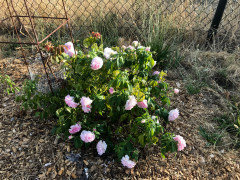
I just have to show my baby Annie Laurie McDowell, Kim. She is so happy, even in 100 F.
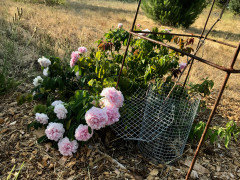 She is happy, happy, happy. I know a full grown plant will be amazing, Kim! Thank you!
 katyajini thanked Sheila z8a Rogue Valley OR
  7 years ago
Roseseek, has there ever been a list published for climbers distinguishing the ones like Dortmund that send out short laterals versus long? It would be helpful for planning in my small yard. The Reve d’Or at Huntington has very long laterals, maybe 4-6ft, which I hope will not be a problem in the spot I have planned for him to grow along the top of the fence separating two houses built 10 feet apart. I am hoping laterals can be pruned back as needed and they can weep down a little bit. We will see. If it is a disaster then I will have to move him since while not super thorny he has plenty of thorns and I do worry the laterals will hit myself or the neighbors in the face. Their home is several feet below ours so the Rose has less chance to hit them, but still I am wondering now about my decision. I have been trying to get your Annie Laurie McDowell, since she is supposed to be totally thornless.....is she totally thornless? Are her laterals as long as Reve d’Or?
- 7 years ago
Hi, Stephanie. No ma'am, I'm not aware of anything printed providing the information you wish. With any of our lucks, that is likely location dependent. Reve d'Or does make very long laterals and it will reach out to touch your neighbor's house as well as hit you both in the face. Kippy the Hippy in Santa Barbara recently built an "arch" over a gate to help put hers up and over the face level. What direction does the sun come from between your houses? If it shines directly on either wall, the plant will grow toward both due to the light reflected off the "shaded" wall from the sunny one. Odd to think it would, but they do.
Yes ma'am, Annie's laterals are as long as Reve d'Or's. And, in twenty-five years, I have only found TWO prickles on any plant of Annie Laurie McDowell. I've found MANY more on the double white Banksiae than her.
For the past two years, I have sent Steve Singer at Wisconsin Roses, bud wood for him to custom bud Annie Laurie McDowell, Grey Pearl, Kimo (striped Peace, which I have sent off to a more suitable home) and Cl Columbia for requests. He doesn't wish to stock any of them but has budded plants to multiflora for those who have requested them. I sent him material this year for the few requests he wasn't able to fill last year. I don't know if he finally did as I suggested and use every bud I sent and I would find homes for the extras as he never alerted me there were any. You can email or call him from his web site. I don't know if he has plants available nor if it's too late for him to bud them now, but if you want to contact him and see what he says, I am willing to send him more if he needs it. You DO want Climbing Columbia! It is NEARLY without any prickles; flowers repeatedly; has HUGE, double, HEAVILY scented HT pink flowers and is fairly easy to train for a stiff sucker. I've often grown it as a free standing shrub. It's easy to keep within bounds, but if you let it loose, it will take to the trees. We encountered an enormous one at Rosemary's Roses which used to be in operation up in Columbia, CA.katyajini thanked roseseek - 7 years agolast modified: 7 years ago
I'm guessing these are tender roses or might they survive in zone6?
- 7 years ago
Annie is a Renae seedling. I know she's being grown in a few colder areas but the long term outlook is unknown. Cl Columbia is a CL HT sport of a bush. The other two are traditional HTs.
- 7 years agolast modified: 7 years ago
Roseseek, Thanks for the feedback! Yes I am on Steve Singer's list this year for ALM, assuming the buds take and there aren't more people ahead of me on the list than plants available. Fingers crossed. She actually sounds perfect for the spot I put Reve d'Or and she was my first choice, but I couldn't find her when I was buying roses last fall. This fence is a 30 ft long cable rails fence sitting on top of a block wall and runs exactly NE to SW and is high enough (7 ft our side and 9 ft their side) to get a good 6+ hours of direct sun each day along the top where I plan to train one cane that will then have laterals. Climbing Columbia sounds like a perfect growth habit for a smaller yard, plus with huge blooms, almost no thorns and great fragrance! Do you know who sells it? I am also thinking Lilyfinch would love this one for her new small California yard too.
- 7 years ago
Thanks, roseseek. I looked it up and it jogged my memory! I had actually put in for cutting of Cl. Columbia on HMF almost exactly one year ago! :)) This would be a great rose for Lilyfinch!
- 7 years ago
Wonderful! I'm glad you're already on Steve's list. Hopefully, he should be able to fill your request this year. He received FAR more ALmD buds than he requested! The rose is euphoric in Kippy's Santa Barbara garden, where, even own root, it's growing like oatmeal on a two year old! She permitted me to cut many feet of it to clear it from a path to send Steve. He also buds the Cl Columbia, which I obtained from The Huntington back in the early 1990's. 6+ hours of sun may or may not be too much. That large ALmD in Valencia grew (it may still. I simply haven't had access to it since early 2015) on the north side of that wall so it received filtered light through the bloody birch and plum trees and reflected light off the house and patio. I do like the sound of the fence, it should be quite pretty! By "plan to train one cane that will then have laterals.", do you mean there will be others but one on that top rail for sure, or ONLY one cane with laterals? I hope it's the former and not the latter. No cane lasts forever and with the sun and heat intensities now, it's going to be easy for them to get sun scalded, which literally kills them. You need all the canes from the bud union possible to maintain the health and vigor of the plant for the long term.
katyajini thanked roseseek - 7 years ago
I originally grew Cl Columbia own root, Vapor, and it built to a narrow, 6' tall free standing plant in my Newhall garden. When I was having to dismantle that garden, I passed the plant on to Jimofshermanoaks who also grew it free standing and returned it to me a year or so before he passed as he knew the time was short. I budded it to Pink Clouds, and if I could get it in the ground, it would eat the place in this climate. I honestly think you want it budded, not own root.
- 7 years agolast modified: 7 years ago
This talk of low-thorn climbers reminds me of a "trick" I use for planting different climbers along a wall. Within reason, I've tried to intersperse thorny roses with low-thorn for ease of care. It's working out quite well so far, helping to separate them more easily for training, pruning, etc. I actually prefer some thorns as it's easier for me to keep them in place by hooking them on the balustrades and the chain link (which I have attached to the balustrades and dropped over the wall to support roses growing at the bottom, ( if that makes sense)). It's been a new experience actually tying Ghislaine de Feligonde, but certainly nicer when all the canes fall on me!
- 7 years ago
Ha!!! Thank you for that very useful info.!!! That is precisely why I'm growing up some multiflora and Dr. Huey: to use as rootstock for less vigorous plants in my zone or those rarities that might not root. I've never done this, but will soon be experimenting. So many cuttings of rare (to me) roses died while trying to root and now are not easily available to me. At the time I hadn't any luck with cuttings, trying methods suited to more arid climates which rotted them all. I just didn't know. With ready rootstock perhaps they'll be better success and then I can always take cuttings of those if I prefer OR. In any case, I'll be prepared for any that come my way! : ))
- 7 years ago
Roseseek,
Did Steve get any Cl. Columbia to bud this year? Or is this something he could do in the future if requested? Also if Huntington has Cl. Columbia, although I don't remember seeing it there, maybe they would bud some for sale at their yearly Plant Sale if requested; I could check. Last Year they put all their energy into the Huntington 100 rose introduction, which sold out in 30 minutes and just had Paul Neyron (which I scored) and one other hybrid perpetual, that I am forgetting, for sale from their own collection. Yes I meant the second....just one single cane along the top of fence. I can't do lower since the laterals would then definitely be too low and hit people in the face. I am hoping laterals can be grown in a way to shade the main cane since I recognize the sun-scald issue in my inland SoCal climate. I do recognize that if the main cane dies the whole plant will probably have to come out and be replaced. It may be that the Reve d'Or laterals will be too vigorous for this placement and will have to come out anyway :-/ I also have a climbing Pinkie which I didn't mention previously planted a few feet from Reve d'Or and was hoping it would fill in underneath Reve d'Or for the first 8 feet of the 30 ft fence since this part seen from the front yard. Do you know if Climbing Pinkie is like Dortmund with short laterals....I am hoping you will say yes. CP is much less thorny than Reve d'Or. As far as root competition the Reve d'Or and CP don't have any other plants near them and I was hoping if they grew up together they would do OK. Also Marlorena in England recommended Marie Nabonnand as a totally thornfree red climber. I am going to buy her from GreenMantle to climb along my back patio. I am curious, have you grown MN?
- 7 years ago
Good luck on the stock cuttings! I hope they're not RMV infected. Many of the pass around roses now are tested virus free.
Yes ma'am, Stephanie, Steve received Cl Columbia. My plant was quite stressed due to a severe mite infestation and outgrowing the pot but he didn't indicate anything wasn't suitable nor unsuccessful.
Please rethink your one cane idea. You can train the main cane against the fence then take the long laterals and tie them in along with the main cane. That large ALmD in Valencia had the laterals all tied in parallel to the main canes. I just kept doing that as long as possible until it got too thick and had to be reduced. That was a gate at the left end of the plant so it couldn't get too thick or you couldn't get into and out of the back yard. You NEED as many main canes producing laterals as possible, particularly in any climate with extremes in cold, heat, UV, light brilliance, etc.
I've not grown Marie Nabonnand. In general, Nabonnand roses are great, but she appears to have the Reve d'Or/ALmD long lateral growth, too. This photo of Cl Pinkie makes it seem you should be able to at least shear it into providing what you wish from it. I've seen similar results from Renae, too. You just keep pruning/shearing it as you would a shrub to create a hedge and it flowers all over the surface. You can do the same with Banksiae, too.katyajini thanked roseseek - 7 years agolast modified: 7 years ago
I want to throw out there my full sun Reve d'Or looks pretty sunbaked here in a not attractive way. Yesterday I had to cut off the only main cane of a sunburned Tea Souv d un Ami, and I am hoping it shoots up some new basals. It was both sun damaged and had started to wilt (although watered). I found a worm in the center of the (only) sunburned cane, so I guess the borer finished it off. This sunburn problem, and one cane problem, is serious stuff. I have another Reve d'Or in a shadier spot that looks better. I have a Marechal Niel in a pot here too and I wonder how it would handle the sunniest hot spot too.
- 7 years ago
A rose really needs dense foliage, meaning short inter nodal spaces, not the overly long ones the Cl Tea types produce, to shield the canes from sun burn. Citrus and other fruit growers white wash the trunks to prevent sun scald. I guess we're going to need to start doing it for roses? Overlapping multiple canes can help shade those long, bare spots with the other foliage, so... It really makes sense when you consider these long noded types are descended from roses which evolved in forests and had to throw themselves through the trees and out into the sun.
I have no idea whether Cl Columbia is still in the Huntington Gardens. Back in the 1990's, it was on the arches between the Mermaid structure and the stairs down to the Chinese garden, about where the red arrow points in this current screen shot. Those arches have been restored/replaced in the past few years and many of the old own root plants have been replaced with more vigorous plantings.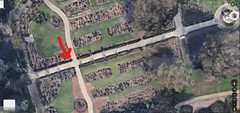
- 7 years ago
Thank you for bringing up RMV. My multiflora and Dr. Huey were old original plantings in my 100+yr. old house so I'm hoping they are good. I've never noticed it on their leaves, but the good Dr. often loses his after blooming! Is it known when RMV was introduced into Dr.H rootstock? Is most multiflora also infected?
 7 years ago
Seedling multiflora shouldn't be infected, and it should be fairly easy to get your hands on some.
Dr. Huey was introduced in 1920. It was a locally used, specialty rootstock until the major growers moved to the West Coast in the 1960's. Prior to that, the usual rootstock was named (actually numbered) selections of multiflora. So if you have very old Dr. Huey, it would have been planted as a climber/rambler, and not as rootstock.
To slightly veer back to the original topic of this thread, Dr. Huey is a *dream* to train. It is the only rose I've ever worked with that actually seems to have read the sections on climbing roses in the rose books. It is very flexible - you can make those nice little fans with it. It produces a lot of basals, so you can not feel bad about cutting out those growing in the wrong direction. Having spent too much of my life doing battle with various New Dawns, I love Dr. Huey in the spring.
katyajini thanked mad_gallica (z5 Eastern NY)- 7 years ago
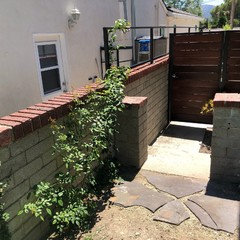
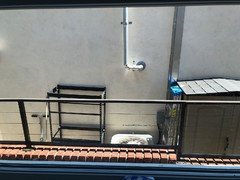
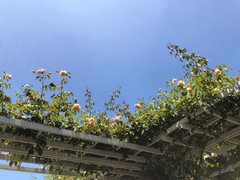
Roseseek, I know exactly the spot at Huntington! I will check next time to see if Cl Columbia is still there. Climbing Pinkie sounds like it will be perfect on my fence since it can be trimmed like a hedge :-) I am working from home today, database updating with long waits in between each step, so I got a 1:45pm picture of my Reve d’Or and Climbing Pinkie. Reve d’Or is planted 2ft further away from CP in the photo with its one and only cane, so far, trained to the top of fence and CPs one and only long cane, so far, trained just above brick wall. These have been in the ground since Nov 1st for Reve d’Or as small band from Rogue Valley Roses (one bloom so far so I know it’s the correct rose) and January for CP from Antique Rose Emporium. CP is most of the leaves you see in the picture. Something needs to extend at least 15 feet to block this terrible view from my kitchen window. Actually I choose Reve d’Or since I wanted it to throw some canes up to increase fence height and block more view. We cheated making it 7 ft high as we are only allowed 6ft. Last pic is Huntington’s Reve d’Or showing just the top of trellis.
- 7 years ago
Interesting, Stephanie, but you only need ONE climber there. If the only planting area is there in front of the gate, plant it pretty close to the corner/end of that planter and train it up and across the surface of the riser. What I have seen that worked perfectly are Banksiae's, sheared and tortured within an inch of their lives, like a hedge. They get dense and flower across their surface, but only when they normally would in your climate. You don't want something with Gigantea type laterals and canes. Those (including Reve d'Or) will fill both your entry and the neighbor's well. The Banksiae would have to be sheared every few weeks.
Whichever climber you plant, only put one. There is not enough room there for all the roses you've mentioned you want to include. I fear you will end up with a mass of plant material you won't be able to enjoy because something is always diseased or infested with insects. Stick with one and allow it to eat the space.
Check all along that section of arches for the Columbia. It would be fun if it was still there, or replaced with a later budded plant of it. It's a GREAT rose! - 7 years ago
Kim is that the same Columbian rose that I got crazy in love with that Daisy. and you have ?
Oh, Stephanie if it is the same rose pls, pls take pics. I would love to see it again :)
You don't see that rose often and not in commerce. I am hoping it is still there...cross fingers !!
jin - 7 years ago
Yes ma'am. The same one. Put pressure on our friend with the Fortuniana to see if what I sent him rooted and I'll send some to him for budding.
katyajini thanked roseseek - 7 years ago
Kim , you are so lucky that you are in CA Bec I would have given you a big HUG whether it works out or not. It is the thought that counts :)
jin
katyajini
Original Author7 years agoSo much has happened since I was here last!
Stephanie I too wish when describing a climbing rose one would state the length of its laterals as a matter of course. I mean why not?
I think I might want to grow climbing Columbia too after how you describe it roseseek. So I have to contact him and see how it goes?
Thank you for those pictures! Wouldnt one use mulch at the base of those roses? Those roses look spectacular. Here I would have thought to plant shrub roses maybe covering the triangle between two climbers. Would that be too much pressure in the root zone for health plants?
Here is another video. Please take a look around 8:30 onhttps://www.youtube.com/watch?v=iNfSaH5fLUM&t=6s
He cuts the laterals. Does this make sense to you? It does not look bad at the end when the laterals grow long again and the blooms come. Also he does not keep many canes. How does this jive or not jive with what you were saying about keeping long laterals? Do you think this particular style of pruning is rose specific? Looked like this is rose Eden, and it makes laterals 1 to 2 feet long. This kind of pruning would not work for a rose making laterals several feet long would it? And if a climber grows short laterals say 2-3 inches would you cut them back a bit to induce multiple branching at each node? In the last shot you see a few shrub roses at the base of the climbers. Do you think that kind of light density planting would work?
I have so many questions. You have got me thinking. Tomorrow I will take a good look at the cane + laterals of the climbers I do have!- 7 years ago
Probably the most accurate way to describe the laterals would be short, medium and long. I don't think a shorter, cooler climate would get the length and warmer, longer one would. Think of the height suggestion issues and you can imagine the lateral length problems. Yes, if budded to multiflora is suitable for your conditions and you would like a Cl Columbia, please contact Steve Singer at Wisconsin Roses. If he gets sufficient requests, he should let me know he wants more material. He's a businessman. He doesn't want to produce plants he has to find homes for (of these things he doesn't normally stock, that is) but he is willing to custom bud to special orders as long as there is a willing source of the material and buyers willing to pony up the money.
Yes, pruning, period, is rose type specific. You don't prune Queen Elizabeth the same way you prune an HP, a Tea or any type of climber, so yes, it is rose type specific. Yes, that's Eden and the laterals are different from the Cl Tea and ALmD type. He doesn't need to keep many canes because Eden pushes MANY laterals which crowd each other and would lead to disease and pest issues as well as nasty, balled flowers if not thinned. The other type pushes many feet of layered growth out into space instead of the more upright, stiff growth Eden provides.
Eden's foliage is also denser. The space of bare cane between growth buds/leaves is shorter than it is with Teas and climbers like ALmD. You may have leaves every few inches with an Eden type where you may have them every foot, or more, with the others. You don't need as many laterals with dense foliage to protect the bare cane as you do with the long stretches of bare cane per lateral.
If you want the plant to remain close to the wall or trellis and be as dense as possible, yes, you reduce the length of the lateral, even if it's only a few inches long. You want that branching of the new laterals to begin as close to the main cane as possible. Otherwise, you will have three or four inches then two, three or so inch long laterals originating at the end of the three to four inch long older lateral. That would likely cause the new flowers to hang and possibly damage the lateral, as well as lead to a very congested mass instead of something resembling more of the Eden or ALmD results in the photos. Will you kill the plant if you don't do it? Nope. Will you lose the war for the Allies? Nope. Can you fix what you didn't do the previous pruning season, later? Very likely, yes. Might either be a "fatal flaw" if you do or don't do it? Nope. Feel free to experiment and leave some if you want just so you can see the effects and decide whether it's easier or more pleasing either way.
In my opinion and to my lazy style of gardening, yes, lower density planting works better. But, I likely have quite a few more miles on me than you and I am likely far lazier than you are at this stage of life. I tired of being grabbed and ripped from the sides and behind by competing rose bushes LONG ago. I mean to the point where I limit the really prickly types in my yard and fawn over the smooth types. I favor the prickle-free seedlings over the prickly ones, too. Plus, spider mites, I believe, originated here on the Central Coast. They were listed as being one of the major farming issues over a century and a half ago when the first farmers broke ground. And, they are EVERYWHERE, ALL the time. The ocean breeze is nearly continuous and it doesn't matter how frequently you hose the plants out, they're just as bad the next day as if you hadn't done anything. Dense planting is precisely what they adore. Add that California is BUILT upon one, giant ant hill and all the insects the ants love to farm and dense planting creates many undesirable problems I simply wish not to have to deal with. - 7 years ago
Katy, Love that video! Thanks for sharing. so helpful just to see someone pruning a climber even if you choose to do it a bit differently than he did.
Roseseek, yes I agree that less density is helpful here in So Cal as spider mites are everywhere! I just hope the native mite predators are around too and I don't spray any pesticides, since I want to encourage the predators. You can buy mite predators online and many are California native ones; I will buy them if it looks like I need to get them started. I only use 1t neem with 1/2t dishsoap in a quart of warm water every couple weeks to keep the grasshoppers from too much damage; works really well actually and I don't need to reapply too often, since it doesn't rain in the summer when grasshoppers are active.
I emailed Steve today about Cl. Columbia. AND he has your Annie Laurie McDowell budded for me so I am excited about that! ALMD has some shade tolerance right? With no thorns I may put it on the shared fence on the other side of the house.
I have recently noticed the red climber Cl. Crimson Glory on HMF. Do you know if its habit is short or long laterals? Does it do well in So Cal? You mentioned that Marie Nabonnand had long laterals and so now I am not sure it would work on my patio rail, but I am drawn to its mostly thornless nature (thornless according to Marolena in England; HMF says nothing about it). - 7 years ago
Thank you for reminding me of the mite predators. I need to obtain some! The mites are LEGION this year. Wonderful! I'm glad he has ALmD for you this year. Hopefully, he'll say something positive about supplying Columbia. Please let me know how that goes and if he needs more.
"Shade tolerance" means many different things to different people. This image is the north side of that block wall. There are white birches and plum trees on the south side of the wall filtering the light the plant receives. It does get a good deal of filtered overhead sun plus MUCH reflected light from the house and yard. I'd say that's a fair amount of "shade tolerance". Does that seem at all similar to your conditions?
I haven't grown Cl Crimson Glory, only the original bush. It is FAR from "prickle-free". It produces gorgeous, dark, velvety-crimson, wonderfully scented blooms on foliage that is guaranteed to mildew and black spot. At least that's what it did in Newhall, in the Santa Clarita Valley. I would think it should have stiffer, shorter laterals than ALmD and Teas as it IS a Hybrid Tea and grows more like what you expect those to be like.
I am serious about not putting more than one rose in the wall and fence section you posted photos of. I honestly fear it quickly becoming a tangle of canes you won't be able to keep healthy and untangled. Consider the Cl Pinkie for it, instead. That looks from the photos, like something you should be able to massage into doing what you wish from it. - 7 years ago
Roseseek, I went to Huntington and no Cl. Columbia anywhere to be seen. I checked the spot you indicated and then every climber they have. I noticed a new Mel’s Heritage though. Also Steve said the Cl. Columbia material didn’t work out this time. I am just so happy he will be sending me ALMD! Yes, I know, my two climbers are way too close. I will have to figure something out. ALMD spot on the other side of the house gets at least 3 hours direct sun, may more I haven’t really timed it, and lots of bright reflected light shining off two light colored houses on either side. I think she will be happy in her chosen spot :-)
- 7 years ago
Thank you for checking. I shall have to call Tom and offer him buds of Cl Columbia so he can have it on his arches. If someone stocked it budded, bud and bloom, they'd sell the daylights out of it.


roseseek