Software
Houzz Logo Print
elaineal_gw

What to do with large Crape Myrtles

7 years ago
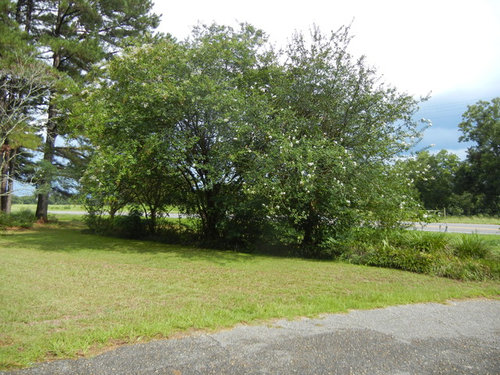
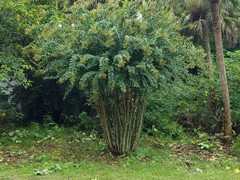
These are Natchez Crepe Myrtles and have grown to high for me to trim. Can I cut the tops out of them or

cut them to the ground and start over or get someone with a backhoe and dig them up and plant new ones.

Comments (16)

  • 7 years ago

    I agree with GG. Since they're out on their own with loads of space why do they need trimming?

    elaineal thanked floral_uk z.8/9 SW UK
  • 7 years ago

    if you cleaned up the weedy areas under them and planted a groundcover, the whole area would probably be lovely.

    elaineal thanked laceyvail 6A, WV
  • PRO
    7 years ago

    Leave them alone to grow as nature intended, or yank them. Topping crapes looks stupid and is bad practice.

    elaineal thanked Revolutionary Gardens
  • 7 years ago

    They are big enough to trim into a small tree shape. Natchez has beautiful smooth gray and brown bark on its mature trunks. As a small tree, you'd see the trunk and have nice foliage & seasonal flowers above.

    Or do you desire to hide the view low-down? In that case, add shrubs that will stay low.

    elaineal thanked User
  • PRO
    7 years ago

    There is no crape that has grown beyond the point of being reigned in and trimmed in a way that shows off its more civilized form. If your goal is to civilize them, it would take more than trimming their height. Describe in detail what you are hoping to achieve in a complete, finished form -- height, size, spread, trunk arrangement, canopy clearance from ground, etc.) and I'll be able to tell you to get there.

    Since they are in a consolidated group, it would be better for long term maintenance to gather them into an island as a base, It could be thick mulch at first, After weeds are well controlled, it could become groundcover suitable for your climate.

    elaineal thanked Yardvaark
  • 7 years ago

    You might like them better if you thin out some of the trunks and open them up so you can see under them. If you want a short crepe myrtle, there are shorter varieties, but a Natchez is naturally a tall variety. Try cutting all but 3-5 of the main trunks back to the ground and removing any low branches. They have lovely trunks when you can see them. You will have to fight suckers, so remove those all the way to the source as soon as possible.

    elaineal thanked catbird
  • 7 years ago

    That sounds like the best I can do with them. I'm too old to start again! Yes, I know a lot about those suckers. Thanks

  • PRO
    7 years ago

    What's going to happen if you "remove" trunks (cut them to the ground) is that 2 or 3 will grow back where one once was. Usually, this is a small battle that continues over years, as periodically, new trunks want to come from the cut stump. To have this as a goal seems a bit futile in terms of maintenance, IMO. Additionally, the trunk system creates an important aspect of the tree's form. One must question if a more sparse skeleton is better than a more thickly populated one.

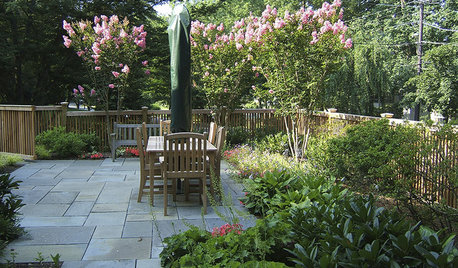
    I asked earlier what your vision was for the finished product, but never heard a reply to that question. As it is the nature of the crape myrtle to be a multi-trunk plant, why not create a trunk system that is somewhat of a "bouquet" arrangement -- leaving trunks but getting rid of the side branches that emanate below a designated canopy bottom height? That is easily more sustainable as side branches will tend to quit growing after a period, especially once they become under the shade of the canopy. This would change the monster, sprawling bush into a tidy tree. Whether or not you top it annually for an enhanced effect is up to you. I agree with Rev on so many things, but when he says "Topping crapes looks stupid and is bad practice" ... that is not one of them. In spite of that, one has the option of going either way on this point -- annually topping, or not. The latter provides a more natural look, and the former, a more robust, cultivated appearance with much larger flower trusses ... and a bit of a weeping habit.

    [I will try to get a picture of what I think is a good example of an annually topped crape. OP, you can make up your own mind about it.]

    elaineal thanked Yardvaark
  • 7 years ago

    Thank you. I will be looking for the picture.


  • 7 years ago

    I see too many gnarly, ugly crepe myrtles that have been cut back year after year. The form in the winter doesn't appeal to me as much as the graceful sweep of the natural tree form, whether you want to limit the number of trunks or not. I agree that if the trunks are large, cutting them back is probably a losing battle, but if you cut out a few when they're small, you can maintain an open tree form that doesn't overpower the area. I always keep mine limbed up so that I can see under them and plant smaller plants if I want to. Just be sure to always cut back to a larger branch or trunk so that you don't leave a stub that will send out a bunch of little sprouts from the end.

    elaineal thanked catbird
  • PRO
    7 years ago

    "I see too many gnarly, ugly crepe myrtles that have been cut back year after year. The form in the winter doesn't appeal to me ..." This process creates a substantially varying form that in most cases -- probably over 90% -- is done with next to zero thought, of which the main one is probably, "Let's hurry and get this over with." Most people stand on the ground and aim the loppers at chest high, as that's about as high as they can comfortably go. That's not going to end with a functional tree form.

  • 7 years ago

    I understand what crape murder is. That is not what I plan to do. I will wait til winter so I can see what needs to be done and go from there.

  • PRO
    7 years ago
    last modified: 7 years ago

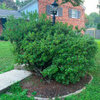
    Too bad i could not catch in bloom when it has a more pronounced weeping effect on account of weight of flowers. I think this is a civilized look that fits any cultivated situation. I stuck a piece of white pipe that marks 6' height, so you can see the canopy well clears any person's head.


    elaineal thanked Yardvaark
  • 7 years ago

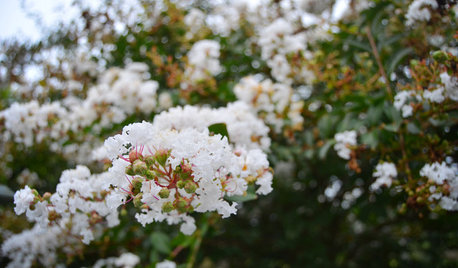
    This looks like when it is cut all the way down and then let the suckers come back up. I don't see a main trunk. But I do like the shape of it. Mine are 20+ years old and have a huge trunk that branches off into other large lower branches. I will wait until winter and the leaves are gone to decide what I will do with them. I know that yours is really pretty when it is in full bloom. What color is it? Thanks again.

  • PRO
    7 years ago
    last modified: 7 years ago

    In a multi-trunk tree all the trunks are main trunks. The one above is white.

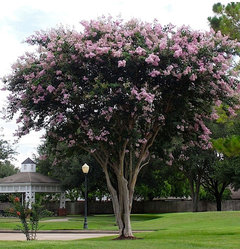
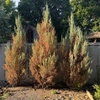
    A form like this is probably a better bet for you since you have plenty of room to let the crapes become large:


    To get this is no more than trimming away the bottom limbs and branches and any trunks that are determined to be outside of the spread of their cone-shaped arrangement (which is arbitrarily determined by you ... it could be wide, narrow or somewhere in between.) The top is not trimmed at all but allowed to grow naturally just as would any tree.

    Maintaining this style of crape can be done mostly from the ground with a folding saw, loppers, and a pole saw. It is not difficult. Sometimes a step ladder helps. It is much easier to maintain all along as it grows, as opposed to letting it become a monster sprawling bush and then trying to remake it into a tree. (For your next one.)

    elaineal thanked Yardvaark
Sponsored
Peabody Landscape Group
Average rating: 3.5 out of 5 stars8 Reviews
Columbus' Reliable Landscape Design & Contracting