Software
Houzz Logo Print
matthewburton

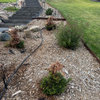
Freshwater beach being overrun by vegetation

7 years ago
last modified: 7 years ago

Our beach on Lake Huron (Zone 6a) is being overrun by various grasses and shrubs. I need help identifying them and figuring out a remediation plan that doesn't compromise the integrity or health of the beach.

Some neighbors have tried cutting this vegetation back, but it always grows back with a vengeance. Others have tried removing the vegetation with a backhoe. That goes too deep, and lake water comes up through the beach.

Here are the various plants:

https://photos.app.goo.gl/BUTyaXj4NppgNRBH7

We suspect the second one (with the broad blades, and the red boat in the background) is a Phragmites variety. It's new this year and very prolific.

We're willing to endure a multi-year process of cutting things back, as long as it works. The perfect outcome would be a beach with some vegetation that is easier to control, doesn't obstruct views or walking paths, keeps the invasive plants at bay, and is more pleasant to look at than the status quo. Extra points if the vegetation helps control the mosquito/sandfly population.

Comments (7)

  • 7 years ago

    what has your county extension office suggested???


    i am surprised there isnt some state or federal rules against backhoe-ing beaches on a great lake ...


    ken


    https://duckduckgo.com/?q=beach+vegetation+remediation+msu&t=ffcm&ia=web


    canadian source


    https://www.lakehuron.ca/beach-and-dune-stabilization


    https://www.lakehuron.ca/coastal-plant-guide


    https://www.lakehuron.ca/about


    Matthew thanked ken_adrian Adrian MI cold Z5
  • 7 years ago
    last modified: 7 years ago

    Are you aware that beaches rise and fall yearly depending on Lake levels? Lake levels have been high, and everyone is losing their sand beaches. If Lake levels go down, you will need that vegetation to hold in the dune. This is Lake life! The health of your beach is complex, and affected by some factors outside of your direct control. Vote for local, state and national policies that benefit Lake Huron! But also, realize that the beach is not a static thing. That's what a beach is, the area in flux between the land and water.

    That said, if you want to plant some additional groundcovers, good luck finding them. Your best bet is a native plant nursery, but they don't usually grow many beach plants since the market for them isn't large. I went to a beach exhibit at the Matthaei Botanical Garden in Ann Arbor. They had to propagate their own plants for the exhibit. Your local conservation district may have some sources for you, they often use them for beach stabilization. But a lot of what you have are the classic beach plants that are the ones that stabilize things. I suggest a boardwalk for your path, that's what all the great parks do.

  • 7 years ago
    last modified: 7 years ago

    Ken: It's not legal, but people do it anyway. Good idea to check with the extension office. Thank you.


    pinkmountain: Our family has lived on this shore for 120 years. I'm quite aware that the lake rises and falls. As I said, I want to do something that maintains the health of the beach. Maintaining beach health includes controlling invasive species. The idea for a boardwalk is a good one. Thank you.

  • 7 years ago
    last modified: 7 years ago

    Matthew sorry if I wasn't helpful with that comment. So in the 120 years you must have observed the vegetation advancing and retreating. I've visited the beach almost every year of my 59 years and I have observed that. The vegetation helps stabilize the beach in both high and low water years. If you have a lot of natural beach vegetation, you should be happy, it is providing you with thousands of dollars of beach stabilization services. Spending a lot of time trying to tame it doesn't seem advisable from a time and cost perspective. Some years it may get hit by weather, high water, erosion, etc. and die back. I didn't see anything that was invasive in your photos, (including phragmites, I didn't see it) but hard to tell for sure.

    If you have vegetation impeding your walking and views, it is possible to cut it back, (as opposed to remove the roots) the vegetation slightly to create views, and put a boardwalk down to create a path.

    If you are not sure if something on your beach is an invasive species, you can take a sample to your local conservation district or cooperative extension for identification.

    There is a difference between a plant that is growing on the dune, (a habitat with constantly changing vegetation) and an "invasive" species. Dune plants are good at colonizing dunes, that's the service they provide for you, they stabilize your beach. They are not weeds. Invasive weeds destroy the habitat's ability to function properly. I don't see any evidence of that from your pictures that you have any of those species, but hard to tell for sure. What I saw was beautiful, healthy natural beach vegetation holding down your beach. Surely you can carve out little spots to enjoy it as is.

    The main plant I have seen on beaches that I would want to watch out for is poison ivy. It's not invasive but problematic for human visitors.

  • 7 years ago

    Phragmites australis, visible by the red boat, is invasive, in the true sense of the word, where you are.

  • 7 years ago

    Here's some more resources if it is Phragmities australis:

    First step is to determine if it is the invasive form. You can contact your local representative for the Cooperative Invasive Species Management Area you live in (CISMA) for help identifying it and they can also help you control it if it is the invasive species. Here's a web site with their contact information. Your person is listed as: Shelby Bauer989-448-2293 ext. 13shelby@huronpines.org
    https://www.michiganinvasives.org/docs/2019_ManagementAreaContactlist.pdf

    Note that tilling and disking the plant roots is not effective or recommended as it will most likely just spread the grass because new sprouts arise from broken roots.

    1. Determine whether the plants are native or invasive
      Phragmites (or another plant species). Useful websites for
      identification include:
    1. Read the following publications to better understand the management issues and control options: A Guide to the Control and Management of Invasive Phragmites, from EGLE and partners.

    2. Controlling invasive Phragmites may require one or more
      permits from local, state and federal authorities, as several
      environmental laws may be applicable. If necessary, apply for and obtain
      the appropriate permit(s):

      Chemical Treatment:
      For inland areas (including lakes, ponds,
      rivers, streams, ditches, wetlands, etc.), a permit is required to treat
      invasive Phragmites using herbicides if the plants are in standing
      water at the time of treatment. Some small backyard ponds may be exempt
      from permitting requirements, depending on their characteristics. For
      shoreline areas along the Great Lakes and Lake St. Clair, a permit is
      required to chemically treat any plant located below the ordinary high
      water mark, regardless of whether there is standing water or not. EGLE's
      Water Resource Division has created a general permit category for this
      type of activity, which allows property owners to request authorization
      for control of invasive or non-native species through a simplified
      permit process.

      For chemical treatment information including permitting requirements and blank permit application forms visit www.michigan.gov/deqinlandlakes (Select Aquatic Nuisance Control) or contact the Aquatic Nuisance Control Program, Water Resources Division, at 517-284-5593. Please read the General Permit for Aquatic Nuisance Control Activities for Certain Non-native Invasive Emergent Plants for specific information, including information about Phragmites.

      The use of a licensed applicator who is certified in aquatic pest
      management is recommended for herbicide application, especially in
      large, dense stands and in sensitive areas such as wetlands: Pesticide Application Businesses Licensed by the State of Michigan.
      (For inland areas, search under Category 5, Aquatics; for Great Lakes
      shoreline, search by Category 5 for wet areas and Category 6,
      Right-of-Way, for dry areas).

      Mechanical Treatment: Mechanical treatment (i.e.,
      mowing) of invasive Phragmites is recommended after chemical treatment
      (at least 2 weeks after, for maximum effectiveness of the chemical
      treatment), to remove dead stems and promote native plant growth.
      Mowing is the most commonly used method for mechanical treatment,
      particularly on privately owned, or smaller properties. If mowing is
      used as the mechanical treatment method, the vegetation cutting should
      be conducted only in those areas where invasive Phragmites is present,
      avoiding adjacent wetland areas where native species are dominant. In
      wet areas, mowing invasive Phragmites as mechanical treatment is most
      often done in the winter when the ground is frozen, which provides
      better and safer access to these areas, as well as minimizes impacts to
      small animals and native plants. Mowing invasive Phragmites along the
      Great Lakes as a method of mechanical treatment requires a EGLE permit
      when the mowing/cutting will occur below the ordinary high water mark,
      is within the St. Clair Flats area, or
      within a designated Environmental Area. Displacement of soil and
      rutting of the ground in an area of mowing/cutting may also require a
      permit. For more information on mechanical treatment of invasive
      Phragmites, please contact the Water Resources Division at 616-250-8637.

      Tilling or disking of plant roots and soil is not an effective
      mechanical treatment method for invasive Phragmites. These activities
      promote the spread of invasive Phragmites, as the broken rhizomes and
      seeds are dispersed and sprout new growth.