Software
Houzz Logo Print
nicholas_contos

Mixed lawn - Questions for the grass experts

7 years ago

My yard is very large and also very old. (1.5 acres - 1972 - East Idaho). I have no idea what kind of grass it started with, but I know that it's been patched, periodically neglected, and added on to a few times by the various owners before I bought the home.


I've worked hard over the last several years, and most of the quack grass has been choked out by the thickening lawn grasses. It's starting to look pretty good, but there are strips in my lawn where it appears that the previous owner tilled things up and replanted. Its taken a couple of years, but now I'm seeing some parts of the yard that look better than others. The parts I like are deeper green, thicker, and somewhat shorter / slower growing than the other parts. It kinda looks like blue grass (boat shaped tips) but so does the other stuff that is taller and lighter green.


I also have other parts of the yard that I think are mostly perennial ryegrass and some sections of mostly fine rescue.


First,

Is there any good way to identify the deeper greener grass that looks so good? Could it be an improved, darker variety of bluegrass? Or am I more likely just seeing a contrast between real bluegrass and the older lawn grasses like tall fescue or something?


Second,

What is the best way to blend these transitions and/or spread the deeper green grass? Killing the whole 1.5 acres and starting from scratch isn't a realistic option for me.


Thanks in advance. I'll try and get some good pictures to post tomorrow.


Comments (22)

  • 7 years ago

    " Could it be an improved, darker variety of bluegrass? "

    Could be, as it was my first thought when you described it. Even pictures may leave us uncertain; there are hundreds of varieties of bluegrass.

    Can you match that variety? No. Can we get close? Not really, no. Not in growth habit, color, density, green-up, disease resistance...you see the issue here.

    With a patchwork lawn, the best bet--and it can be done in sections, one each year, on a sizable lawn like yours--is to renovate it. Kill it, wipe the deck, and start over with a consistent grass.

    Not doing so will leave you with an eternally patchwork lawn. Or, learn to live with and love what you have.

    But frankly, in eastern Idaho, it's probably already too late to do anything for this year. Let us know the exact city you're closest to and we'll see...but if what I'm seeing for Idaho Falls is accurate, it's far, far too late. Temps are dropping into the lower forties at night.

  • 7 years ago

    Yeah. I'm near Idaho Falls.


    Killing over an acre of grass would really make my neighbors think I'm insane, but I also worry that it wouldn't give me perfect results anyways. For one, the remnants of quack grass is sure to try and re-establish itself, and I'm afraid that I'd also end up with other weeds and grass mixes in a country lawn as big as mine.


    My yard isn't quite like some of these guys that have controlled, sanitary lawns with concrete and fences all around.


  • 7 years ago

    How big is the difference really between newer KBG like Midnight and older stuff?

  • 7 years ago

    What's an "elite" lawn exactly?


    I've put in brand new sod in a few spots and it's not anywhere near as nice as the dark green stuff sections that I like. Not as nice as the fescue and/or perennial ryegrass sections either for that matter. Presumably, the sod was pure KBG.

  • 7 years ago

    Elite lawns are bred cultivars, usually having highly consistent characteristics (or at least well-matched ones) between chosen grass types. Read "more expensive" as desired as well. :-)

    So in my case, my lawn's darker, hyper-dense (no weeds naturally), grows consistently at the same speed across the cultivars (less shaggy looking even if not mowed), has good winter color, and excellent disease resistance. Those are the characteristics I chose for, and they were all achievable here in Pennsylvania with proper care. Read "tons of work" as desired.

    Personally, I wouldn't count on winter color in Idaho, for instance, but everything else can be done.

    You might be able to favor the dark green sections by killing out around them, feeding those heavily with organics (synthetics run the risk of burn) and encouraging them to spread over time...but that's kind of like encouraging islands to become continents. It works, if you have a lot of time and geologic levels of patience.

    Some smart a...lec is going to suggest plugging those, but again...without excellent care, that's going to fail, and it's going to take forever as well.

  • 6 years ago
    last modified: 6 years ago

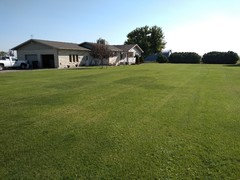
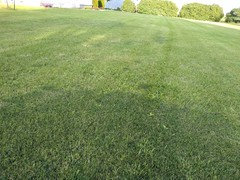
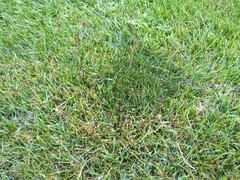
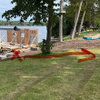
    Here is a picture showing the color variation across my lawn.


    It's color differences seem to be more stark at some parts of the year than others. This is about as noticeable as it ever gets.

  • 6 years ago
    last modified: 6 years ago

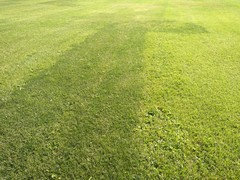
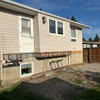
    Another picture


    I think this strip was tilled up and re-replanted at one time by the prior owner. The neighbors said that he was trying to get rid of quack grass.

  • 6 years ago

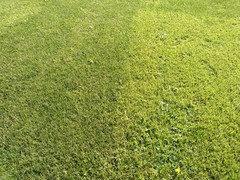
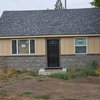
    This picture shows the light colored grass (right) next to the darker grass (left).


    If you ask me, the grass looks like the same type - just darker color, and the darker stuff seems to grow slightly slower.


  • 6 years ago
    last modified: 6 years ago

    Another picture with dark grass on the left and lighter color on the right


  • 6 years ago
    last modified: 6 years ago

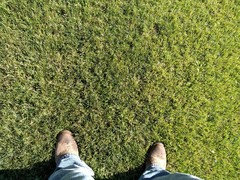
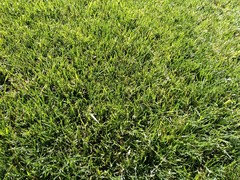
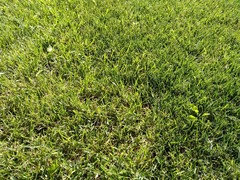
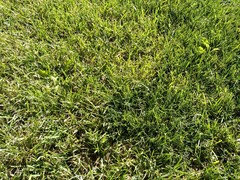
    Here is a close up of the nicer, darker grass.


  • 6 years ago
    last modified: 6 years ago

    Here are a couple side by side close ups


  • 6 years ago

    The darker grass seems to be standing out more and more as we get closer to fall.

  • 6 years ago

    I really don't find it that objectionable. You might try some Milorganite and see if the iron evens out the color?

  • 6 years ago
    last modified: 6 years ago

    It might not show up well in pictures, but I think the color variation is very noticable in person.

    Here's a couple more shots:


  • 6 years ago

    Eh, OK, maybe. I guess you could wipe the patches that really bother you and reno those? But I think it's going to lead to other patches bothering you because they don't match the new ones. And so on.

    At least it means you won't have to do it all at once. :-)

    Personally, with that much property, I'd be inclined to choose a zone near the house that I actually used, and let the rest go a little more. Feed less, if at all. Let it stay a mix of cultivars and ignore the weeds. That sort of thing. I mean, if you really want 1.5 acres of perfection, that's wonderful. But I'd find it overwhelming; I have my hands entirely full with a third of an acre.

    That would certainly cut down on the work, expense, and reno time and energy expended. And you can always decide that you want to reno more in 2021 if you want.

  • 6 years ago

    If I got vote on it I’d say to love it as is. Lawns take up so much energy...maybe plant some shade trees to break up those different colors....

  • 6 years ago

    I definitely do approach a big country lawn like this much differently than guys who have little patches of perfection.


    But I'm also capable and willing to take it up a little notch if possible. Mainly I want to find a way to darken and thicken it up. Whether PR or KBG, there has got to be a way to overseed and see a little improvement over the years. Right?

  • 6 years ago

    Can anyone take a guess at what type / variety of grass we're looking at?

  • 6 years ago

    A little bit of everything, but mostly a tri-mix of KBG, fescue, and rye.

    Nicholas Contos thanked User
  • 6 years ago

    The dark patches have got to be one or the other though, right?

  • 6 years ago

    I am not good with that, particularly with older cultivars. But not necessarily. I've seen some absolutely beautiful weeds.

    Make me guess from a distance and I'll say bluegrass. But most of us will need a real closeup shot--including grass tips--to be sure.

    But it's easy. If the grass has tips like a boat prow, it's bluegrass (or at least in the Poa genus, but most other species are lime green, pale green, or something obviously not grass-green). If not, fescue or rye.

    What cultivar? Your guess is as good as mine, and I won't venture one on that point.