Software
Houzz Logo Print
taylorbritain

Led, Halogen, Incandescent

6 years ago
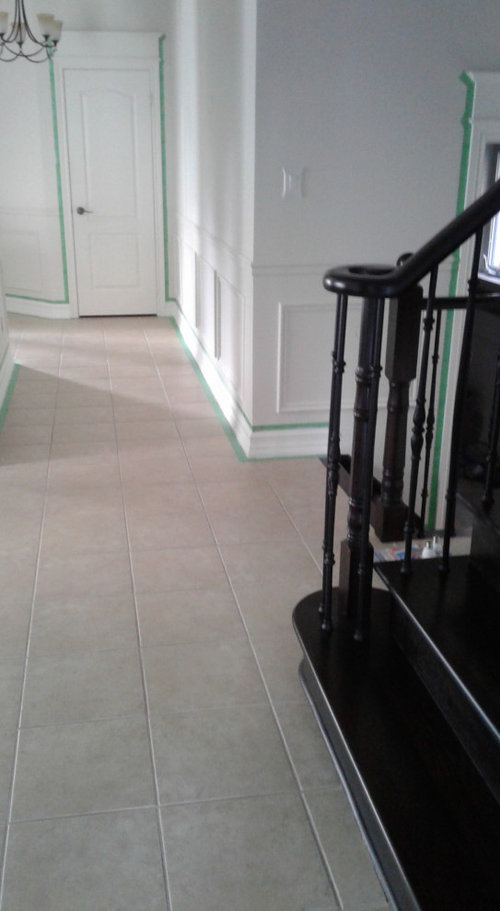
How does a tile look so different from night and day? How do you choose a paint colour when the undertone of the tile changes from day to night? Would changing the lights help? Thankyou for any advice.


Comments (41)

  • 6 years ago

    Buy 4-packs of bulbs with three different color temperatures (2700, 3500, 5000) and try them out at home.

  • PRO
    6 years ago

    If you change all your bulbs to LEDs in the daylight or 4000K range the colors will remain true at all times of the day.In Canada we have not had incandecsents for a long time alreay. LEDs are reall the way to go if you like ythat yellow glo you get from incandecesnts go with 3000K I have no idea wht anyones want that yellow glow at night that changes all the colors.

  • 6 years ago

    Natural daylight, and "daylight" color temperature (4500-5000+K) has more blueish or "cool" light to our eyes; incandescents typically cast a much more yellow light with a color temp around 2700k; LEDs can range from 2700 to 5000 k (unlike Patricia Colwell, I prefer 3000k as being more neutral than yellow) as can fluorescents. Any surface will reflect different tones in different lights (light reflection is what makes color to our eyes).

    So it all depends on what nighttime lighting you have combined with the particular color composition of the tile.

  • 6 years ago

    Change the lightbulbs before you do anything else. I can see distinct yellow on the floors on the one picture. I prefer daylight 4000. I had a hallway that I hadnt changed out bulbs yet in, and the turquoise walls looked gold. I have finally gotten those bulbs all changed too, and now it is the right color all the time.

    taylorbritain thanked cat_ky
  • 6 years ago

    Figure out your lighting first because lighting is everything in colour perception. For all their positives, I find LEDs a pita to get right. The colour is often too cold and somehow "empty". The latest bulb I changed to LED was in my office and I like the colour of it. Also noticed the box says "wide beam spread" and I suspect that was the key to making the overhead light satisfactory. Good luck!

    taylorbritain thanked tartanmeup
  • PRO
    6 years ago

    All those things need to be considered when doing LEDs 5000K is very blue and I never use it except in commercial spaces.

  • 6 years ago

    I have had good luck with Hyperikon 3000k 90cri bulbs. People often focus on the color temperature and ignore the color rendering index.

    taylorbritain thanked nexp
  • 6 years ago

    nexp is right. Also look at Cree brand for good color rendering.

    As the days grow shorter I now see more interior lights on as I walk home through the city. It constantly amazes me to see the blinding bluish glare of LEDs in cans in people's ceilings. Yuck.

    I need 3000K with good CRI.

    taylorbritain thanked tatts
  • 6 years ago

    When I was buying a house-full of LED bulbs I went with Hyperikon because they seemed to be the only ones with high-CRI dimmable bulbs. CREE certainly makes excellent bulbs - they basically invented LED lighting.

    taylorbritain thanked nexp
  • 6 years ago
    last modified: 6 years ago

    CRI compares the color rendering of a light source with a standard "natural" light source. It is independent of color temperature but for color temperatures of 5000K and above, daylight is the light source standard for comparison. For color temperatures below 5000K, the light source standard for comparison is incandescent/halogen.

    Thus the CRI of a 3000K LED lamp is usually between 80 and 90 but close to 100 for an incandescent/halogen lamp.

    When color is critical I use low-voltage halogen fixtures.

    taylorbritain thanked User
  • 6 years ago
    last modified: 6 years ago

    "CRI compares the color rendering of a light source with a standard "natural" light source. It is independent of color temperature but for color temperatures of 5000K and above, daylight is the light source standard for comparison. For color temperatures below 5000K, the light source standard for comparison is incandescent/halogen."

    Did not know this. Thanks for this info, @User. Why is 5000K so blue then? It looks otherworldly (and ghastly). Or is that the bulb's lack of "wide beam effect"? ETA: I must admit that I do not recall the CRI of the 5000K bulbs we tried. Perhaps the CRI was not high enough.


  • 6 years ago


  • 6 years ago

    5000k looks blue because it is very blue compared to light sources we are used to looking at. Sunlight (I say this because the color of the sun does not change, but the color of sunlight after interacting with the atmosphere does) at noon is about 5500, but we tend not to look at it then because it's dangerous. It does appear to be a blueish-white. When the sun is closer to the horizon, the color temperature shifts. An hour before/after sunset/sunrise, it is about 3500 (presuming you're not at extreme latitudes).


    5000k bulbs seem unnatural in a house because having noon-time daylight in a house is somewhat unnatural. Since we tend to use artificial illumination in our houses when it is dark or near-dark out, it is not natural (or relaxing) to use a light source that simulates noon-time daylight for this.

  • 6 years ago

    When installing a "dimmer switch" for LED's it is very important to know the "total wattage" of the fixtures being dimmed. The cheap dimmers from the Big Box stores will cause the lights to flicker if the wattage is too high. Be sure your electrician is familiar with this problem and buys a USA-made dimmer if needed.

  • 6 years ago

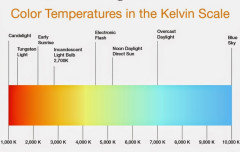
    Makes sense, @nexp. Thanks. (I know that taking pictures in noon day sun is pretty pointless as it washes out everything.) Looking at the chart again, I'm surprised to see that Overcast Daylight has a higher temperature than Noon Daylight Direct Sun.

  • 6 years ago

    Absolutely awesome information thankyou so much for this, finally an understanding.

  • 6 years ago

    @chiflipper, SO glad you piped up with that comment as I'm shopping for dimmer switches today! My kid and I are very sensitive to light and flickering (while the DH doesn't see a dif between a warm LED and fluorescent).

    @Lori A. Sawaya, super interesting info. You're hired! :)

    I'm guessing there's also tiny differences in everyone's rods/cones that might make them see color a little differently?

    All this is a little crazy making when trying to choose something as seemingly simple as ceiling paint and lightbulbs! How did cavepeople manage? :-D

  • 6 years ago

    This really belongs in a new thread, but... PAR-16 and GU10 are separate things. PAR-16 is the size and shape of the bulb. GU-10 is the base. There is such a thing as PAR-16 bulbs with GU-10 bases. GU-10 fixtures are quite rare in the US, except in California. For recessed or track lighting, the best fixture for this type of luminaire is one with integrated LED - it will have the best optical control and heat management. Mini-reflector LED replacement bulbs have many compromises and I wouldn't install a new fixture that requires them.

  • PRO
    6 years ago
    last modified: 6 years ago

    I'm guessing there's also tiny differences in everyone's rods/cones that might make them see color a little differently?

    Yes. And your own color acuity shifts and changes throughout the day.

    Beyond the light source, it matters if you're well-rested, tired, hungry, have a head ache, if what you're wearing reflects on to the chip, etc.

    That's why color experts use color data values and hue/value/chroma/LRV notations as a framework to visually assess colors. Color measurements make color as close to tangible reality as color can be.

  • PRO
    6 years ago
    last modified: 6 years ago

    Like another poster said above, I prefer a warm 3000K. I’ve had electricians mistakenly use bulbs called “daylight” (sounds nice) but those bulbs are very blue like a surgery theatre for accuracy. In a house its OK If daylight and artificial bulbs don’t match, just test colors that look good under both.


    Generally there is Soft White (2700K – 3000K), Bright White/Cool White (3500K – 4100K), and Daylight (5000K – 6500K).

    In some places 2700K is good (a little warmer) and sometimes sparingly I’ve special ordered 2400K bulbs for the warm & cozy effect (BTW candlelight is @ 1800k).

  • 6 years ago
    last modified: 6 years ago

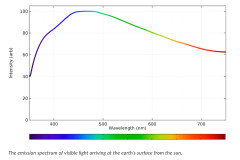
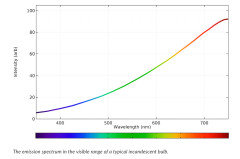
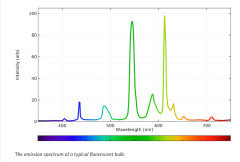
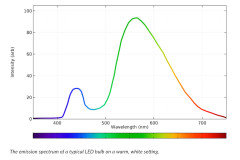
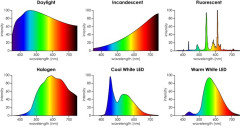
    The emission spectra for natural daylight, incandescent lamps, fluorescent lamps, and LED lamps are quite different and none of the lamps perfectly replicates natural daylight.

    Here are charts of the emission spectrum of each of these light sources. The spectrum for LED lamps can be altered by the design and even changed during use.

    Notice which colors are more intense (higher on the chart).


  • 6 years ago

    I understand what Lori Sawaya tells us, and I always appreciate when she chimes in on a color dilemma -- but here is why I still use the term "undertone" even though it is technically not a "thing".


    It is what my eye thinks it sees, and is the easiest way to describe that.


    My walls are painted BM Simply White. The walls look white. People coming into the room comment on what a nice bright white it is. Yet, if I hold a piece of white paper up against the wall, I can then see that it is actually yellow - a very, very pale yellow, but yellow. My eyes or brain doesn't see the yellow unless forced to -- it is not the dominant impression of the color! White is. It is almost as if the yellow is hiding within or under the white. Of course it is what made Simply White the right color for my room, but just looking at the paint chips or sample I might not have noticed.

    But, the yellow has to be taken into consideration when choosing other colors, doesn't it? Whether is it warm or cool, or clashes with other colors I am considering. As does the lighting that will be in place.


    So, that is what I mean by undertone: the color that isn't the dominant impression but is definitely influencing the appearance to the layman's eye. A lot of the folks who post here don't see that, they wonder why this blue paired with that blue doesn't work? They are both blue!


    It is easiest to just describe the non-dominant aspect (say, a lavender tendency to the blue, or a "cool" aspect vs "warm") as the "undertone" that must be recognized, and to mention tricks that help them to see it (eg, placing it on white printer paper). Of course it will change according to changes or variations in light (but that is also something that gets mentioned - to evaluate it in the planned light.)


    This is a basic approach that works a great deal of the time for most people (including myself) who are likely never going to hire a color expert, or take the time to use color data values and hue/value/chroma/LRV notations as a framework to visually assess colors.


  • PRO
    6 years ago
    last modified: 6 years ago

    The only light that replicates natural light is halogen. It is 100 CR1 and led's are not. With led's it is usually a choice of color temperature which has no relationship to CR1. Fluorescents are 6000 kelvins but they produce a horrible light. Halogens are generally in the 3000 range but the quality of light is far superior, especially low voltage mr16

  • PRO
    6 years ago

    So, that is what I mean by undertone: the color that isn't the dominant impression but is definitely influencing the appearance to the layman's eye.


    Maybe not the dominant impression according to your eye, your color acuity under whatever random light source your using to view the color.


    Your eye, your acuity doesn't define color appearance for every "layman's" eye.


    Only your own.


    Which is why the theory that colors can be subjectively judged and assigned static categories of "undertones" doesn't work, why it can't be applied beyond a single individual to describe and define color appearance.

  • PRO
    6 years ago

    Thanks Lori great article!!

  • PRO
    6 years ago

    Seeing those graphs that RES3d Sketches posted totally explains to me why I do not like flourescent or LED lighting. They both transmit much too much green which I do not find attractive. And the LED is a "warm white" setting. I'd be interested to see a graph of halogen lighting, which to my eye is the next best thing to incandescent.

    And I agree wholeheartedly with Sabrina!

  • 6 years ago

    Here’s halogen and others.

  • PRO
    6 years ago

    thank you, nexp. I see that halogen leans toward the yellow/red which I find soothing and natural.

  • 6 years ago
    last modified: 6 years ago

    Halogen vs Incandescent

    Halogen bulbs are technically incandescent light bulbs – illumination is produced in both when a tungsten filament is heated sufficiently to emit light or “incandescence.” The difference between the two is in the composition of the glass envelope and the gas inside the envelope.

    A standard incandescent bulb has a heat sensitive glass envelope that contains an inert gas mixture, usually nitrogen-argon. When the tungsten filament is heated it evaporates and deposits metal on the cooler glass envelope (this is why incandescent bulbs appear black at the end of life). This process requires incandescent bulb filaments to be heated less than optimally to give the bulb a reasonable life. The lower filament temperature gives incandescent bulbs their typical orange-yellow, warm appearing light.

    Halogen light bulbs utilize a fused quartz envelope (“capsule”) allowing for higher temperatures. Inside the quartz envelope is a vapor, originally iodine, now usually bromine. The tungsten filament evaporates as usual but the higher temperatures are sufficient to cause the tungsten to mix with the vapor instead of depositing on the envelope. Some of the evaporated tungsten is re-deposited on the filament. The combination of this “regenerative cycle” and higher filament temperature results in a bulb that has a longer life and slightly higher efficiency than standard incandescent bulbs. The higher temperature filament also produces the “white” light often associated with halogen bulbs.

    Halogen is the name given to a family of electronegative elements, including bromine, chlorine, fluorine and iodine. Halogen bulbs are referred to variously as “tungsten halogen,””quartz halogen” or simply “halogen.”

    [from topbulb website]

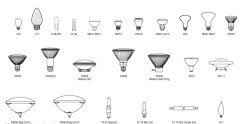
    Halogen lamp shapes:


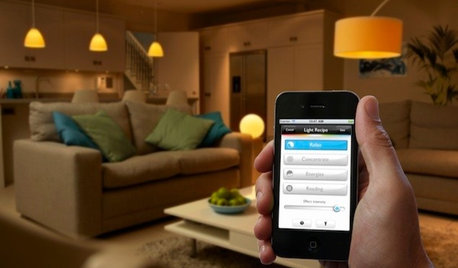
    Low voltage Halogen is still the best light for natural rendition of color but COB LED lights are impressive as are RGB LEDs, the color of which can be adjusted from your smart phone.

  • 6 years ago

    Low voltage Halogen is still the best light for natural rendition of color but COB LED lights are impressive as are RGB LEDs, the color of which can be adjusted from your smart phone.


    @User, I presume they can't compare to LEDs, but are low voltage halogens substantially more energy efficient than their white-hot predecessors? (she asks hopefully)

  • 6 years ago
    last modified: 6 years ago

    Low voltage halogen lamps are more efficient and last longer than traditional incandescent lamps but they are not nearly as efficient and don't last as long as LEDs. There are rarely simple choices in this business.

  • 6 years ago

    Low voltage halogens are not inherently more than moderately more efficient than non-halogen incandescent. Non-halogen produces 800 lumens with a 60 watt bulb. Halogen does 750 with 50 watts. There is a special type of halogen that has an Infrared coating, which reflects heat back into the capsule, causing the filament to be brighter. A 37 watt IR halogen produces the same lumens as a 50 watt regular halogen. An average efficiency LED can do this with 9 watts.

  • PRO
    6 years ago

    The operative word in RES 3d Sketches' comment is "choices." Consumers need to have choices in what type of lighting to use. Energy efficiency is merely one aspect of lighting use.

  • PRO
    6 years ago

    Actually Halogen low voltage Mr 16 bulbs have about 1500 lumens

  • 6 years ago

    You are likely thinking of ceramic metal halide MR-16. Even 70 watt halogen (the highest power) does not achieve 1500 lumens - they are 1125.

  • PRO
    6 years ago

    One can certainly dig deep into the finer technicalities of each type of light bulb/system, however for the average home owner color temp and lumen output are likely the most important considerations. Some of the newer recessed LED lights have a selectable color temp switch on the driver that let's you choose 4 different temps and many now provide 750 or even 950 lumen output. This coupled with their longevity and low power consumption makes them an excellent choice for most home applications.

  • 6 years ago

    @sabrina that is clearly a typo on the vendor’s site. They merely entered the CBCP (center beam candle power) rating in the lumens box as well. There is no MR-16 halogen (especially without the IR coating) with an efficacy of 30 lumens per watt.

  • 6 years ago
    last modified: 6 years ago

    The best quality light is produced by COB (chips on board) LEDs but the nature of the chip design does not allow the color temperature to be selectable on the fixture. As for the best color temperature, its wise to specify warm white (2700K) to minimize the damaging effects of blue LED light to your eyes.