Software
Houzz Logo Print
armoured

Best tips for composting leaves?

6 years ago

It's that time of year, and the leaves are accumulating. For once, I've got all of the household members on board to help me collect and shred the leaves and put in one area (in the past, it's mostly just been dumped in piles with no shredding). Our primary shredder is just a lawnmower, which mostly does a decent job. The main thing is that doing this reduces the space taken up by a whole lot.

So far it's already a good-sized pile (perhaps a cubic meter) but there's a lot of leaves yet to come - I'd guess somewhere between one-fifth and one-tenth of the total we'll get.

We're running a bit short of yard space, as some of the areas previously used for letting the leaves rot need a rest/have been repurposed; and the compost bin is mostly full, and there are some other composting projects ongoing (a big pile of woodchips). Mind, I can always find some space here and there for some shredded leaves, but what I'd like to do better this year is get the bulk of the leaves to rot down/compost faster, both to reduce the space taken up and to have some useable leaf compost earlier next year (otherwise - especially with unshredded leaves - our leaf compost is 'ready' at best by late summer, or even only the following year). We have a long cold winter and the ambient temperature is already touching freezing at night, so I'm not going to get a lot of mileage out of hot composting; and while I can do some turning of the piles before solid snow cover is established, we have enough trees that the bulk of available labour will have their hands full with leaves.

Anyway, just looking for comments and tips from others. I don't have any brilliant ideas beyond the basics - adding water/making sure the leaf pile isn't too dry; adding some existing compost for innoculation; adding a bit of 'greens' like clippings (although don't want to add much of the usual kitchen waste as would like to be able to use 'as is' early in year; perhaps a bit of nitrogen fertiliser; and, occasional turning of the pile (but I won't be doing much of that once it gets good and cold).

About the only thing I'm considering doing that might require more work (at least to start) is some kind of enclosure to contain the pile - it may be time to just admit that it may be more space and compost efficient to have a two-metre by two-metre pile with proper sides. Also not fully decided on whether to cover, perhaps does need a tarp or old carpet on top.

Anyway, enough about my piles. What are your best ideas and methods to speed things along?

Comments (27)

  • PRO
    6 years ago

    You could try making a couple leaf towers. Get a roll of that 2x4" square mesh in 4' or 6' wide roll. Make a tower however big around or square as you want it. Stake the tower down and fill with leaves.


  • 6 years ago

    I do that and also jump in there and roll around to crush them. Of course if they're already shredded you may not need to do that.

    Nitrogen is the thing. I use leaves as a major component of compost by taking the slightly-rotted leaves from last fall that sat out in the leaf bins (or were corralled on top of the gardens by laying down all the tomato cages as walls) and mixing them with spring grass clippings. That compost won't be ready till mid to late summer though.

    If you can still mow any green grass, mow up grass and leaves together and compost that.

    I also use em during the winter to layer with kitchen scraps.

    If the conditions are right in your space, you can use DAHSU*.

    * DAHSU = directly applied, human-sourced urea. ;-)

  • 6 years ago

    as noted... going up with a bin will reduce the footprint of your leaf collection. You can make a quick one from old pallets to a decent size. There are plenty of other ideas out there for bins too.

    Shredding, nitrogen, and turning is the quickest method of course. So it's a matter of what you can get your hands on easily. I am cheap so the one year i wanted to quickly cook down my leaves, I just started collecting used coffee grounds from starbucks and dumping them into the pile. You can get quite a lot of them if you have busy stores in your area. I turned the pile a few times over winter. It was kinda nice to see the hot steaming pile while there's snow all around. Come spring it was a nice crumbly compost.

  • 6 years ago

    I think tox has the right idea. I haul my leafs with a tarp. I've found that if you dump the tarp and then spread it out over the pile and walk on it that the leaves will compress seemingly endlessly. Instead of your foot sinking into the pile, your foot takes on a huge diameter.

    I've also used a bagging riding mower and allowed the bagger to fill and jam up. Then keep driving around the lawn, overlapping the passes. The leafs will fall on the side of the mower where the discharge is. Since it's jammed they'll slowly fall on that side. By overlapping passes you'll pick up those chopped pieces again. By the time you work to the middle the pieces will be dime size and take up 1/10 the space. You'll have to go over the lawn again with the bagger unjammed to clean up. There will be a hint of leaf dust giving the lawn a brown color till it rains it in.

  • 6 years ago

    Depending on your garden plans and layout, you could pile the leaves as a mulch directly on the garden beds where you plan to use them next year. They might not compost fully but you could just turn them into the soil in spring and they would be a great amendment. Or, for perennials and trees, just leave them there as a mulch and add more every year. It's excellent for the health of perennials and trees to have a permanent mulch.

  • 6 years ago

    leaf shredder, pile as cubic as possible to save area, and man-made urea. you are welcome.

  • 6 years ago

    Thanks for suggestions. All pretty much along the lines of what I do. I may have to look at building a 'tower' with some kind of temporary wall. I should have noted that I also use a leaf vacuum/shredder sometimes, although it's been finicky; when it does work, it gets things more finely shredded. But the lawnmower has been consistent and decent enough.

    While doing some fiddling around in the yard today, re-discovered a section of our fence that drops down from the ground around it - perhaps ten metres long, a foot lower. Not very visible in summer as there are vines growing on that fence. This whole long area looks like a good place to dump/store a bunch of leaves (and let them fill up that gap over time).

  • 6 years ago

    You could skip the composting altogether and just put the shredded leaves straight onto your beds. It would save a lot of time and barrowing.

  • 6 years ago

    I'll do some of applying the shredded leaves wherever I can, but the balance is still heavily in favour of leaves. And getting some composting started and as far along as possible. I should have mentioned, also a shortage of much in the way of greens that can be mixed in (not that there aren't any, just a serious mismatch).

    Frankly overall the main thing is to get maple leaves shredded as much as possible. Most of the other leaves and duff is reasonably amenable to breaking down, the maple leaves are tough, durable, and mat like crazy.

    Much appreciate all the suggestions, thanks all.

  • 6 years ago

    Thanks - the reason I want 'faster' not necessarily super-fast this year is an accumulation of existing piles and leaves, not as much space as I'd like, a long cold season, and leaves that are pretty resistant. I want to shred as much as possible and use it for mulch - in the late fall if possible and spring for whatever's left. Also would be helpful if it's as degraded / composted as much as possible. I'll be okay with it being only partly composted. And yes, quite a bit will get mowed/mulched into the existing lawn and turf.

    The maple leaves have started coming down and wow there's going to be a lot. (I'll take more too wherever I can get it, just want to speed things along where I can)

  • 6 years ago
    last modified: 6 years ago

    Quick update: have been shredding and adding. Did some shifting about of the growing pile, to pile higher and deeper, which meant a bit of turning of the oldest bit (sort of unintentional). Most pleased to discover that part cooking away and deep, deep compost smell. Leaves there dark and sort of looked like burnt or smoldering (white mold throughout), starting to break down noticeably. Noticeable immediately by the weight of the pitchfork - already getting quite dense.

    In short, easy instructions to help: shred. Pile up. Water a bit. Turn a bit. Wait a bit. More water than I would have thought is absorbed.

    But shred and pile up are the main things, it seems. I've been adding, ahem, natural urea, but not so much compared to size of pile. The big change from previous seasons has been getting other household members on board with the shredding aspect (or at least piling leaves up so I can shred later).

    I probably didn't notice how quickly the pile was actually shrinking because we were adding so much to it at the same time.

  • 6 years ago

    Good work!

  • 6 years ago

    Ha, day after posting that last, I started to think about leaf-scrounging, getting from neighbours, etc.

    Fortunately big rain and wind made the bulk of the remaining leaves fall in a day or two after that. So got my hands full, nowhere near done, and the pile is maybe twice as big. And wet.

    But it almost keeps me out of trouble.

    Not doing anything much wiht the pile except to add more to it, but it does seem to be cooking away.

  • 6 years ago

    Bulk of the leaves down and had a good couple part days to do the shredding and piling. This morning saw steam coming off the pile at one end - it's sort of a short windrow for space - and despite the other end of the pile being newer material (most from the last two or three days), discovered later today it's cooking away as well. It possibly helped that more recent additions have been wetter. Perhaps it'll be for a bit of turning in a week or two.

    Once again the compost effect - despite feeling I have been adding and adding and adding, probably at least the size of the pile again in the last several days - it's shrinking before my eyes and roughly back to the size it was before this last push. Of course, some of this is just settling, but the reduction in size overall is tremendous.

    (Now I'll start eyeing neighbours' leaves again...)

  • 6 years ago
    last modified: 6 years ago

    My heart quickened reading that. Steam, cooking, turning, shrinking...

    Some people don’t enjoy turning compost. Imagine.

    i was lucky enough to get some really rugged hardware cloth or something several years ago. It’s my “leaf tower” for making leaf mould.


  • 6 years ago
    last modified: 6 years ago

    As Richard Brennan points out the quickest way to make leaf mould or compost is to make it the year before.

    I gather large amounts of compost feedstock in the fall and I’m able to build full compost piles every couple of days with grass clippings, pumpkins, apples, and seaweed for greens and mostly leaves for the carbon. I flip them every few weeks through Nov. and they get cooking.

    At some point, I started piling up way more than I needed. I covered one lawn area with leaf bags standing shoulder to shoulder—-about 80 of them—-and left them there until the bags disintegrated., about two years later. The last couple of years, I’ve placed the bags against my foundation and fireplace. Bags placed under where the icicles fall off the roof make decently finished mould in a year.

    I’m lucky in that I have a large yard, no road association, and neighbors whom I have acclimated like frogs in boiling water. My point is there’s never too much feedstock, if you have the space to store it. Rugged hardware cloth towers are a great way to go If you can’t store it horizontally.

  • 6 years ago

    I assume those disintegrating bags are paper? I find the plastic ones disintegrate in the sun, especially in the summer, and that's a PITA to deal with. I have to make sure my shop sawdust and wood ash bags aren't left out in the sun while I get round to using them or I'll have a mess on my hands.

  • 6 years ago

    People are only allowed to take their leaves to the local dump in those large paper leaf bags. I empty them out at the dump, inspect the contents, then reload them. I use to use those large black contractors’ bags, but you’re right, they degrade and make a mess.

  • 6 years ago

    Since annpat's got a braggy thread, I'll just add to this one: checked on my big pile today to see if it needed turning. Just cooking and cooking away; on the part of it I check, it was uncomfortably hot just a hand's length in, almost painfully so. I'll have a bit more leaves to add but just cooking along even though it's not warm out. Will have the first days of frost this week but doubt that will have much impact on a big old pile.

  • 6 years ago

    I love a good brag! Will you turn it again, do you think? Make sure someone’s walking by when you do.

  • 6 years ago

    I do intend to turn it, but I'm not going to mess with it while it's cooking along so well. Perhaps in another week or two. Actually I haven't really turned this at all yet except some checking and adding and re-piling, as it's freestanding , it collapses a bit when added to. So the leaves on the outside don't look composted at all except for changing colour to darker.

  • 6 years ago

    Got back from some time away, and the hot phase seems to have stopped (still warmer than outside air - which is ranging around freezing, perhaps room temperature - but I attribute that to just insulation of the leaves.

    Did a small amount of spelunking by digging into the pile. Very dry inside, light where seemed heavier before, with few signs fo physical breakdown, but musty smell and lots of what I'd call white rot on the leaves. (I mean that I'm sure there's been some chemical breakdown but at first glance it doesn't actually look like leaves have changed much).

    Given time limitations and laziness, considering what to do. My thinking right now is to turn the whole pile with some light watering as I do so. Add something for some nitrogen source? What I see looks consistent to me with the hot composting using up pretty rapidly the sources of water and steaming off (even if wasn't very noticeable, was still happening). I'm not too surprised at the lack of apparent physical breakdown, just the heat too much for the biologicals that physcially consume stuff (chemical breakdown will let them move in once temperature and water content allows?).

    I'm overthinking, will be compost eventually anyway. Would kind of like to spread about close to time of first serious snow.

  • 6 years ago
    last modified: 6 years ago

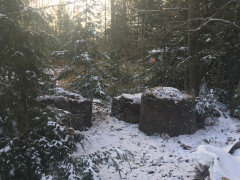
    These four bins (and two others) were built in the last month. The rightmost bin was built yesterday in the first falling snow of the season using stockpiled feedstock. When I was a young woman, I used to drive around scavenging foodscraps and coffee grounds. Consequently, my car always smelled like an Italian sandwich. I’ve come to compost far differently, although with no less labor, as I’ve matured and I really like the new method.


    Yesterday I placed a newly emptied bin that had held Oct. 2018’s well-finished compost and emptied a mixed bag of grass clippings and chipped leaves into it. I threw in something hot, in my case, about eight forkfuls of rank seaweed. I found a bale of hay last week, so threw in a layer of that with more grass clippings/chipped leaves on top and so on until that bin was filled.

    The two piles on the left are about the same age as yours. They all have pretty much the same ingredients except that one of the ones on the right is fueled by pumpkin and pear and apple layers. (I depend greatly on pumpkins in the fall for my nitrogen offerings.)

    I turned those bins last week and saw ash, and felt some slight heat pockets, but the heat wasn’t impressive, so I added pumpkins, seaweed, pears as I turned the pile. My intention was to turn all of those piles at least one more time, but tonight’s plummeting temperatures may put an end to that—-especially since I still have a ton of leaf mould to spread, a ton of tulips (I don’t know why tulips appealed to me so much this year, but when the prices dropped last week, I got stupid) and my garlic yet to plant.

  • 6 years ago

    I suppose I could post this on my own brag post, but...

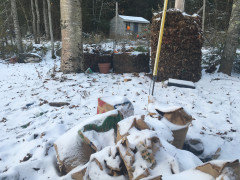
    See that tower of leaves!? !! See those two half collapsed compost piles? See those bags of excess leaves I barely know how to cope with? See those pumpkins?! My tower of leaves is impressive, because the entire core of that bin is pure leaf mold, vintage 2017.


  • 6 years ago

    This is likely an 'evergreen post' that I could just put out every month or so:

    I remain impressed by how _just when_ I think that my bin is getting too full and this time I'm definitely going to run out of space for kitchen scraps in our very cold winter ...

    ...what happens is what always happens. I go away for a few days and/or the temperature is more moderate than usual and the materials in the bin shrink or decompose or whatever. Dramatically, all of a sudden. And I'm back to more or less as much space remaining as I started with.

    I've come very close to running out of space in cold weather. But somehow, never quite there.

    The reality, if I was just using it as a tip for organic matter and didn't overdo it with adding extra leaves or wood chips or cardboard or whatever, I could probably run a single kitchen waste pile almost forever and forget about it. Or deal with it once every five to ten years.

    Reality is I add some garden stuff depending on whatever dumb idea I have in my head and empty every 1-3 years, but driven almost entirely by having some garden space I want to rebuild or dig or do something with, not by 'running out of space.'

  • 6 years ago

    Well as a sort of update: attempts to hurry along my leaf composting were not really successful. At least in the sense that not composted enough to use yet (for what I wanted to do). Guess the bottom line for my climate (colder side) is that leaves just take at least a full season. Volume down, the process is going along, but slow when it's still cold. Doing a bit of turning to keep myself busy.

    On the positive side, dug into where a pile used to be from a previous season (perhaps two) and it's beautiful dark leaf-soil. There's some bits of less digested stuff in it - worst of all is clumps of roots from the dang maple trees all around, so it takes some shovel work to get it out - but gorgeous stuff. That's been spread around. Of course it's never as much as you think or would want.

    A related question: we have a heavily treed lot so there are just continual amounts of twigs. Branches and heavier stuff my wood chipper/mulcher deals with well, but not twigs. They just don't get chewed up as readily (somewhat but not entirely) - a deficiency of the design I guess. Lawnmower does reduce volume and whack them about a bit, but far from as much as I'd like. Leaf shredder doesn't handle them well either (or only a bit).

    What do others do? Some I use for firestarter, but as for composting, they just don't break down much. Or very slowly.

    Suggestions? What do others do? Just stick them in leaf pile or compost and let time deal with them?

Sponsored
Peabody Landscape Group
Average rating: 3.5 out of 5 stars8 Reviews
Columbus' Reliable Landscape Design & Contracting