Software
Houzz Logo Print
home2518

flex duct in attic

7 years ago

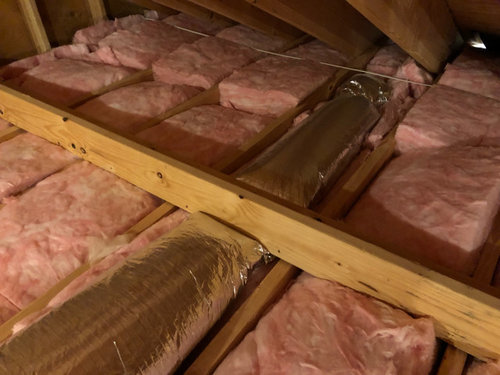
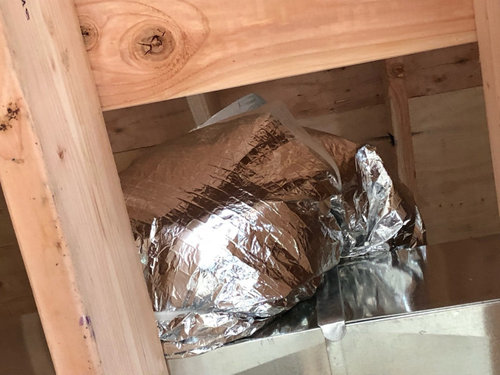
Can someone please tell me if this looks right. Flex duct run in attic. I does not to me. TIA

Comments (30)

  • 7 years ago

    Nope looks wrong. Especially the second and third pics.

  • 7 years ago

    From what I understand the ducts should be supported every 4 feet with 1.5 in strap, no hard bends, no sagging more then 1/2 inch.
    Can someone please give me some advise. This was just done recently. I mentioned before the walls were closed that it did not look right I was told it was fixed. I just noticed this recently and it was not fixed and inspection was done. Shouldn’t I also question the inspector?

  • 7 years ago

    In the first picture is that an uninsulated hard duct? If it is then it needs to be covered with insulation.

    Get the contractor to come back an fix this. This is poor workmanship. You should question the contractor and inspector if they know how duct work in should be installed in an unconditioned attic.


  • 7 years ago

    Mike_home, I think but I am not 100% that there may be a black felt. Like material inside the hard duct. Is that what you are referring to?

  • 7 years ago

    If the duct is insulated from the inside that that will work. The flexible duct work is usually rated at R6 or R8. Find out the insulation value of the hard duct.

    What is this house located? What is the R value of the attic insulation? I see a lot of gaps between the batts and the joists. The installation could have been better.

  • 7 years ago

    Yeah - that insulation is terrible. Who does batts any more in an attic? I mean blown is so cheap and can easily cover the joists to help with thermal bridging.

    That looks like the 1983 house I have as a rental.

    Must be a really mild climate if that passes code.


  • 7 years ago

    I've seen worse re: the insulation but the flexduct is wrong, wrong, wrong! In the 1st picture, sling supports every 4 feet should be installed and there should be no hard angles/crimps in the flex. You aren't going to get 1/2" but it should be less than 2"-3". The duct in the second picture should have been run over the joist, not under it - it looks like its pretty much flattened!

    Get them back to do this right!

  • 7 years ago

    Must be a really mild climate if that passes code.

    I'm in FL and they did blown in insulation in the attic.

    I would suggest you hire an independent inspector on YOUR dime (cost is about $250-$400 depending on where you are) to come in and be your bad cop. Then you can go to the builder with the report.

    Is this a custom home or a tract home?

  • 7 years ago

    Thank you everyone for all your advice and answering my questions. I have talked to the contractor and he has expressed to me that this is how it is. I knew something was wrong and I asked for it to be fixed. My worry now is they are going to brush me off and tell me that this is the best that it can be done and walls have been closed and I know masking and/or tape were not placed on joints either

  • 7 years ago

    This is A custom home. Renovation started In March. And has been a very slow process. That aside I would be OK if it was a slow process if the work was being done correctly. The house is in New Jersey

  • 7 years ago

    If it's a custom home on your lot, do as I suggested and get an independent inspector involved NOW. And it's your money. Tell the builder it's not acceptable and to go no further until you check with YOUR inspector.


  • 7 years ago

    Thank you. I’ll be looking for inspector tomorrow.

  • 7 years ago

    The only leverage you have is if you owe money to the builder. He has already told you that that how his low priced contractors do the work. Paying money to an inspector is unlikely to change anything. You may be better off putting the money towards hiring your own contractor to to do the fixes.

  • 7 years ago

    ^^^ Mike you can't just get rid of a contractor and hire a new one and once the house is finished is too late and much more expensive. Ask me how I know.

  • PRO
    7 years ago

    The ductwork looks odd to me. It looks like it may possibly be a trunk line duct system which is typically indicative of a commercial type HVAC company. (I could be wrong as the picture only shows a small glimpse.)

    Not that you can't do a trunk line system in residential, but it typically doesn't work so well because homes are much smaller than commercial. The other is that what flex duct is used isn't hung properly. Clues are clues. I would bet this contractor does mostly commercial work.

    When you get mixed skill sets like this, this is how mistakes are often made. The skill set of commercial is completely different from residential market.

    Now to even worse possible problems: A commercial firm in many cases does very little installation that requires refrigeration work (air conditioning is refrigeration work --- except that it's high temp application). It's not that they don't do it, just not as much as a 'primary' residential HVAC service and repair company like me. (As an example of typical commercial work a package system that sits on a roof top. Comes all ready to go once you hook up curb based duck work, electrical, controls etc. --- there is virtually no refrigeration work except to check operation of the machine upon start up.)

    How much work were they doing? Did they replace the whole AC system?

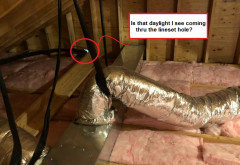
    I see something in this picture below that looks like daylight coming thru the hole in the outside wall in which the line set comes thru. If this is indeed not sealed I think with all these other issues you need to have an outside company come out and check this system top to bottom.


    I service the Katy, Texas area.

  • 7 years ago

    Cpartist,

    I agree with you but in this case the contractor has declared the job is completed and I assume he has been paid.

    Were there any permits for this work? The standard practice in New Jersey is to not make the final payment until the local code official has made the final inspection. If anything fails you have leverage with the contractor to fix it.

  • 7 years ago

    So as far has I know inspection was done but not the final. Thank you for pointing out the opening. I didn’t even see that. We will not be making final payment until work is done to our satisfaction.

  • 7 years ago

    Why would a little daylight on a vented attic matter that much? I mean it isn't great but the consequence is maybe a little water - maybe.

    I would think your insulation up in an attic should be R-49 - how big are the joists? That looks like R-38 from a distance.

    That ductwork would be laughed at here in moderate central NC. More supports, less kinking.

    Is that ductwork just for a/c? Not that it matters but a/c in NJ is at least a minor cost issue.

    Good luck.


  • 7 years ago

    Is that duct work just for a/c? Not that it matters but a/c in NJ is at least a minor cost issue.

    Another poster who thinks AC is rarely used in NJ. The cooling season in NJ is typically May 15 to September 15. We don't get the oppressive heat and humidity as down south, but we get long stretches of high 80s to the low 90s. This year we have had an very warm October. On October 2 Newark ht a high of 95 degrees. It seems we had a extra month of summer this year.

  • 7 years ago

    "Why would a little daylight on a vented attic matter that much?"

    That's a shocking comment. You're a general contractor? I can only imagine the quality of the work you do.

  • 7 years ago

    He was being sarcastic.

  • 7 years ago

    Mike - The cost is still heavily driven by heat. It isn't that a/c isn't used - it just isn't the dollars that heat is.

    I wasn't being sarcastic. That hole looks way too small for a squirrel or rat. But I was thinking energy only. A vented attic has daylight all over. But the standards for these things are regional I am sure. I see stuff like that all the time.

    The vermin risk is obviously regional also. Not a problem here generally on newer houses that are majority 2 stories with no overhanging trees.

    Bees obviously could get into any vented attic.

  • PRO
    7 years ago

    I wasn't being sarcastic. That hole looks way too small for a squirrel or rat. But I was thinking energy only.

    A cat can get through an opening just 3 inches wide. A squirrel needs only 1½ inches. A raccoon can get through a space 4 inches wide. The reason this seems so improbable is that their bodies just look too darn big to fit. But that’s all show — a lot of hair or fur covering a very scrawny little body.

    Now here comes the part that could give some people nightmares. Mice need a hole only about a quarter-inch wide and young, slender rats can zip through a space as small as a half inch. We’re talking the size of a dime for mice and a quarter for rats. Not all rats can fit through a space that small. Older, plumper rats need a about an inch.

    Some people say rats and mice are so good at this because they can collapse their rib cages, but that’s a myth. These animals simply are sleek, cylindrical creatures accustomed to navigating narrow spaces. And as with other animals, if their heads fit, their bodies will follow.

    (reference: https://www.mercurynews.com/2013/11/27/morris-big-creatures-fit-through-tiny-openings/ )

    A vented attic has daylight all over.

    True. However, these openings are covered with vent screens... if not you're asking for trouble.

  • 7 years ago

    Mike - The cost is still heavily driven by heat. It isn't that a/c isn't used - it just isn't the dollars that heat is.

    In NJ we are paying $0.17 per KWh for electricity, and $0.69 per gas therm. In New York the electricity rates are higher. Cooling costs are driven by our high electricity rates. So we may be spending about the same money as people in the South. However the cost of heating has gone done significantly for those who have high efficiency gas furnaces. This is the reason why heat pumps are virtually non-existent in my area.

  • 7 years ago
    last modified: 7 years ago

    " A vented attic has daylight all over "

    My vented attic in a mild climate area has no gaping holes like that. All vents are screened. Such a hole would soon turn into one or many infestations.

    Mr Cary, is your non-reaction to the poor workmanship shown in the photo mean that the structures you have built commonly have such F-ups?

  • 7 years ago

    I am not a builder. But those holes are common. Not saying it is ideal. In our area, only large areas are screened - soffit vents are not.

    Vermin in the attic are clearly common in some areas and not in others.

    Since this thread was about crappy flex duct insulation, I was just making the point that a hold that size is not an energy concern.

    But by all means, the hole should be covered. I have seen a lot worse things. The ductwork and insulation wouldn't pass inspection as an example but I honestly think the hole would.

  • 7 years ago
    last modified: 7 years ago

    I apologize for the error and the accusations but still scratch my head about your thinking it was normal/acceptable.

    Soffit vents I've seen were either screened or of a mesh-like design with smallish holes. Sometimes with both.

    As many have learned the hard way, designing, equipping, and executing any part of a building or remodeling project "to code" doesn't necessarily ensure either quality or a standard many would find acceptable.

  • PRO
    7 years ago
    last modified: 7 years ago

    I am not a builder. But those holes are common. I have seen a lot worse things.

    @ David Cary, Yeah I've seen much worse --- the idea here is to cut down the number of them.

    (I'm not a builder either, my job can sometimes evolve around fixing their mistakes long after they are gone.)

    'an ounce of prevention is worth a pound of cure.' It's an old proverb that has been replaced with: 'if it isn't broken, don't fix it.'

    So you realize why bee nests, rodent control problems and other kinds of building calamities because of dismissive attitudes toward prevention. (because it's common)

    There are older areas in which I live 'but those holes are common' is clearly accurate. That however, doesn't make it right.

  • 7 years ago

    Bats would love living in that attic, and easily fit through that hole.


    As for the duct - home2518, have you turned on the fan to see if you are actually getting any air flow through this system? Compare the flow rate upstream of this disaster to the flow downstream - I'll bet you see a big difference.


    Good luck - I hope you can get this resolved before winter!

Sponsored
Buckeye Basements, Inc.
Average rating: 5 out of 5 stars40 Reviews
Central Ohio's Basement Finishing ExpertsBest Of Houzz '13-'21