Software
Houzz Logo Print
kwhoughton

15A warming drawer

6 years ago

I have purchased a Bosch warming drawer. The Specs. say 120V 450W and 15A ("circuit breaker"). My concern is the word "circuit breaker". All other electrical specs I read will usually say 15A or 20A as a rating. I understand 15A and 20A circuits and know that all of my home receptacles are on 20A circuits with 15A receptacles. I also know that many items that are rated below 15A can plug into the 20 A circuit as long as I don't overload the circuit. However, this warming drawer seems to be wanting a 15A breaker. I have never run into this phrasing on appliances in the past. My question is this: Does anyone think the specs are telling me to actually plug this into a 15A circuit and that plugging this unit into a 20A circuit would be an issue? (Like what happens if the unit somehow fails and starts drawing 18A, which would not trip the 20A circuit. Would it damage the unit?) Or, are they just stating the rating in a different way? I can always change the breaker to a 15A if necessary, or I could hard wire a 15A GFCI between the existing outlet and the warmer.

Comments (23)

  • 6 years ago

    If the appliance's installation instructions call for it to be protected by a 15 amp breaker, that's what you should use. It's a code violation to disregard installation instructions. Connect it to a circuit protected by a 15 amp breaker.

  • 6 years ago
    last modified: 6 years ago

    The spec sheet is loopy.

    The installation instructions (which is what is regulatory) just says that the CIRCUIT requirements are 15A 120V.


  • 6 years ago
    last modified: 6 years ago

    Stax (who deleted their post),

    Your lamp doesn't have installation instructions that specify a requirement for a 15amp circuit breaker. That's the difference. It only states what it draws.

    If the installation instructions say that it has to be on a 15 amp circuit breaker then that's what it has to be on. Whether it needs it in reality or not is not the issue. To conform to code, you have to follow the install instructions.

    Otherwise this comment is correct:

    Breakers are sized to protect a circuit, not an individual component.

    And by the way, the receptacle on your range is protected by a fuse in the range, not the circuit breaker for the range circuit. You can't draw 30A from the receptacle on the range.

  • 6 years ago

    BTW - I think DavidR's account is compromised. I've seen a few weird posts from him that always have a link to some random faroeisland website. So that 'conversion table' post is probably just nonsense.

  • 6 years ago
    last modified: 6 years ago

    (Edited to add: Ignore this post since it's in response to a deleted post)

    The fuse is protecting the receptacle and the circuit breaker is protecting the whole circuit. The fuse is downstream of the circuit breaker.

    Therefore if you had a device that required a 15amp protection (as stated in it's installation instructions) and you plugged it into the range receptacle, then it is following the code.

    It was being nit-picky but I was just pointing out that your range example wasn't relevant to your point since that receptacle is protected by a 15a 120V fuse. You aren't plugging your lamp into a 30A 220V circuit.

  • 6 years ago

    I've seen cases where a specific fuse or breaker was called for in the installation instructions for because it's necessary to prevent a hazard. Most of these have involved keeping a motor from overheating if it's overloaded.

    BTW, my account hasn't been cracked; some spammer registered a GW account using the same handle. Pretty clever. If you click on the names and compare the profile pages, you'll see that they're different accounts.

    The fact that GW allows 2 different accounts to have the same handle seems like careless design. That's just asking for exactly what's happened here. Probably the programmers never thought to check.

    I report the spam when I see it, in the hopes that GW will eventually ban the user, and I ask you to please do the same.

  • 6 years ago
    last modified: 6 years ago

    (Edited to add: Ignore this post since it's in response to a deleted post)

    The upstream protection isn't really relevant.

    I guess I technically should have said:

    the receptacle on your range is protected by a fuse in the range, not JUST the circuit breaker for the range circuit

    I was not trying to insinuate that the receptacle in your range somehow got around the protection of the circuit breaker in the panel. But the fuse in the range is restricting the protection down to 15A.

    In the same way that if we are talking about a 20A circuit, we wouldn't really care if it's in a subpanel that is rated for 50A and that that subpanel is feed by a circuit in the main panel that's 50A and that the main panel is protected by a 200A main breaker.

    We wouldn't say that the lamp that you plugged into that outlet is protected by the 200A main breaker. Although that's technically correct, it isn't relevant.

    But I digress. We've really derailed the conversation with nit-picky details and SPAM that appears to have been removed and so on.

    But hopefully the OP got the answer they were looking for. The code can't take into account all of the devices that exist or ever will exist, so it simply states that you have to follow the install instructions so you need to do that. Install instructions can't loosen the requirements that are specified by code, but they might tighten the requirements.

    It is in the manufacturers best interest to make the requirements as clear as possible.

  • 6 years ago
    last modified: 6 years ago

    (Edited to add: a link to a random Bosch model was posted by Stax. This is in response to that)

    I never saw any actual documents, so I was just basing it off of what the OP said.

    If that's the product, then the install instructions just say:

    Circuit Specifications: 120V, 15A, 60Hz

    So it isn't limiting it to a 15A breaker. There is no breaker mentioned at all. So the whole conversation is pointless. Go to the Bosch site to get the official install instructions. Don't go by what some reseller's site says.

    And it looks like Stax deleted all their comments so that my comments just look like I'm correcting nobody and they make no sense. Oh well.

  • 6 years ago

    greg_2015 states the following:

    "I never saw any actual documents, so I was just basing it off of what the OP said.

    If that's the product, then the install instructions just say:

    Circuit Specifications: 120V, 15A, 60Hz

    So it isn't limiting it to a 15A breaker. There is no breaker mentioned at all. So the whole conversation is pointless. Go to the Bosch site to get the official install instructions. Don't go by what some reseller's site says. "


    I tried to clearly state that the the installation instructions provided by Bosch say: "Circuit Breaker (A) - 15 A. I am using the Bosch instructions and NOT what some retailers site says. Like many others here, I know that almost all items plugged into an outlet draw much less than what the circuit is rated for and therefore, I have never worried about the the devises I'm plugging in. Unless, of course, I want to plug in too many devices like two 1800 watt hair dryers into a 15 amp circuit at the same time which will trip a 15A circuit. But, I have never worried about plugging in one 1200 watt hair dryer into a 20 amp circuit. The unit I am referring to here has a 450 Watt heating element which will require a 15A circuit. I am just trying to figure out if somehow Bosch is trying to "limit" me to a 15A circuit or if they are just trying to tell me I "need" a 15 A circuit. I have added circuits for outlets at 20A with 12/2 grounded because I have had houses in the past where 15A circuits just weren't enough to handle everything. But, never heard about putting in smaller Amp circuits in order to install devises that are limited.

  • 6 years ago

    This question is being wayyyy overthought, and overwrought.

    As M says above, 450 watts at 120 volts is approx 4 amps.

    That's equivalent four table lamps each with a 100-watt bulb, and one with a 50-watt bulb.

    Does connecting a single table lamp with a 100-watt bulb (approx 0.83
    amps) to a 15A circuit present a problem in terms of the breaker being
    15A? What house has a circuit with a 1A breaker on it specifically to
    handle a single table lamp? Or a circuit with a 4A breaker dedicated to handle four table lamps?

    That's not how it works.

    The installation instructions are just saying that a typical 15A, 120V circuit will handle the warming drawer.

    A 20A, 120V circuit will also handle it.

    ALL the 120V branch circuits in my house are on 20A breakers.

  • 6 years ago

    Stax once again deleted his comment where he put a link to a particular Bosch warming drawer model. Looking at the instructions on the Bosch website for that model, it didn't specify a breaker size.

    Since my posts are the only ones that are left, it appears that I'm being ridiculous and long winded but I was just trying to correct information that was being posted.


    kwhoughton, if you post the model then I'd like to look up the actual install instructions.

  • 6 years ago

    Who is this Stax? I see many references to a post by Stax, but usually can't find them. I saw one on this thread yesterday but Greg says he deleted it. I wouldn't trust anyone who can't stand by his (her) comment to leave it up!

  • 6 years ago

    I really wish that the ability to delete your posts wasn't available. At least if a person edits their post and removes all of the text, people will still see that there was an actual post that someone else may be responding to. Ideally, I think editing a post should only be to add text or maybe just correcting a typo or something like that. The contents of a post should remain.

    Stax had many posts on this thread. All of my posts were in response to one of his/hers.

  • 6 years ago

    Thanks greg_2015, I understand the frustration,. The Model number of the Bosch warming oven is: HWD5751UC. The 15A breaker is under the Technical Details. I have always know that circuits were designed to protect the house and not the devise. Like one post noted, if that weren't the case, they would have 4A breakers. My "experience" tells me that I can hook this up to a 20A circuit with no problem. Also, like "dados" says, I am way "overthinking" this issue. However, when I saw the specs, I got into the "what if" mode and started thinking maybe I missed something along the way. I can imagine some devise that has a cord that is made of 14 gauge wire being plugged into a 20 amp circuit and if it were to somehow malfunction and start drawing like 18A, perhaps that would heat up the cord. But then again, I know lamp cord is pretty minimal and it's not a problem. But then again, you're always warned to not to overload extension cords because they could overheat. and I am wondering if that could be the case with appliance cords connected to a larger circuit. I suspect a cord with a 20 plug on it would have a larger wire gauge than would a common 15A cord. Would there be an issue with wiring an oven rated for 30A two pole to a 40A two pole. In that case it would be hard wired, so perhaps the "rules" change. Sorry for babbling on, but it does interest me.

  • 6 years ago

    I can imagine some devise that has a cord that is made of 14 gauge wire being plugged into a 20 amp circuit and if it were to somehow malfunction and start drawing like 18A,


    That's why your appliance would have a fuse right where the cord enters the appliance. If the appliance was overloading the cord, the fuse would blow, and thus protect the cord. And if the cord shorted out before even getting to the fuse, then the short would trip your breaker. So, either way you're fine.


    But then again, you're always warned to not to overload extension cords because they could overheat.


    Extensions cords aren't permanently attached to devices. So, there is no good way to install a fuse that is sized appropriately for both the device and the cord. I guess, somebody could build an extension cord with a built-in fuse (protecting the cord, but not the device). But that seems unusual. I have only ever seen that for power strips.

  • 6 years ago

    I've rarely anymore seen a major appliance in the U.S. that has an onboard fuse separate from the power supply circuit. I recall my grandmother had a Kelvinator washing machine back in the late 1960s that had a fuse. Some electronic control boards on modern appliances have a fuse but it's typically hard-soldered and not intended to be consumer-replaceable.

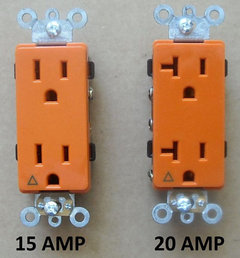
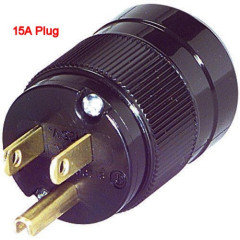
    Also for reference, 120V 20A outlets and plugs are different from 15A.

    20A has one of the prongs turned horizontal on the plug. The outlet has a matching T-slot so that it can take both 15A and 20A plugs.

    I mentioned above that all of the 120v branch circuits in my house have 20A breakers ... but all of the duplex outlets are 15A (without the horizontal slot).


  • 6 years ago

    Some electronic control boards on modern appliances have a fuse but it's typically hard-soldered and not intended to be consumer-replaceable.


    That's not really all that surprising. If the fuse blows, it usually is indicative of a bigger problem somewhere else. Simply replacing the fuse won't fix the problem. So, making the fuse a user-replaceable part would only make sense, if the user could then also be expected to fix the underlying root cause. Unfortunately, with modern devices that is rarely the case.


    Or to look at it the other way, if the user knows how to fix the problem, then a soldered fuse won't really pose a barrier either and it's easy enough to replace.

  • 6 years ago
    last modified: 6 years ago

    If I leave a comment that is no longer applicable, I see no reason to leave it...

    I don't think it's that big a deal, you chumps. -- Stax #1 --


    That is not my post above. -- Stax #2 --


    I don't know if it's the same guy that got DavidR, but be on the lookout. -- Stax #1 --


    Again, not my post above. -- Stax #1 --


    There are a number of forums that allow deleting and/or editing of comments. Across all of the ones that I am familiar with, it is considered extremely rude and inappropriate to do so, other than to make obvious corrections. And even then, many users expect that you leave the old content and only add an update with corrected information.

    You rely on other subscribers to have a conversation with you and to spend their time and effort to respond to you. It is only fair, that you then leave all the information available for anybody who later wants to research the same topic.

    By deleting your own messages, you come across as selfish and as disrupting conversations. Please don't do that. Not here, and not anywhere else.

    Also, if you didn't delete your posts, we might be able to make sense of who you are and who posts spam.

  • 6 years ago
    last modified: 6 years ago

    Here's the installation manual for the model HWD5751UC

    Installation manual

    Page 3 just says:

    Circuit Specifications: 120V, 15A, 60Hz

    So it isn't stating that it's limited to a 15A breaker.

    With some devices, there might be something that states something along the line of : "Dedicated circuit protected by a 15A circuit breaker"

    In that case, you wouldn't be allowed (by code) to put it on a 20A circuit. Whether it matters in reality is something that you can argue as much as you'd like but it doesn't change the fact that it would be a code violation to do otherwise.

    But as suspected, there is no problem with putting this warming drawer on a 20 A circuit.

  • 6 years ago

    As I said in the earlier post.


  • 6 years ago

    I guess I should copy/paste the post that Stax wrote that I'm responding to since he'll probably delete it:

    And I cited your post - you pointing out the OP's "Spec" was loopy. But the experts repeatedly stated that their was a Spec/Requirement for a 15 Amp Breaker.

    The first couple of posts had answered the OP correctly.


    Stax,

    I'm assuming that you're referring to me. I never stated that there was a requirement for a 15A breaker. I said "IF" that's what it says ...

    You can actually re-read my posts because I didn't delete them.

    I never saw any installation instructions since the model number wasn't posted until recently. Maybe all Bosch warming drawers have the same requirement so the exact model number wasn't needed, but I wasn't aware if that was the case and I never stated that Ron was wrong.


    Yes, the first couple of posts did end up answering the OP correctly. And then you (Stax) got on here and posted false information that drew it off on a tangent.


  • 6 years ago

    Two years ago you posted that you were smarter than anyone else on this (Actually Gardenweb) forum. I don't think so.

    I did? :)

    I'd love to see a link to that thread.

    Anyways, I'm done feeding the troll. My posts stand as they are and you can feel free to interpret them as you wish. Have a nice day.