Software
Houzz Logo Print
westes

Questions on Escallonia Hedge Variants

6 years ago
last modified: 6 years ago
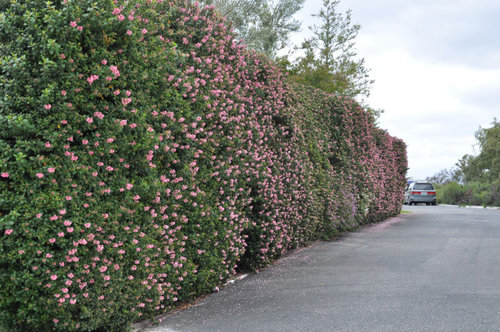
I am thinking of Escallonia for a hedge and want to check on some key issues:

* Which variants grow over 10 feet tall? I know Escallonia Rubra is the one that grows to 15 feet. Does Rubra have any variation on the color of flowers?

* Are there different variants that would look good side-by-side, either because of variations in flower color or leaf patterns/size? I would potentially alternate plants within the hedge if there was any good aesthetic to be gained from doing that.

* How would these plants do in clay soil in zone 9a in the San Francisco Bay Area, away from the ocean or the Bay? I guess they prefer fast-draining soil but can still grow well in clay? How much growth would I gain by building mounds of a faster draining soil, on top of the native clay?


Comments (13)

  • 6 years ago

    If anyone knows of a book or website with a lot of photos of different Escallonia varieties, please share that reference.

  • 6 years ago

    @floral_uk That is a fantastic site, but not because it shows 150+ Escallonia. They include filters to let you view the subset of species that meet your criteria. I want tall growing plants and that brought the list down to three:

    • Escallonia rubra 'Crimson Spire'
    • Escallonia bifida
    • Escallonia rubra

    Rubra (not Crimson Spire subtype) really seems to have no competitors. It grows very high and reaches mature height pretty quickly (5 to 10 years).

  • 6 years ago

    Obviously if you want a hedge like the one in the picture it will need regular clipping. But if you have the space they can just go free style and will still make a good informal hedge. Planting an Escallonia hedge is one of the gardening activities I did with my Dad years ago.

    westes Zone 9b California SF Bay thanked floral_uk z.8/9 SW UK
  • 6 years ago

    @floral_uk I have no idea why, but gardenweb is not notifying me of any of your replies. I have to discover them by entering the thread and checking for replies manually.

  • westes Zone 9b California SF Bay thanked ken_adrian Adrian MI cold Z5
  • 6 years ago

    btw .. top of the page ... on the right .... YOUR houzz .... edit profile and settings.... then hit advanced settings ..... then look for the email fix .... ken

    westes Zone 9b California SF Bay thanked ken_adrian Adrian MI cold Z5
  • 6 years ago
    last modified: 6 years ago

    One shown in original post is Pink Princess 'Frades' which is also one of the most likely to be encountered in commerce at this time.

    https://plants.monrovia.com/search?w=escallonia

    westes Zone 9b California SF Bay thanked Embothrium
  • 6 years ago

    @ken_adrian, unfortunately the search tactic you use gives 95% of the search results as plants that do not match my height requirements. The website that floral gave is absolutely perfect and basically identifies the three plants that are candidates. Now I need to figure out if they can all thrive in my environment.

  • 6 years ago
    last modified: 6 years ago

    @ken_adrian, the settings you are referring to are when you are sent email. The notifications I am referring to are the notifications we get when we are logged into houzz. It looks like you cannot control those notifications. In any case, I get notifications when anyone else here replies to my posts. It is only floral's replies that do not create notifications while logged into houzz. I believe he must have some very strict privacy setting in place.

  • 6 years ago
    last modified: 6 years ago

    Unlike the 'Frades' which you showed in your picture producing presumably the effect you are looking for these others aren't necessarily going to be easy to find in local commerce at this time - when hunting for plants to fit a particular purpose it really makes more sense to me to see what is available to oneself first and then ask about variety selection on discussion boards. Even plants like 'Frades' which can seem to have become standard items in a particular market such as mine can suddenly disappear from it at some point - in fact I am not sure I have been seeing much of the 'Frades' offered here in the last few years.

    Of course, kinds chosen through reading rather than local shopping can then be hunted for among sources elsewhere that ship to where a body is located. However even if a desired item is located in this way ordering in has the significant disadvantage of not being able to inspect the merchandise in person beforehand. In addition to one not being able to see the physical condition of the stock there is the problem of misidentification of plant material offered by nurseries not being as unusual as it should be.


    westes Zone 9b California SF Bay thanked Embothrium
  • 6 years ago

    @Embothrium the Frades is described online as growing to 6 to 8 feet. The plant in my photo appears to be over 15 feet. I wonder if it is a subvariety.

  • 6 years ago
    last modified: 6 years ago

    Understatement of tree and shrub height growth potential is common - one thing to always look for is if a reference is using a specific time frame - 10 years from a small size is typical - in its descriptions (this may often be indicated in an introductory section or key where what is covered by all of the descriptions is laid out). And keep in mind also that how rapidly a particular kind develops and how tall it gets varies with site conditions. Including regional climate, how much water a planting gets, how well it likes the soil and so on.

    westes Zone 9b California SF Bay thanked Embothrium