Software
Houzz Logo Print
opaone

Ice Dams on new construction ?

6 years ago
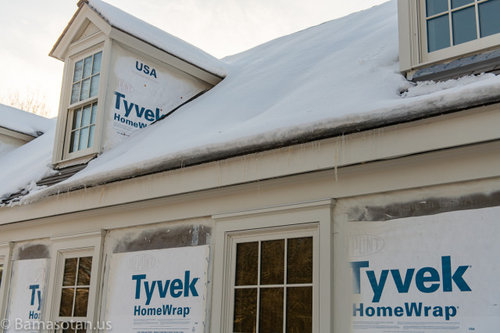
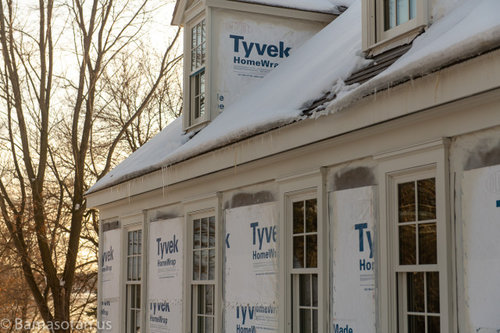
I was quite surprised to see these Ice Dams on our almost complete house in St Paul MN. We had our first snow about 9 days ago and 3 more since with about 7" total IIRC.

Interior is rocked, primed and with trim & cabinets nearly complete. Interior temp is about 50°f. This is on the east facing roof.

Insulation is closed cell spray foam.

Thoughts?

Thanks,


Comments (23)

  • 6 years ago

    We had an ice dam in our last house after living there only one year or so. Leaky ceiling into a bedroom. Called our Builder. He crawled up into the attic called the insulation guy for more insulation. solved the problem.

  • PRO
    6 years ago
    last modified: 6 years ago

    Has the sun been shining on the snow on the roof? Sometimes the sun will warm the roof's surface causing the snow at the roof's surface to melt and cause ice dams at the eaves. If my ice dams were that small I would not worry. Here I think the sun is forecasted to come out some time in January for a short visit.

  • 6 years ago

    It is extremely difficult to not have some ice issues on a roof with dormers and living space below. I hope builder covered everything with ice and water protection. Let us know what it looks like in February.

  • 6 years ago

    When we where having our present home inspected the home inspector said an area of the back roof could be prone for ice dams. My husband put some kind of heat wire on the roof and if the weather is ripe for ice dams he switches it on for a while.

  • 6 years ago

    After we had ice dams a few years ago, we put an electrical wire on the roof shingles that we turn on when we expect melting and refreezing. No problems since then. It is unavoidable in cold climates!

  • 6 years ago

    I showed the photos to my husband, who builds houses and also does a lot of roofing here in Alberta, and he suggests more insulation in the proper areas, and also checking for adequate insulation stops and adequate attic ventilation.

    He says those sort of ice dams would be unacceptable here in Alberta (where our temps went from 19F with snow yesterday to -18F this morning) in new construction. It's definitely avoidable in cold climates. Good luck!

    opaone thanked beckysharp Reinstate SW Unconditionally
  • 6 years ago
    last modified: 6 years ago

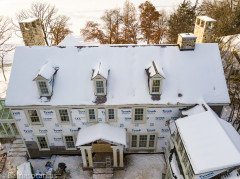
    You can see the problem areas clearly. Where there’s no snow, it’s not insulated properly. You’re getting interior heat under the sheathing. Where it’s melted, it’s not insulated properly. The heel area is often difficult to both insulate and ventilate properly. It’s almost impossible to do with no real overhanging eaves. That is one of the pushes to an unvented roof system. That would be the better choice for situations like this that face difficult to access places that still need to be insulated.

  • 6 years ago

    Would this not be expected in a cold climate roof with no gutters? Plus east exposure.


    prevailing winds are from the west therefore you typically won’t have snow in front of the dormers.


  • 6 years ago

    Thanks all. Some updated info.

    There are ice dams on both the east and west facing roofs. East appear slightly thicker than west. I'm hoping to get a drone up tomorrow to look at the one north facing roof that has heat under it (the other is over a slightly heated (35°f) garage.

    Other houses in the area, most much older, do not have ice dams so far as I can tell so it SEEMS isolated to our house and likely an issue of too much heat escaping though I could be wrong.

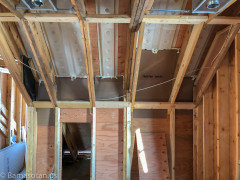
    The roof/insulation is somewhere between vented and hot roof. The plan was for a hot roof (closed cell applied directly to the interior of the sheathing). The insulation contractor installed foam vent pans (photo below) just prior to spraying.

    Even if these don't collapse under the heat and pressure of the expanding foam they'll not provide much venting. On top of which the ridge vents are covered completely or partially with snow a portion of the winter. So I believe this is effectively a hot roof.

    The insulation is against the roof down to the heel (so the crawl space behind the knee walls is within the insulation envelope).

    To what @BeckySharp said, it is possible to build a house well enough to never or almost never get ice dams. A buddy in Sweden said that no house built there in the last 20-30 years will have ice dams.

    Our builder said that it is because of the new cedar shingles (installed in January 2019) and that they have not fully dried out yet and are holding or giving off water. ??

    Thanks all,

  • 6 years ago

    You have one of the best experts on energy in your backyard. Contact Pat Huelman with the Cold Climate Housing department at the U of M. You Also have Residential Science Resources that could help. A site visit would be important, infrared camera pictures and scans could answer a lot of questions.

    opaone thanked Julie Praus
  • 6 years ago


    What kind of spray foam and how thick? I have never seen spray from applied over vent baffles or used with eave and ridge vents. But its also not clear if there is an attic space and, if there is, whether or not its conditioned or unconditioned.

    What was required by the drawings and who drew them?

  • 6 years ago
    last modified: 6 years ago

    In cold snowy weather ice dams can be created by a warm roof but they can also be caused by freeze-thaw conditions.

    Are the dormers real? The configuration of the roof and upper level or attic is not clear.

  • 6 years ago

    Your builder probably did a pretty good job making the dormers and roof water tight. However, it seems apparent that they did not do a good job making any assemblies here air tight.


    If spray foam was part of the contract, it's a shame it wasn't done eave to ridge and left the roof unvented. The labor involved trying to insulate and air seal the knee walls would probably be equal in cost.

    You've got can lights in your ceiling which don't help, but they do look like nice units and are leaking less than cheaper ones would.


    Nothing appears catastrophically wrong, so I wouldn't lose sleep over this. If you're interested in efficiency, it'll be a good idea to get a pro out there to look at things.

  • 6 years ago
    last modified: 6 years ago

    It’s the attempt to mix a vented and unvented roof assembly that is the culprit. The spray foam should have been directly on the roof deck, and no ridge venting or soffit vents. Or else TEC dilation is at the floor level, with soffit and ridge vents. Surely no one knowledgeable drew this weird hybrid? https://www.buildingscience.com/documents/published-articles/pa-crash-course-in-roof-venting/view

  • 6 years ago

    Thanks all. To answer a few questions:

    - The attic (3rd above-ground level of house) is conditioned and finished (my office, my wife's craft room)

    - The dormers are real. You can walk in to them.

    - There is no vapor barrier. Primary insulation throughout for walls and underside of roof deck is closed cell spray foam (which should act as vapor barrier?).

    - Walls are 3.5" so R-21 (plus 2" blown fiberglass). Underside of roof deck is R-49.

    - The only batt insulation is in interior walls for what minimal sound reduction that provides.

    - The exterior wall cavities were filled out with blown fiberglass (between closed cell foam and drywall). This was to alleviate my concern that the 2" of stud projecting beyond the 3.5" thick foam would act as a cold sink and make the already bad thermal bridging that much worse.

    - There is no way that I know of to see in to the vent pans (insulation stops).


    A blower door test after insulation and just prior to sheetrock was 1.8 @ ACH50 which was disappointing.


    For anyone interested there are numerous photos here: http://bamasotan.us

    And here: https://www.instagram.com/bamasotan/

  • 6 years ago

    Do you have the CFM50 number? I estimated your house is around 55,000 cubic feet, which translates to 1,657 CFM50 if 1.8ACH50.

    Thats not a bad number for a large house, and prior to sheetrock.

    In fact, thats pretty good.

    Will you be getting another blower door test at some point?

  • 6 years ago

    There is a phenomenon that occurs in sunny cold weather when exterior walls heat up from the sun, and heated air moves up through soffit vents and under the roof sheathing. The heated sheathing melts the roof’s snow cover.

    The solution is to vent the fascia, not the soffit.

    Just something else to consider/ complicate things.

  • PRO
    6 years ago

    Hi, Opaone,

    I consider myself blessed to live in the southern portion of the U.S., and I'm delighted that I have no personal experience to relate about ice dams.

    If you'll forgive me getting a little off topic, I'm surprised the siding on your home wasn't installed before winter. Please be aware that the Tyvek HomeWrap installed needs to be covered within 120 days of installation to meet the manufacturer's recommendations.

    opaone thanked Charles Ross Homes
  • 6 years ago
    last modified: 6 years ago

    Thanks. A rep from Tyvek came out a few weeks ago for that reason and because of several concerns that I'd raised such as the interface between the Tyvek and the felt used when the windows were installed (house was originally to be felt but when they couldn't get the siding done last fall as planned they put Tyvek up this past March to protect the sheathing). He said all was OK from an age standpoint and provided some guidance on other bits.


  • 6 years ago

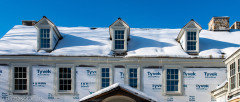
    A couple of photos from today:


  • 6 years ago

    wow, great looking house. Beautiful trim and windows.

    opaone thanked bennyben75
  • 5 years ago

    Preventing Ice Dams With Electric Heat Cable,

    https://www.air-conditioning-ductless.com/


    Improving ventilation and reducing heat sources against the inside roof surface are the best ways to prevent ice dams, but if these methods aren't practical, then it is possible to install electric heat cable along the edge of the roofline and gutters.


    When looped in a zig-zag pattern along the edge of the roof, heat cable will prevent the melting water from cooling enough to freeze when it reaches the eaves. Instead of freezing, the meltwater flows harmlessly to the ground.


    Heat cable is rather unattractive on a roof, but it does serve to prevent ice dams when installed properly. But be aware that mixing water and electricity always comes with risks.