Software
Houzz Logo Print
webuser_373715355

kitchen hood selection please

6 years ago

which is the best wall mount hood? what are things I should look for while selecting a hood? CFU levels/ Noise levels? I cook a lot. Please help. Thanks

Comments (13)

  • 6 years ago
    last modified: 6 years ago

    In a nutshell...

    Ideally, it should be at least 6" wider than the cooking surface/appliance. E.g., a 30" range or cooktop would have a 36" wide hood.

    The depth should be 24" if against the wall; 27" if over an island or peninsula.

    It should be installed per manufacturer's specs -- no higher unless you power up the fan and increase the size of the hood (so the hood can capture the rising and spreading FOGSS (fumes, odors, grease, steam, smoke)).

    The duct work should be per the hood's specs as well, no smaller!

    The physics of why each of the above are in the FAQ posted above and in the Appliances FAQ:


    BTW...I have a Vent-A-Hood and it's not too loud nor is it difficult to clean.

    Cleaning...Just remove a couple of screw nuts, clean, and replace. It's very effective and when we build again, I plan to get another Vent-A-Hood.

    Noise...we rarely have to use it on anything other than the lowest setting, so the noise is not bad. I can carry on a conversation with others in the Kitchen without having to raise my voice and I can hear the TV without any problems.

  • PRO
    6 years ago

    I have had vent-a-hood in my last 2 homes they are IMO the best on the market . I do not find mine easy to clean but I also do it once a year I also do not think it needs to be 6” bigger than the range if you get a bit higher CFM .All hooods are noisy but use it whan you cook and then turn it off. The most important issue is where it is venting to.For every turn in the venting you need to up the CFM so ideally out the wall and the next best in a one storey house straight up through the roof.

  • 6 years ago
    last modified: 6 years ago

    "For every turn in the venting you need to up the CFM "

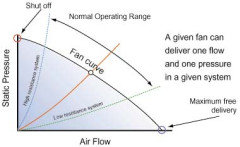
    Not exactly. It's not a function of CFM but blower strength which is known through the fan curve for the blower.

    With a short straight duct a strong 800 CFM blower will do 800 CFM and a 1200 CFM blower will do 1200 CFM. All is good. Put a range hood & grease trap on one end, a few 90° el's, and a roof jack on the opposite end (so much greater static pressure) and the strong 800 CFM blower may be down to 700 CFM but the weaker 1200 CFM blower is now down to 400 CFM.

    Similarly, I've seen 90 CFM bath exhaust fans barely pulling 5 CFM (and thus not exhausting humidity from a shower) when care is not used w/ flex duct installation (which is why most countries now require rigid duct). A good inline 90 CFM blower (E.G., from Fantech) is much better able to overcome this so might do 40 CFM rather than 5. 40 is still too little for any bathroom but much better than 5.

  • 6 years ago
    last modified: 6 years ago

    Sorry, opaone, but I fear your sentence: "With a short straight duct a strong 800 CFM blower will do 800 CFM and a 1200 CFM blower will do 1200 CFM." could lead to a misunderstanding.

    Blower ratings are made in free air, i.e., no hood or ducts or restrictive make-up air supply. Hoods, hood filters, ducts, or any pressure drop in the supply of air back to the kitchen (MUA) will reduce the volumetric flow rate (CFM). Hence, one should not expect a blower, hood, and hood filter combination, even with the most unrestrictive exhaust duct, to supply much over 2/3 of the the blower's rated CFM.

    Your use of "strong" would have to be interpreted as having a more squarish fan curve versus "weak" which would imply a more triangular fan curve between max flow and max pressure, but most blowers used for residential hood exhausts (and as far as I know most up-blast commercial blowers) have the same general quasi-quarter-round shape. To get a significant deviation from this shape may lead to a fan curve that is not monotonic counter-clockwise along the curve, which would cause 'hunting' during operation at higher pressure losses. It is also necessary to keep in mind that the fan curves we see are often full power only, and at lower power settings may behave a bit differently, which has to be accounted for in the design.


    To the OP, I suggest this order of determining characteristics.

    • Determine hood canopy size -- the size of the fume entry aperture -- such that expanding rising plumes are captured within the limits set by the kitchen design and affordability. This was addressed in an earlier post in this thread, among others.
    • Determine flow rate; strive for actual 90 CFM/square foot of hood entry aperture. If all of the needed parameters relating restriction pressure loss to flow rate are not available, multiply the product of aperture area and 90 CFM/sq. ft. by a factor of 1.5 as a rough guess to find rated CFM. This should assure containment of the major parts of the plumes that are captured.
    • A means of supplying air to the kitchen to make up for that which goes up the hood is needed. This should have low pressure loss. The entire subject has been extensively treated on this forum and can be found by searching for "MUA."

    Lowest noise results from using a blower remote from the hood and inserting a silencer into the duct between blower and hood. Space may thwart adding a silencer in many architectures. Further or alternate noise reduction can result from using an oversized blower at less than full power. This all depends on too many variables to provide definitive answers. opaone is doing both silencer and oversize. He should end up with only baffle hiss, easily talked over.

    There are other aspects that have been addressed on this forum. A search and some review time will aid your familiarization with the topic.

    In summary, hood ventilation and MUA may be one of the most architecturally intrusive parts of a kitchen renovation, and require both planning and aesthetic, performance, and cost trade-offs to achieve a satisfactory result.

  • 6 years ago

    Patricia Colwell


    How Old is your Venta Hood? I have one in the FL house and find it works exceedingly well. However, I found cleaning it a bit of a Pain. I have to get up on a step stool then bend at a very

    awkward angle trying to reach. I purchased it in 1999. It only had one speed LOUD

    I keep looking at baffles that look so easy to pop into the dishwasher. Do you have an opinion?

    I keep coming back to the "devil you know is better than .......

    I know Venta Hood works and feel they've improved with variable speed blowers. But.... am I missing something.

    Inga

  • 6 years ago

    I'll let Patricia write for herself; but feel that some background may help set the stage.

    Baffle hood systems derive from commercial systems. In commercial systems, the hood blower and MUA system are generally mounted on a roof. The goal is full fume capture and containment, and collection of much of the larger particle size end of the grease aerosol size spectrum. Ability to easily clean ducts and filters is important. These systems generally run at full power for the duration of the cooking hours. This simplifies MUA tuning. Their electrical operating cost is a major, if not the major cost to the enterprise. Hence, the system designs are directed toward best electrical efficiency for the required performance.

    Residential kitchen ventilation has similar requirements in some respects, but not in others. For one, the differential electrical cost between different designs is negligible relative to the imputed interest cost of the money sunk into the kitchen renovation.

    Noise is a larger factor in residential ventilation, and here is where baffled vs. squirrel-cage blower grease extraction can make a difference. However, the difference will be slight if both designs have smallish high blade-tip speed blowers in the hood (and acoustically in the cook's face). Baffled designs allow for the blower to be moved farther away, in-line in the duct or outside, and potentially using more efficient blowers and/or larger blowers than the hood can accommodate.

    There are also aesthetic considerations, such as the look into the hood when baffled vs. not baffled.

    By examining their volumetric flow rate data vs. pressure loss, the VaH offerings may be seen to typically have a shut-off pressure (see earlier diagram) and corresponding fan curve lower than comparative radial and axial blowers typified by Broan/NuTone/Wolf/Abbaka blowers over most of the flow rate extent. In my view, this makes them more suitable for simple out-the-wall duct systems, so long as MUA pressure loss is minimal.

    Over the 12 years that I have been on this forum, my initial view and that of some others -- backed up with sound pressure measurements -- was that VaH blowers were noisier than comparable in-hood baffled systems. Comments made in later years suggests to me that VaH have learned from the earlier comments and quieted their systems down as the competition ate into their sales at those appliance stores touting VaH systems.

  • 6 years ago

    Thank you. I have copies of most of your posts on this subject Unfortunately some of the technical stuff goes over my head.

    For certain I don't want silencers up on the roof or in line; sounds problematic for maintenance and difficult with a flat roof.

    MUA is not required; not sure if I will need it. The gas furnaces have their own air supply so should not be an issue. The only thing would be the gas fireplace. Not long ago I talked to an Hvac guy who shrugged his shoulders and said " just open a window". If the local talent feels that way, I have little confidence they will know what needs to be done.


    Inga


  • 6 years ago

    Note that to get full power (whatever that turns out to be) you will need to open a window even without the fireplace operating. Else you move up and to the left on the fan curve, reducing the actual flow rate.

  • 6 years ago

    My thank you button has once again disappeared. So thank you for that. Maybe when I get ready to remodel hopefully soon, you can do the design for me ! I'd be happy to pay you:))

  • 6 years ago

    Thanks for the vote of confidence, but I am well retired (and I wasn't employed doing HVAC except for myself). But I will be happy to comment here on whatever questions you pose that I have any insight into.

  • 6 years ago

    Thanks. I have a brother in law who is also retired. He worked in commercial construction on big jobs (Sea World one of them) and knows all of that stuff. I offered to pay him as well to hook up my gas kiln and help with the MUA.

    Same story, he's too busy being retired and my money isn't any good. Whatever happened to money talks:))

  • 6 years ago
    last modified: 6 years ago

    I suggest this: Spend all the time you can reading the kitchen forum on every detail of your conceptual kitchen. Also this forum. You will find many ideas that may have application.

    Get a kitchen designer you can work with who can show you various layouts that incorporate your appliance, storage, and workspace needs. Mentally move about in the area thinking about where landing zones are vs. should be. How heat is provided. Where lights can be and what the shadowing will be.

    As you close in on a cabinet provider be sure to take the detailed plans and measure everything against the plans. Be sure there is enough room behind things (make counters larger if necessary) for hoses, plumbing, electrical, DWV, etc. There are many traps (pun intended). The larger Insinkerators, for example, require a lower trap weir height than was historically used. Let the kitchen forum see your plan so a range of criticisms can be obtained and evaluated.