Software
Houzz Logo Print
mxk3

Fast growing, clean trees

6 years ago

What are some fast-growing trees that are not messy (e.g. willows are out of the question - love them but hate the constant mess). Have to have a couple choke cherries in the pasture removed because they died and need replacement(s) to give the horses some shade.

Comments (26)

  • 6 years ago

    Morus alba, which is not toxic to horses and provides very dense shade. That's what we use in our horse pastures.

  • 6 years ago
    last modified: 6 years ago

    ^^ Is that a mulberry tree?

  • 6 years ago

    Yes.

  • 6 years ago
    last modified: 6 years ago

    Morus alba is highly invasive here and restricted in our state.

    I have no recommendations for a clean tree but I would suggest Liriodendron tulipifera if you have decent moisture.


    I see Acer negundo quite often on the boundaries of horse pastures around here.

  • 6 years ago

    ^^ I have tulip tree on my property, and it grows very well, is a beautiful tree.

  • 6 years ago

    If the trees are to be located out in a pasture, does it make any difference if they are "messy" or shed various parts?

    Be sure to check on whatever choices you may make being non-toxic to horses

  • 6 years ago

    ^^ Yea, it does -- DH has to mow occasionally. I have such a mess with a massive willow I have I think I'm now overly concerned about a debris field.

  • 6 years ago

    In my experence with horses they will chew any tree to pieces, they do not need shade,lol, Sorry but I think this will end badly for the trees.

  • 6 years ago

    I second the Honey Locust recommendation. No seed pods (on the one I have anyway), rarely has any branches fall (unlike my stupid Silver Maple) and the leaves are small, so you don't have to bother raking them up because they decompose in like a month or two.

  • 6 years ago

    You can get fruitless Morus alba (mulberry) that do not reseed so are not invasive. The horses will do a good job of eating the leaves thus controlling debris. Check to make sure that the honey locust doesn't sucker. No red maples - they are toxic to equines.

  • 6 years ago

    "No red maples - they are toxic to equines."

    As are yews, black walnuts, black locusts, anything in the Prunus genus, and oaks

  • 6 years ago

    Don't hate on a tree because someone planted it in the wrong location!


    Leaf debris is over-rated. I get that a willow won't work as they do drop 100s and 100s of little branches. Hopefully you're not eliminating trees due to leaf debris - unless they are toxic to your horses.

  • 6 years ago
    last modified: 6 years ago

    Sara, Morus alba hybridizes with Morus rubra here and basically replaces those native populations. This plant ranks with Buckthorn as the most horrendous invasive here.


    Its basically the Pyrus calleryana of the north.

  • 6 years ago
    last modified: 6 years ago

    I had a Katsura Tree (I'll try to dig out a picture) and it was absolutely beautiful. Blue Green heart shape leaves in the spring and the most beautiful butter yellow leaves in the Fall. When the sun hits it in the fall it is pure magic 😊. Even smells wonderful. I drops all its leaves at once so only one clean up and didn't seed around for me. I can't say enough good things about it.

  • 6 years ago


    The following trees are GOOD choices for shade trees in horse pastures;

    Hickory, Shagbark – mature height of 60-80 feet. Best along woodedges, bark peels off making the tree “dirty.” Shagbark is one of the fastest growing hickories, but it is slower than most other hardwoods such as oak. Slow growth.

    Beech, American - Mature height of 50-70 feet. This tree is huge and does best with lots of space (width is almost the same as height!). Prefers sun. Slow-medium growth.

    Hemlock, Eastern/Canadian - Mature height of 40-70 feet. Evergreen hedge when planted 2’ apart, used for windbreaks. Slow-medium growth.

    Cedar, Eastern Red - Mature height of 40-50 feet. Good windbreak when planted in rows. Medium growth.

    Birch, Yellow or River - Mature height of 40-75 feet, depending on variety. Medium-fast growth.

    Hackberry, Common - Mature height of 40-60 feet. Tolerates many growing conditions. Medium-fast growth.

    Ash, Green or White - Mature height of 50-80 feet, depending on variety. Green Ash has a fast growth rate, White is medium.

    Honeylocust, Common - Mature height of 30-70 feet. Adaptable tree that tolerates pollution, salty soil and drought. Fast growth.

    Poplar, Tulip - Mature height of 70-90 feet. Prefers full sun and lots of space. Fast growth.

    http://thepetscene.blogspot.com/2016/04/top-10-toxic-tress-to-horses.html

  • 6 years ago

    Whaas I see. No native Morus here so nothing for them to hybridize with!

  • 6 years ago

    Canadian hemlock is having an adelgid problem. And ashes are being hammered by emerald ash borer in much of the eastern US - it might be a waste of time to plant one in MI.

  • 6 years ago

    Yes, EAB has absolutely oblierated Ash at a staggering pace. As litle as 6 years ago you'd have the forest light up with yellow and burgundy. Now the forests and streets are plagued with dead trees.

  • 6 years ago

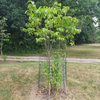
    Katsuratree is a very good tree if you can find it. Below is the trunk of my 15 yr old:

  • 6 years ago

    I like serviceberry as a fast-growing tree. They have berries but I've never seen one hit the ground before the robins get to them. Not sure if it's dense enough for shade, though.

  • 6 years ago
    last modified: 6 years ago

    Thanks for the ideas. I have tulip trees and love them, so definitely a possibility, as is the honeylocust. Ash is out of the question (blasted emerald ash borer...I don't even think you can buy an ash around here anymore). I love horsechestnut, but what is the growth rate? I need something FAST, I thought HC's were fairly slow-growers - ?

  • 6 years ago

    If the squirrel-planted ones that pop up in my garden are any example, I'd rate them as very fast growers when young but moderating a bit as they age - 13-24 inches annually.

    This is not one I'd plant in a horse pasture, though, as consumption of any part of the tree can be harmful to horses, causing tremors and convulsions as well as gastric upset.

  • 6 years ago

    ^^ do you mean the horsechestnuts or the honeylocust?

  • 6 years ago

    I was responding to the HC, which I assumed meant horse chestnut :-) And I would not consider that to be a 'clean' tree either..........sheds big leaves on long petioles (all through the summer if a dry one) and then there are all the husks and conkers.

  • 6 years ago

    The horsechestnuts around here (upstate NY) all suffer badly from leaf scorch and the foliage turns a miserable shriveled brown by late summer. Not sure if you care about looks though. It’s still not a great idea for a livestock pasture for other reasons that GG mentioned.