Software
Houzz Logo Print
paintedpeggies

Chimney vs. integrated range exhaust

Is there any difference in these as far as efficiency? We are trying to decide which to get and have to make the decision soon.
Range is on an outside wall so we will be venting directly out.

Comments (7)

  • 6 years ago

    $$$$$

  • 6 years ago

    I need to know what you mean by “integrated range exhaust”. I thought perhaps a metal chimney hood vs a hood that has a cabinetry enclosure to match the surrounding cabinetry? Just taking a stab in the dark. If you’d explain more, and say the width of the hood you want, we could help you.

  • 6 years ago

    Yes! I did some googling and that’s what it’s called, I thought.

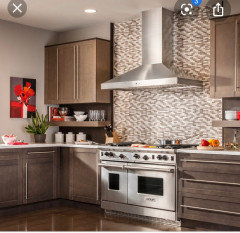
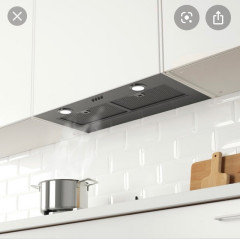
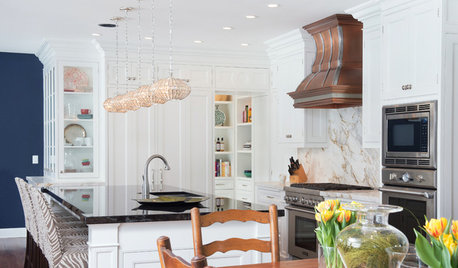
    This vs. this

  • 6 years ago

    The plume of hot gases rising from your pot expands and for the most part rises straight up. The hood can't really do anything about that. And in fact, as soon as the hot gases hit the hood, they'll bounce back before they finally (hopefully) get sucked up.

    This has a couple of implications for proper hood design. The hood needs to fully overlap all the burners and in fact extend a little bit further. As a basic rule of thumb, people frequently suggest that hoods should be about 3" wider on both side than the range. And if you have upper cabinets that can "frame" the hood, then that's a good thing. It'll help guide the airflow.

    A good hood should also be about 27" deep; if you can only do 24", that's still not horrible. You might just have to occasionally get used to moving smellier foods to the back burners. But any shorter than that, and your hood won't capture all of the cooking smell.

    Also, in order to actually capture the rising gases, the hood needs minimum height. A flat surface won't really work well, as the gases simply bounce off and then make it back into the kitchen.

    Finally, baffle filters work better and are easier to maintain than mesh filters which tend to quickly clog up and need to constantly be washed.

    Knowing all of these facts, I think you can now answer you own question. It's not the hood inserts don't work. But the type of insert that you showed in you picture is next to useless, whereas the type of chimney hood that you showed tends to work pretty well. You can get inserts that work well, but they'll be much bigger (e.g. 36" × 27") and need a much larger cabinet to hold them.

    And that brings us to the question of required air flow. In order for the hood to operate properly, the airflow at the hood aperture has to match with the airflow of the rising gases. As a rule of thumb, this means you need about 90 CFM per square foot of aperture. Let's assume your aperture was 36" × 27", then you'd get 6.75 square of a required airflow of about 600 CFM. But you can't just buy a hood that gives you 600 CFM. Hoods are measured without any ducts attached to them. That's highly misleading.

    In practice, performance losses thanks to ducts can be quite significant. Even if you keep your ducts short and keep them at least 8" in diameter (10" would be better), expect that you need to add at least 50% to make up for these losses. So, now you are looking at a 900 CFM hood.

    But building codes in most states require that you need make-up-air as soon as your hood exceeds 400 CFM. So, now you need to add that to your list of infrastructure upgrades. And don't just gloss over that, even if you find an inspector who might let you get away with it. The air that you want to vent needs to come from somewhere, after all. Without a properly sized make-up-air system, at best, your vent hood simply wont vent anything, but at worst it'll suck in carbon monoxide from vent pipes of other gas fired appliances in the house (e.g. water heater and furnace).

  • 6 years ago

    That won’t meet code in the US. Even a nothing coil top electric cooktop says that combustibles have to be 24” minimum from the cooking surface. The wall cabinets would have to be 27” deep in order for the combustible door to not be directly over the cooking zone. The rest of it is covered by the insert, which isn’t wide enough.


    30” from the cooktop is a standard clearance to combustibles. Some high BTU cooking equipment requires 36”. The reason for that restriction ought to be obvious.

  • 6 years ago
    last modified: 6 years ago

    M, good stuff.

    "In order for the hood to operate properly, the airflow at the hood aperture has to match with the airflow of the rising gases."

    Sort of. The effluent from cooking is quite bursty. Mostly it's rather minimal but occasionally you get huge bursts like when you flip a steak over or add something for deglazing. The bulk of the odors and grease are in these bursts which can be several thousand CFM. That would be a huge blower.

    This is why commercial hoods are so big and empty. That big empty space is containment area that contains these massive bursts until the exhaust blower can exhaust the effluent. With a large enough containment area the exhaust blower need only work hard enough to exhaust the average amount of effluent over time, not enough to handle the bursts.

    So to M's earlier point, that flat hood would need about 18,000 CFM to perform at the same level as a commercial hood at 150 CFM. Just guessing on the containment volume of the chimney hood pictured, much better than the flat one but still quite small, it might need 2,000 CFM to equal a 150 CFM commercial hood.

    More: https://www.gardenweb.com/discussions/5161173/hood-faq 

    So to the original efficiency question - you need containment volume. Our commercial hood (https://www.houzz.com/discussions/5745986/commercial-range-hood-install) will perform better at 150 CFM than a consumer hood at 1,200 CFM - because of the containment area. In cold, hot or humid climates that will also make a big difference in heating/cooling costs.

    It is also much quieter. Standing in front of the range with no other noise in the house you cannot hear it until around 500 CFM and with normal ambient noise you can't hear it until about 700 CFM.

    I'm guessing that we'll run it at 150 CFM most of the time to quietly accomplish better effluent removal than our VAH at a very noisy 600 CFM (and VAH actually has among the largest containment volumes of all consumer hoods).