Software
Houzz Logo Print
rschroeder987

Aphids, black and white stuff on boxwoods?

6 years ago
last modified: 6 years ago
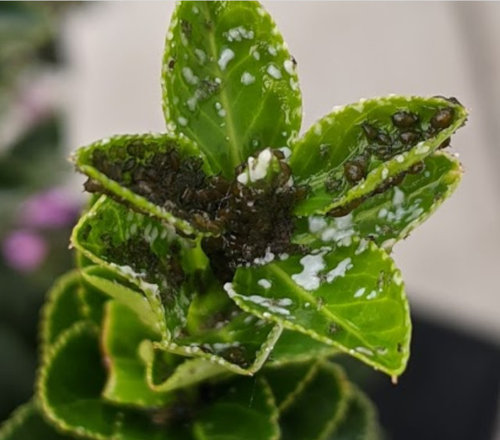
I'm new with plants. I put in four self watering containers and planted a green spire boxwood and creeping lantana in each container back in early November. They've been thriving until the last 3 - 4 weeks and it's honestly devastating to me and making me doubt if I can actually grow things. Our huge backyard is a wasteland and I was excited about slowly turning it into a beautiful garden. These were my starters.

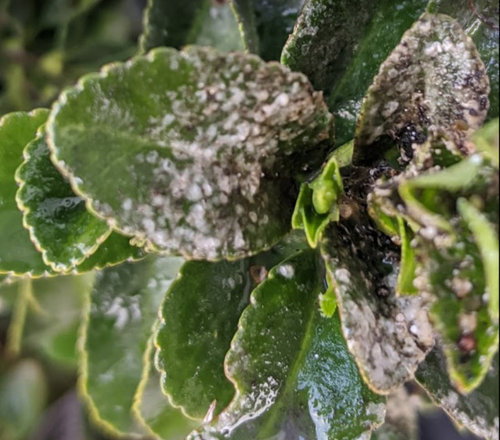
So it seems I've got some dark colored aphids, see photos below, but there's also crusty black AND white stuff now too, and I'm not sure what to do. It appears to be fairly isolated to two plants, and just a few branches of each, and is affecting the older growth more than the new growth.

Aphids and I assume aphid eggs or droppings or something white and squishy:


I sprayed an insecticidal soap on them the last two weeks, but it appears it is getting worse. In addition to the aphids, there's both white and brown gunky stuff even where there are not aphids, but there's also new unaffected growth. I searched the internet, but the aphids don't explain the white and black gunk too. I'm worried I have a host of issues going on here and I don't know which to treat first, or how.

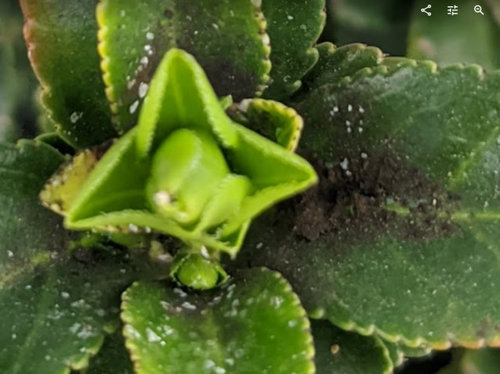
White crunchy looking stuff:


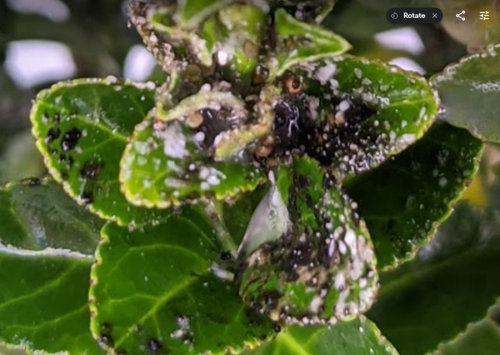
Black powdery stuff


Just complete chaos and devastation:


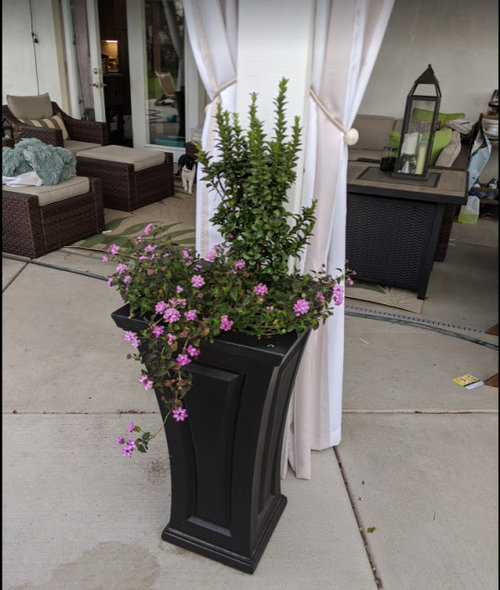
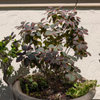
Here is the entire planter. There's nothing else but concrete surrounding it. There's four in total, with this one being heavily affected, one having some minor issues, and the other two are still doing okay. They're raised off the ground and were planted with purchased soil, specifically so I could make sure it didn't pick up anything from our yard. The overall plant looks good. I water once a week, and I know the water reservoir in the planters isn't full yet.

In the last 2 - 3 weeks the weather has warmed up, I live in central California and we've started an early spring with temperatures back up around 70 during the day and 45 at night. I also added bark mulch a few weeks ago. Those are the only changes since they were planted, and I'm not sure if those are contributing factors or not.

I've read aphids are closely tied with ant populations, and while we obviously have ants out and about in the yard, these containers are nowhere near any any populations.


Help would be appreciated. I was thinking of just cutting the heavily infested bits off. I sprayed again with insecticidal soap this morning as well. I'm surprised a little at how upsetting this is, I think I've grew more attached to these than I was ready to admit. I was really proud of them. :(

ETA: These face south and take full sun every day.

Comments (12)

  • 6 years ago

    That is Green Spire euonymus (not boxwood) and you have euonymus scale. Scale is a very difficult insect pest to control and you will probably get almost zero control with insecticidal soap. Horticultural sprays are better but must be properly timed to the insect's life cycle. A systemic applied to the soil may be a better approach.

    And you can prune out the worst affected portions as well. It is also fair to warn you that the problem can be severe enough that you will never control it and then it's best to just cut your losses and get rid of the plant.

    Becky thanked gardengal48 (PNW Z8/9)
  • 6 years ago

    Thank you! I appreciate the warning, brutal as it is. So, how did my plants catch this little pest? Did it come from the nursery? I got these at a local reputable nursery back in November, I specifically avoided the big box stores because I thought I would be getting healthier plants.


    Will the horticultural spray or systemic in the soil impact the hummingbirds feeding off of the lantana? As much as I love my plants, I don't want to jeopardize the wildlife over it.

  • 6 years ago

    Like aphids, scale is one of those things that can just "happen" :-) It is possible the plants were already infested with scale eggs when you purchased them but really impossible to say for sure.

    Both the hort oil spray and any systemic should not be of any concern to hummingbirds. But the systemic could be create a issue with bees, depending on its active ingredients.

    Becky thanked gardengal48 (PNW Z8/9)
  • 6 years ago

    you said something about ants .... ants milk aphids and sometimes scale for the sugary honeydew ... and the ants are otherwise irrelevant.. other than you usually see the trial of ants.. leading you to the bug/scale problem .... so i see no reason to otherwise treat for ants ...in other words.. no need to kill the ants .. unless you just have a hate for them .. lol ...


    you are going to have to manually remove all that yuck ... else it will take a couple of years for it all to disappear ... after you actually kill them all ...


    https://duckduckgo.com/?q=are+scale+insects&t=ffcm&ia=web


    i would use the systemic.. applied properly per the label to the soil ... so the plant soaks it all up and kills all the scale and the following generations that might hatch afterwards ... scale is a sucking bug.. so when it sucks the juices of the treated plant.. they die ...


    you have to buy a product labeled for scale ...


    before you go investing in the treatment.. and the labor of cleaning them.. consider it might be easier to just go buy new plants ... if you do;... start with new media... and sterilize the container.. etc ... start clean ...


    ken

    Becky thanked ken_adrian Adrian MI cold Z5
  • 6 years ago

    The first image shows a very bad infestation of aphids, probably worthy of attacking with insecticidal soap and sharp sprays from the hose. Use your fingers to squish.

    Lantana is susceptible to infestations of Lace Bug and spider mites, either of which can cause considerable damage. I have found that these pests can be very difficult to control without chemical that can be harmful to bees, butterflies, hummingbirds, and anything else.

    Some of your descriptions do sound like the dreaded euonymus scale, practically a given on this plant.

    Becky thanked rhizo_1 (North AL) zone 7
  • 6 years ago

    Use your fingers to squish.


    ==>> thats the part i never manned up and did ... lol ... others are apparently braver .. lol


    ken

    Becky thanked ken_adrian Adrian MI cold Z5
  • 6 years ago

    I trimmed back the plants wherever I saw damage or evidence of pests yesterday, a lot of it really was fairly localized. Still, after reading up it seems unlikely I managed to get it all. So I have some options I'm hoping you all can help with.


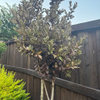
    My original goal was to have topiaries in these containers. Here's a picture of the patio with all four containers, one at each pillar of the patio cover. Sorry I have no daytime pictures. There's a close up of a single container in the original post during the day. We poured a LOT of concrete this past summer when we put the pool in, and I wanted plants to help break it up. I was trying to add something to grow high and take up vertical space, and something to trail over and add color to soften the overall look. I thought I was putting in a boxwood with the lantana. Ideally I wanted something that attracted hummingbirds and butterflies more than bees since this is where people hang out and eat.


    For the first year or so I was just going to let them grow while I got my bearings and a better grasp of taking care of my plants. Once it was established and healthy I was going to prune it into a cone shape, and maybe down the road attempt a spiral.


    After reading up more, it appears these euonymus aren't really suited to that in any case. So here we are. Given my inexperience I'd rather not try to start investing in all the chemicals to try to save these and am leaning towards replacing them. What would you suggest I use? I live in central California, zone 9, these are south facing in full sun.


    I understand replacing all the soil and cleaning out the containers, but what do I do with the lantana? It appears to be thriving and is attracting hummingbirds and I love how it looks. I don't want it to recontaminate whatever goes in with it, but I don't want to just toss it either. I've examined it carefully and I don't see any aphids or other pests on the lantana. I did just purchase some hanging baskets to put in each patio bay, so if it's important to keep it segregated I could maybe transplant it into the baskets? Nowhere else in the yard has any irrigation currently so I'm not sure it would survive anywhere else.


    TL;DR Version:

    If I was to start over, what would you recommend to go in these containers with the following constraints?

    • I'm a novice gardener, easy low risk plants please
    • Something tall I could trim into a cone shape (eventually)
    • Something colorful co-planted to trail over the planter
    • Zone 9, south facing in full sun all day
    • Attracts more butterflies and hummingbirds than bees since it is a lounge/eating area


    THANK YOU!!


  • 6 years ago

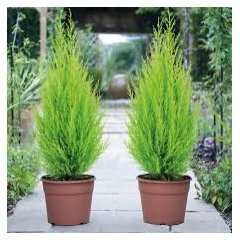
    To replace the euonymus, I'd suggest something like Cupressus macrocarpa 'Wilma Goldcrest'. This is an exceedingly popular container plant that should be widely availability all along the west coast. It has wonderfully scented chartreuse foliage (giving rise to the common name of lemon-lime cypress) and has a natural cone-shaped form that can be easily maintained by light pruning. Grows slowly enough in a container planting that it should last years with careful management. And the purple lantana is a great accent for the chartreuse coloring.

    Becky thanked gardengal48 (PNW Z8/9)
  • 6 years ago
    last modified: 6 years ago
    Despite prevalence of combination "Wilma Goldcrest" in commerce it appears name is actually 'Wilma', with 'Goldcrest' being the parental cultivar of which 'Wilma' is a sport. With the latter differing from 'Goldcrest' by being smaller and narrower growing. Anyway if "central California" means well away from the coast in this instance Becky should check to see if Monterey cypresses are successful in their area.

    Becky thanked Embothrium
  • 6 years ago
    last modified: 6 years ago
    Your girls talking to the bees is absolutely adorable. I understand bees come with the territory, just looking to minimize the risk for everyone (including the bees!) as we have lots of company over.


    Those lemon lime cypress look nice! Actually, I'm sort of kicking myself for not thinking of cypress myself, I just think of them as huge trees, didn't occur to me they could stay small. Most of the ones I'm familiar with are these huge towering things usually used along the perimeters of yards. I'm in the central valley, very different climate than the coast. Much hotter, and also much colder in the winter, though still very mild by the standards of the rest of the country.


    I found a nursery I like much more and trust more than the original nursery I purchased these from. I'll head there this weekend and see if they have something similar. They should be able to point me towards something similar that will thrive in our area if these won't.


    I appreciate everyone's help!! This all seems so daunting.

  • 6 years ago
    last modified: 6 years ago
    The yellow Monterey cypress cultivars including 'Wilma' do grow into trees* but as described previously if using this plant in your pots you would be shearing yours to control top growth. And same as with putting any other kind of woody plants in pots these will not be able to be left in the same containers for an indefinite period. If nothing else they will eventually have to be taken out of the pots in order to replace at least part of the potting soil. Which brings up the possibility of using shaving of the outer roots to dwarf top growth additionally and make room for new soil to go into the same sized containers.


    *Them having only recently become highly prevalent at outlets in my area about 15-20' is typical for the scattering of larger ones seen growing in the ground here. With most of these latter day plantings likely to be consisting of either 'Goldcrest' or 'Wilma'. Otherwise the small number of local examples of the green parental species does consist primarily of large, skyline height specimens that date back many years

Sponsored
Hope Restoration & General Contracting
Average rating: 4.7 out of 5 stars35 Reviews
Columbus Design-Build, Kitchen & Bath Remodeling, Historic Renovations