

Furnace size question
30 year old house in Chicago area with original furnace needs replacement. 1,800 sqft 2 story with partial basement. All windows replaced in past few years and attic has had additional insulation blown in. Current furnace is 100,000 btu. I have a quote now for an 80% and 96% replacement both 100,000 btu.
Question is: does this home still need a 100,000 btu furnace? Even with the 96% model? I would think an 80-90K btu would do? Do the furnace installers think this way or just replace with the same?
Comments (69)
 6 years ago
Elmer, you went to accusing Austin of disparaging load calculations when he never even mentioned them, you simply carried over your previous bias against Austin’s comments.
Your explanation with regard to ducts is a strawman, at best.
Then you proceed to berate Austin for thinks I simply cannot find in his comments.
I have a suggestion, Elmer, why not try to help people without taking a shot at others doing the same. If you disagree with a suggestion, respond with a clear reason why, not an opinion why.Related Professionals
Atlanta General Contractors · Lake Charles General Contractors · Traverse City General Contractors · Beatrice General Contractors · Kearney General Contractors · Utica General Contractors · Hannibal Home Remodeling · Austin Home Remodeling · Petersburg Home Remodeling · Muncie Home Remodeling · Modesto Home Remodeling · Amarillo Home Remodeling · Pierre Home Remodeling · Everett Home Remodeling · Cincinnati Bathroom Remodelers 6 years agolast modified: 6 years ago
Thanks. I was trying to help the conversation and caution about his advice. Some background:
From other conversations with him, I've concluded he's not exactly up to date with his views or practices. While load calculations are getting pretty standard (and required by code in some areas, including mine), he's said he doesn't do them, he replaces sizes like with like. There is also such a thing as duct calculations, a bit more arcane and needed for new construction and useful for new equipment installs, but he's said he doesn't do those either.
For both furnace and AC equipment sizing, it's well accepted that work done in past decades put in oversized units quite consistently. Furnaces and A/C systems with too much output. There are major efficiency AND comfort negatives of doing that. It's also pretty accepted that ducts were rarely too big and more often too small. It's why such systems often produce air noise. And why when existing systems are replaced, load calcs should be done and smaller equipment sizes should be expected to be better choices and should be expected to be fully compatible with existing ducts.
Several contributions above have suggested these as points to consider and recommended a load calc be done. He said
"Smaller furnace will make duct work over sized, will suffer 'throw' or velocity out of the duct problems, which will lead to other problems--- namely cold spots especially in your climate."
This is baloney. For a number of reasons, but one is, a smaller furnace can have the same airflow as a larger furnace - there are different models in all brands. But he suggested putting in a two stage furnace. A two stage furnace has a low and high output levels. In low, the fan is running at a lower speed. So if a smaller furnace with a lower fan speed (which it doesn't need to have) produces some kind of duct problem, why would it be that a two stage furnace (which are more expensive) running at a lower fan speed would be okay?
Okay?- 6 years ago
Nope. What he said could be incorrect, and quite as easily can be correct. You simply placed your bias on his statement, and assumed a few things that make it so.
I’ve watched you and Austin bicker, and it’s tiring for people looking for help. His points are usually pretty solid, and his view on load calcs is more nuanced than you credit. Load calcs are good, if done by reputable contractors...if.
You have plenty to offer, but you distract from it with the sniping. Just my $0.02. - 6 years agolast modified: 6 years ago
Thanks for the balanced words, and I'll keep that in mind. I do think it was a doubletalk moment, it's not the first time he's said things in that way.
You're spot on in saying "if done by reputable contractors". I'll add "competent" to "reputable" in your sentence to express my view. It's a good way to see who's reputable and who isn't. I'm not sure how someone could offer a fixed bid for an equipment job without being specific about supplying right sized equipment. He's said he does them only if asked, and for an extra charge.
He can rationalize away as unnecessary many things done as a matter of good practice elsewhere and I think his advice is misleading because of his attitude about some of this stuff. But it's not my magic show and not my rabbits.
 PRO6 years agolast modified: 6 years ago
But he suggested putting in a two stage furnace. A two stage furnace has a low and high output levels. In low, the fan is running at a lower speed. So if a smaller furnace with a lower fan speed (which it doesn't need to have) produces some kind of duct problem, why would it be that a two stage furnace (which are more expensive) running at a lower fan speed would be okay?
This is what a non pro doesn't understand (why is beyond me)... even with all the long winded posts that I write. You seem to forget that even a really cold climate will have periods of 'not so cold weather'.
So sure a two stage furnace will have lower output... for? milder weather.
If you put a smaller furnace in there and it turns colder... the opposite is what?
Not having enough output (capacity) --- this is where throw or velocity out of the vent comes into play. (not to mention a furnace that runs and runs and never shuts off. -- that won't hurt anything, but it most certainly won't be very comfortable because a cycle is one that runs and eventually cycles off --- unless it's the higher end modulating.)
Milder weather ----- velocity is of little concern. The furnace kicks on runs a little bit on low speed and shuts off. (weather dictates most of it)
Completely different for a climate like yours in California where you might get down into the 50's or a rare 40's (coastal areas) --- mountains can get colder, but nothing like Chicago area.
The house in question here is 30 years old. The furnace seems to be original. All these years it's sizing has never been challenged until now. There's been some up grades windows changed, attic insulation blown in.
But does that really reduce drafts in a 30 year old house? It's not going to hurt anything by having the extra capacity needed in the event of a bone chilling event.
This is why a two stage similarly sized furnace to the original will be more than adequate. (worst case it runs on stage 1 --- 80% of the time - bone chilling season the other 20% of the time in 2nd stage high heat)
If you don't have the extra capacity and you're too cold --- you rip it out and start over. 30 years is a long time of proof the furnace was sized right. (if not it wouldn't have lasted this long, would it?) Do you know of anyone who would keep a furnace for 30 years that isn't working right???
No, no, no... you must do a heat load calculation. (there is nothing wrong in doing a heat load calculation, but it's not fool proof. It's a tool for those who understand how to use it.)
Why I charge for it: If it's not done correctly --- it becomes a sales tool to sell you more often than not things you don't need.
Ok if your in that camp how are you going to determine the R-values of the insulation in the walls, the insulation blown in the attic, what is the R-value of that?
What is the R-value of the newly replaced windows. Were the stickers saved that came with the windows --- no let's guess some more here.
The common theme among those recommending heat loads is not fully understanding the fallacy in using them. Does this make them bad, no. Only when you think a heat load is infallible is when they become bad.
How could I have formed the opinion I have? Going back behind others, talking to people. Even people within the company that at the time I worked for.
Experience. (what is it? from doing it, living it. -- talk to anyone else and they may have a different opinion, but most of the time it's nothing more than salesmanship.)Let's take all this time to do a load calculation --- but let's ignore the duct work. Let's assume the duct work is under sized for the past 30 years!
Certain people of this board will go and recommend people to do a heat load, but then on certain posts claim something is over sized without even doing a heat load for that property?Grossly oversized....probably a 60 KBTU high eff furnace or an 80 K 80% eff model...definitely not a 100 K model...
TDLike S
Let's recommend a smaller furnace / air conditioner what ever. How in the world does this board recommending heat load calcs for proper sizing / no mention of duct work --- nothing in that regard in this example from this post (top of the thread).
Oh, well he's not a pro. He's a home owner like the rest of us?
Note: Let's take all this time to do a load calculation --- but let's ignore the duct work. Let's assume the duct work is under sized for the past 30 YEARS!- 6 years ago
Ok if your in that camp how are you going to determine the R-values of the insulation in the walls, the insulation blown in the attic, what is the R-value of that?
What is the R-value of the newly replaced windows. Were the stickers saved that came with the windows --- no let's guess some more here.
Ray you are absolutely right on this point. You should always ask the homeowner how much insulation was installed in the attic and the model number of the windows.
... you must do a heat load calculation. (there is nothing wrong in doing a heat load calculation, but it's not fool proof. It's a tool for those who understand how to use it.)Right again Ray, a heating and cooling load calculation is only as good as the input. The numbers have to be entered correctly. The tool is only as good as the user.
Note: Let's take all this time to do a load calculation --- but let's ignore the duct work.You are right Ray, you should not ignore the duct work. The installer should do a Manual D along with Manual J calculation.
Why I charge for it: If it's not done correctly --- it becomes a sales tool to sell you more often than not things you don't need.You should be compensated for your time and the overhead to maintain your lap top and all the required software.
I realize every installation is different, but what is the going rate for a heating, cooling, and duct calculation in your part of Texas? Mike Butler
Original Author6 years agoI really appreciate all the info and comments and I am learning a lot.
I don't know what is needed to do a Manual J calc, but it seems we would have to guess at some things. The walls are likely R-13 insulation. The attic we could measure the blown in depth. The windows I'm told were replaced in 2018 with vinyl replacements. I don't know the U factor. I don't if the builder used a Tyvek type wrap.
If furnace Choices are 60K, 80 or 100K btu then does it matter so much? 100K is probably too big, 60K is great for a mild winter like this year, but some years it gets to -10F around here and 60K might struggle. So 80K with a 2 or variable speed blower wins?
- 6 years ago
Mike Butler, a best guess Manual J will give you ballpark data...and you have more than enough data to get close.
As for what will work, once you determine a furnace, the duct work can be assessed for its suitability for the furnace and adjusted/replaced as needed. As a bonus, you can fix any supply issues at this time. - 6 years ago
A quick and dirty load calc is head and shoulders over no load calc. The key to the comment is calc, not a guess or Kentucky windage or "what's there looks fine". The better HVAC contractors I encountered could do it in about 30 minutes, as part of the bid process. And refined it when the bid was accepted as a double check. The calcs will determine the NET output needed, you can then decide what equipment and what efficiency you prefer to get you there.
A 30 year old house can be expected to have leaky ducts, that's also something to be assessed as part of the work if not required by the HVAC building code in your area.
- 6 years ago
Absolutely agree, IF there is some knowledge of the in-wall, roof and floor insulation and the duct conditions, or there is a way to check.
If there isn’t, a load calc is a sales tool for whatever the contractor is overstocked with. - 6 years agolast modified: 6 years ago
north, doing expedient load calcs seems to be like so many other things, experience gained through repetition develops expertise and efficiency.
It happens I asked one of the bidders what he used for insulation values. It was the job I had done last year and It was a property I'd purchased 6 months earlier -I didn't have a clue about its insulation. He said something to the effect of "remember when I asked you how old the structure is ? I have a file that tells me what the building code required for ceiling and wall insulation for any particular year. I assume that most places are built to code and not more and that's pretty accurate. I also look in the attic as a double check anyway but my table tells me what I need to know".
A quick duct assessment was done by the better bidders by turning on the fan and taking a look at the accessible larger duct connections. Leak testing (and remediation if outside the requirements) is required by code in my state for any equipment replacement so it's not something extra. The two I used for the two different jobs (one for each) also sealed with mastic tape around the metal duct boots (notoriously beat up, bent, and open around the sides to the ceiling, crawlspaces, or wall cavity), just below the supply grills. It hadn't been done in the original construction and there were big gaps at both homes.
The phrase "conscientious workmanship" has gone out of fashion but in all trades, it's something better ones demonstrate and the slackers don't.
- 6 years ago
The HVAC contractor I used for my installation told me he has a database of load calculations for installations he has done in the past. In many cases he has a calculations for a specific house models. He just has to import the data from a previous calculation for the same house model and change the physical orientation. From that point he can modify the parameters if additional attic insulation has been added or windows have been upgraded.
- 6 years ago
That’s true enough, but in a huge market like DFW, the variety of builders, plans and building booms makes it a little more of a lottery. Few homeowners can properly even identify upgrades, and that’s where contractor experience can either payoff or bite you.
My home was built in 1988, but has some changes and uses half the energy my neighbors do. But it the contractor ran with that and assumed it was because of better insulation, etc, they’d be badly wrong. I simply have all LED, use a more efficient HVAC setting and have a little more airtightness. - 6 years agolast modified: 6 years ago
The thermostat settings (several that matter) are a key cost efficiency tool but equipment matters too.
Do the range of possible insulation values make that much of a difference? I would think that historically for non-custom, development-type construction that's relatively recent (last 40 years), insulation upgrades weren't necessarily that much in demand. Most were built to code for most categories. Is your experience different?
- 6 years ago
The point I was trying to make is that a load calculation doesn't always start from a blank sheet of paper. The contractor should not rely on homeowner's knowledge of the house. He should be measuring and inspecting on site.
The monthly energy use is not a input parameter to the load calculation.
- 6 years ago
No, mike, it isn’t. But two contractors that I had quote my HVAC replacement wanted the data to “refine” there calculations. Calculations they didn’t want to make until I asked for them, and then that they did in a sloppy and slipshod fashion. Oh well, made it easy to rule them out.
Elmer, the switch to LED’s was my biggest savings, but replacing non-AT-IC pot lights with AT-IC units and adding an extra layer of insulation in the attic did quite a bit. I could possibly have downsized the HVAC, but it would have been marginal, and in Texas that don’t cut it in the summer. So I have a system that works fine and can keep the interior at 70 degrees on 110 degree days (not my choice, the wife’s).
The only trade-off is my humidity runs 40-50%, versus a preferred 30-40%, on days when the system doesn’t run as much. - 6 years ago
I have a house of similar size and location, but about 60 years older. I have a 60K BTU furnace and I was sure that it would prove to be too small in frigid weather. However, it was a pleasant surprised when at -25F, the furnace did not struggle to keep up. Seems like the HVAC guy's calculations were reasonable despite my misgivings.
Mike Butler thanked Lyndee Lee - 6 years ago
I don't know about your area, North, but where I am, the temperature differential between the attic and the interior is typically greater in the summer than in the winter. Cooling the attic helps to reduce the heat radiated into the home. Sometimes it's even better than adding insulation. It can be done passively with heat reflective "cool roofing material" in lighter colors and also with powered attic ventilation. Maybe you have either or both.
One of the advantages of downsizing (really better called "right sizing") HVAC equipment is that smaller sizes will have longer running times and that provides better comfort. In the case of AC in humid areas, more humidity removal. Have you considered having a dehumidifier installed? I think they remove more humidity per unit of electricity than running the AC does, but that's something you can check. - 6 years agolast modified: 6 years ago
Elmer, I dumped two powered extractor fans (with issues) for three carefully positioned whirlybirds. Not enough ridge to support ridge vents, unfortunately. Around here, the attic gets to 120-130 pretty easily, even with good ventilation. Some people swear by sealed attics, but I’m not in that camp.
The humidity doesn’t both me at 45-50%, it just slightly offends my sensibilities.
- 6 years agolast modified: 6 years ago
"two powered extractor fans (with issues)"
Can you describe these a different way? I'm not sure what you're referring to.
Can't any ridge section have a ridge vent? Though, if you have fan exhausts, you want to minimize higher level vents to make sure that the make up air is coming in low. Otherwise, you not really going to get much cooling acting, the fans will suck air from the closest opening.
Cool roof? Insulation on underside of roof deck if not?
- PRO6 years ago
I have a house of similar size and location, but about 60 years older. I have a 60K BTU furnace and I was sure that it would prove to be too small in frigid weather. However, it was a pleasant surprised when at -25F, the furnace did not struggle to keep up. Seems like the HVAC guy's calculations were reasonable despite my misgivings.
Completely different possibilities here, because that far out your furnace was likely 60% efficient. Flues were of natural convection type (no inducer motors) --- so 40% of that heat went up the flue.
So say you had a 60% 100,000 BTU furnace: what is 60% of 100,000?
30 years ago was roughly the start of the 80% gas furnace, so if you're going back with an 80% furnace they are more or less equivalent.
He said something to the effect of "remember when I asked you how old the structure is ? I have a file that tells me what the building code required for ceiling and wall insulation for any particular year. I assume that most places are built to code and not more and that's pretty accurate. I also look in the attic as a double check anyway but my table tells me what I need to know".
LOL, Elmer... so you're going to base the correctness or the lack thereof on an 'I assume' statement? So good at proving my point.
A calc is better than no calc:One thing you fail to understand is that I can run that calc, and make it turn into what ever I want to. A minor change. I've performed thousands and thousands of heat load calcs over the course of my career. It wouldn't take but running a heat load a hundred times to learn certain tactics.
You don't think a HVAC salesman wouldn't learn tactics around the proposed heat load of a building to benefit himself? These are commission based jobs.
How much more the HVAC salesman makes if he convinces you that:
You need a new furnace, you need new duct work, you also need a new AC, new evaporator coil... yeah the refrigerant lines you need new of those too.
See it all the time. (There's nothing wrong with replacing entire systems if that is what you are setting out to do) --- completely different if all you are wanting to do is fix a 30 year old furnace.So now you know why the big HVAC companies do the things they do... it's to convince you they are doing it 'better'. It's a commission based business, the tech / the salesman / the installer (piece count).
If your numbers aren't good (not what you think is good) --- you are let go, or the work they give you is reduced to the point in which you quit. *My numbers were always good enough* ---- but this kind of nonsense is what drove me to start my own Company 12 years ago.
-------
It's completely different if you have no record of nothing in terms of older equipment in the structure. (no previous equipment to base the decision on)
I would not hold anything in high regard over something that is based on 'Let's assume'.
Nor would I give a salesman that kind of leeway. But that's me, I'm special for a wide variety of reasons.In case you missed it: I service the Katy, Texas area.
- PRO6 years ago
"two powered extractor fans (with issues)"
powered attic exhaust fans.
Usually the issue is they (the motors) burn up in the heat.
The other issues is in many cases putting the home under a negative pressure. Often they do little to nothing to reduce heat in a hot attic.
Whirly birds with cleared air passages along the eaves of the roof are much more effective.
- 6 years ago
Exactly what I did. One of the powered fans was frozen too. It did result in an outlet in the attic thou!
- 6 years ago
Sorry, Elmer, missed your question/comment.
One fan was noisy, the other bound up.
Ridge vents are great, IF you have enough area for them. Unfortunately, my ridges are short and of varying heights. In that case my highest ridge vent section would exhaust (at least partially) what was pulled in through some lower ridge vents. Two of my whirlybird‘s are placed as high as practical, even with each other. The third is lower, and over a section of attic whose airflow into the primary space is limited, but which has plenty of soffit venting. The lower whirlybird is likely not as effective as it could be, but still cools that area reasonably well. Mike Butler
Original Author6 years agoThis house is actually my daughters and she closed last week and we are moving her in this weekend.
We settled on a York 100k btu 80% 2 stage with ecm motor and an Aprilaire 700 humidifier.
All in was under $3k and money is tight for her right now (first house and expecting first child).
- PRO6 years ago
We settled on a York 100k btu 80% 2 stage with ecm motor and an Aprilaire 700 humidifier.
Perfectly fine for your climate of Chicago given your previous configuration. Hopefully they wired it appropriately to a 2 stage heating thermostat. (if not this can always be done later if push comes to shove.... like if there is some problem, like there is too much heat --- which I think would be a rare complaint for some place like Chicago.)
If you suddenly have a mild Chicago winter anything you put in will be over sized. Sizing is sized for the worst possible day of the year. Nothing to fret about in a cold climate in my opinion, especially Chicago.How hot is hot? so much to debate with this. How comfortable is comfortable?
You've got 30 years that the old furnace sat there proving the sizing is appropriate. Leave the worrying to the home owners that post here with too much time on their hands.
- 6 years ago
Sizing is sized for the worst possible day of the year.
Ray,
Is that how you do your load calculations?
- PRO6 years ago
Mike how are load calculations performed?
(because you think you know something as opposed to someone like myself who has actually done this for nearly 26 years now.)
If you want a pro, I service the Katy, Texas area.
If you want Mike, so sorry --- he doesn't do anything... professionally. - 6 years agolast modified: 6 years ago
Ray,
You are right I am not a professional HVAC installer. But I like learning how professionals do tasks. This is why I asked the question.
 6 years ago
There is a Nest thermostat already there.
Most online estimators say 45-50 btu per square foot in my area. That is 81-90k btus. My only choices in 80% models was 80 or 100K btus. I chose 100k. The next step down I deemed too small. What more is there to it?
- 6 years agolast modified: 6 years ago
I am an HVAC professional and Austin Air can size my house anytime - But he ain't putting in no Nest thermostats!
IMPO
SR
- 6 years agolast modified: 6 years ago
"Ray,
Is that how you do your load calculations?"
From prior comments, I think the true answer is that he usually doesn't do a load calculation but instead looks at the model tag of the equipment he's replacing.
- 6 years agolast modified: 6 years ago
Re: tigerdunes
“ The furnace selected is oversized despite the know it all from Texas...”
I tend to agree; lower output, higher efficiency would be a better way to go (I know that would be more expensive).
You and ‘the know it all from Texas’ can size my house. I don’t know of many others (& mike_home) here that I would trust to get it right (besides myself of course).
IMPO
SR - 6 years agolast modified: 6 years ago
"In case you missed it: I service the Katy, Texas area."
Why isn't this and similar solicitations considered spam by all?
- 6 years ago
As a part of Houzz, I think it's fair to say this is a commercial site. Spam in that context would be, other than the obvious random thing, more like the Mini split guy who once a week bumps up years old posts, buries a link to his website in the response and suggests the answer is minispit equipment.
- PRO6 years ago
Ray,
You are right I am not a professional HVAC installer. But I like learning how professionals do tasks. This is why I asked the question.
There are trade schools for that Mike. I know school learning is on the outs these days, but from a perspective of trying to learn this in a forum board? There's no comparison. Outside of going to trade school that's just the basics. Many try and never make it to my level. (It's tougher than you think... my work ethic is really the only reason for my success. --- there's only one Ray Austin.)
From my perspective you could have me with about 25 1/2 years of experience and someone else with that same amount of experience but completely different skill levels due to various paths that someone could take.(Some stay at one or two companies their whole career, I've worked at many different -- from commercial HVAC facilities maintenance to several different residential HVAC companies to running my own HVAC service company for the past 12 years.)
So because of my exposure to different ways of doing things what do you think this did for me professionally? Realizing I am a one man operation, have always been a one man operation, don't have any plans changing that.
If I have a problem it's up to me to figure it out. I don't have someone to 'go to'. I don't "send a tech" --- I am the tech. LOL.
The know it all in Texas... well no one knows it all. I only have to know more than the last guy..... which isn't saying much these days. Some times I am surprised, most of the time I'm not. That's what nearly 26 years experience does for you. - PRO6 years agolast modified: 6 years ago
There is a Nest thermostat already there.
Most online estimators say 45-50 btu per square foot in my area. That is 81-90k btus. My only choices in 80% models was 80 or 100K btus. I chose 100k. The next step down I deemed too small. What more is there to it?
If you go too low air flow will be an issue. So that is where the 'more to it' comes into play.
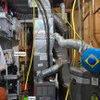
Here's a picture York furnace model with various information, this may be your furnace or it may not be. York makes a slew of different models, configurations and so on. You can't cheat if you need 1600 CFM or more air flow, put in a smaller furnace the blower on a smaller furnace is not capable of doing that kind of work.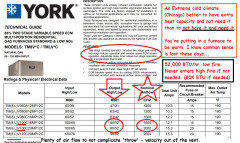
Air flow will effect temperature rise among other things like 'throw' out of the vent. Without proper throw (velocity) during climate extremes (really cold weather Chicago is known for) --- too small a furnace and you'd be ditching that after one really cold winter there.Down here in Katy, Texas it's more about air flow for AC. So furnaces are mostly an afterthought, depending on whether it's a cold bird or hot bird living in the home. Some people like it chilly here, some like it 78 or 80 degrees in the winter (if you could call it that here) because that is what they've grown accustomed to by keeping the house warm throughout the summer. (to save money on utility bills, living on fixed income etc.)
So is there a problem if you have a 60 degree temperature rise? nope. You may have furnace blast issues in mild weather, but knowing what your customer wants versus what they don't want? What would you call that? A menu perhaps? - PRO6 years ago
I am an HVAC professional and Austin Air can size my house anytime - But he ain't putting in no Nest thermostats!
IMPO
SR
Well I don't sell Nest thermostats. In fact I just condemned one a few days ago for a long time customer of mine. (home owner put it in.)
So the complaint was the furnace was making noise... but upon getting there the furnace fired off no problem, operating fine then all of a sudden cut out. ( The noise was more or less the constant restarting / attempt to restart -- you know box of chocolates type of thing.)
Went thru a weird sequence of trying to start multiple times all of a sudden started working again, maybe 3 minutes - then furnace shut down again.
Concluded the battery in the nest was failing, causing the goofy thing to steal too much voltage from the furnace causing the erratic behavior. I'll be really surprised if the nest is even still around in another decade. Google continues to lose money in that division.
If I was interested in getting more business it would be an easy way to garner service calls, that's for sure. But people that have the nest love them... but at $250 a pop I think that will wear thin after awhile. Warranty is only 2 years as far as I know.__________
With that said the particular York furnace I posted above only needs a single stage thermostat... so a two stage thermostat is not necessary, the furnace main board is capable of handling 2 stage heat on it's own. Likely a timed algorithm if I had to guess.
If the OP has a different model than what I posted I would think it would be similar features to the model I posted. - PRO6 years ago
"In case you missed it: I service the Katy, Texas area."
Why isn't this and similar solicitations considered spam by all?
I am listed as a PRO on this site. Just me responding to a post is a solicitation, but I respond to posts in areas of the country in which I do not service.
HVAC service is a local market type thing. Service is the magical word here.
I aide people in letting them know the area in which I service (Katy, Texas area)
Because? there are people who call me that don't post. (If you only knew, half of what I hear off this board.) I get calls from all over the place.
Note: If I am busy, the call will be short. Remember I am one guy and *my time* is limited. I run not one, but two different companies by myself. So please keep this in mind.(I also know alot of people do not want to get involved in the theatrics of this board.)
- 6 years agolast modified: 6 years ago
Re: Austin Air
“(I also know alot of people do not want to get involved in the theatrics of this board.)”
This is something for posters, trolls, etc. to keep in mind – and you know who you are! Trash the ‘Pros’ and they contribute less - or never more again.
Happens to me sometimes. Why bother when ‘no good deed goes unpunished’!
IMPO
SR
- 6 years agolast modified: 6 years ago
There are many Pro's here - including yourself - that help without trolling nor spamming.
- 6 years agolast modified: 6 years ago
" too small a furnace and you'd be ditching that after one really cold winter there."
Size the furnace for the load. Size the fan for what the AC (also determined by load calc) needs. The two don't walk in lockstep.
Let's say the existing oversized furnace has a blower appropriate for a 3 ton AC unit. I believe most brands offer a fan in a furnace of lower BTU output with the same air output as the larger furnace. The settings for heat and AC fan speeds can be different. So there's no such thing as "you need a larger furnace because of the AC" .
You don't believe in the necessity of load calculations. Building science engineers, better HVAC contractors, and building codes in many areas do.
Customers can choose who they want based on the level of skilled workmanship they want to have.
- PRO6 years agolast modified: 6 years ago
" too small a furnace and you'd be ditching that after one really cold winter there."
Size the furnace for the load. Size the fan for what the AC (also determined by load calc) needs. The two don't walk in lockstep.
Let's say the existing oversized furnace........
The two don't walk in lockstep..... yep, the furnace has separate settings for blower speeds for heating and cooling.
The problem is that you are trying to 'fit' your idea that a 30 year old furnace is over sized. 'Let's say:' doesn't make it so. Oh but the AC is a 3 ton. So you think this makes the furnace oversized in an 'extreme' winter climate???
Temperature rise of a furnace the range is 30 to 60 degrees. The temp drop of an AC is 15 to 20. You see a difference here?
I'm not there so I am assuming alot here too... but look at the facts of what we do know: a 30 year old furnace in the Chicago area has gotten a heck of a workout over the past 30 years. Not only was the furnace 30 years old, but also the house.
Building science in that time period is no where near today. Furnace technology is similar in some regards and exceptionally better in other regards.
So you keep the same size furnace but you put in a 2 stage furnace. The 2nd stage is insurance for those nights with wind chills in the -40 degree range.
-----------
The AC what about the 3 ton AC? it has separate blower speeds if need be maybe you raise the speed to 450 CFM per ton on cool. Chicago summers are nothing compared to Katy, Texas area. Why would I leave that place over 20 years ago?
I left there for a multitude of reasons. Why didn't I go to California? Because the climate there... no challenge.
Remember HVAC is not a one size fits all. Much of it is dictated by the extremes of the climate you're in.
If you put in a smaller furnace because the AC is say a 3 ton and you want to assume that the furnace is over sized... but to put this further into context...
Many 'older' homes in the Chicago area do not have air conditioning. If they do it's primarily window units. I know because I used to live there. That climate does not have half the problems in terms of air conditioning that the climate of Katy, Texas has.
We must have a properly sized unit. This is the danger of the internet. Let's not go to school and learn something, let's not become professionals, let's go around and sit in forum boards pretend that we know something and then spout this nonsense at our own free will.
We'll demote those that claim to have any intelligence on the matter, or do this kind of work professionally. In a world filled with 20 year old somethings running around with no experience (not alive long enough to have any), book learning is absconded because the evil school is in it for profit as well. We will all look to the forum boards to garner our knowledge from.
Then we'll all sit around and complain when the AC man comes, refute what he says and then complain some more when the 20 year old something does something and the proverbial heat wave comes or the vortex cooling wave.
This is what the HVAC business was built on: complaints. It's too hot, it's too cold.
In a cold climate like Chicago what are the odds of it's too hot or It's Too Cold?Oh you mean you can make a 5 ton furnace work with a 3 ton air conditioner ANYWHERE?
NO. re-read the entire thread. 'Key word above': anywhere. This is what an amateur does not understand.
Do not hire an amateur. Do not listen to an amateur. Rinse and repeat.
If you don't like these comments, you are probably an amateur. Here's my advice to you: find a new hobby.
I service the Katy, Texas area. - PRO6 years ago
Re: Austin Air
“(I also know alot of people do not want to get involved in the theatrics of this board.)”
This is something for posters, trolls, etc. to keep in mind – and you know who you are! Trash the ‘Pros’ and they contribute less - or never more again.
Happens to me sometimes. Why bother when ‘no good deed goes unpunished’!
IMPO
SR
People are people, if it's one thing I've learned in over 25 years. Some will never change. This board is proof of it.
My skin is thick, I've been called worse--- demoted worse --- treated worse beyond anyone's wildest imagination. This business isn't for amateurs. Period. I have nothing more to prove. Over 25 years in this business. Over 12 years running my own company. If you think I have something more to prove, you are a sad person. (not saying this to you SR... those people know who they are.)Everyone is entitled to their own opinion. Never been afraid to post my opinion here or anywhere. If someone wants to claim this as trolling.... yeah in a way it kind of is trolling.
Trolling for people with similar problems within my area of service that are looking for a no nonsense approach to solving their HVAC problem ---whatever it is---. (Katy, Texas area)
Posting here does a few things... people can read get an understanding of what I am about before hand. I am a no nonsense kind of HVAC company. If you like nonsense don't call me, you will not like the outcome.
Plenty of other choices you can choose from. Let me remind you though: There's no crying in baseball and there is also no crying in HVAC.
If you don't like me here, probably a good bet you won't like me in person either. I am ok with that. No nonsense for you --- means no nonsense for me either. It's not a one way street.Oh so it's Ray Austin's way or the highway? yep, I'm a pro. If I don't know better than you... all hope is lost. Have fun!
I don't do what I do only to turn around an make you fix it.
- 6 years ago
Chicago summers are nothing compared to Katy, Texas area.
Ray,
You are correct that Katy, Texas has a much longer hot season than Chicago. However it can get hot in Chicago also. You know when doing the load calculation for an HVAC systems you have to use the typical highest and lowest temperatures.
The summer design temperature for Chicago is 91. What design temperature do you use for Katy, Texas?
- 6 years ago
"What design temperature do you use for Katy, Texas?"
Haha. You've got a 6 paragraph response coming, the bottom line of which you probably know already. He likely needs to look it up when needed, it isn't something he often deals with. However, the problem is solved using a 2 stage furnace, you can put in something you can be sure is probably oversized and undersized at the same time without doing a load calculation.
- PRO6 years agolast modified: 6 years ago
"What design temperature do you use for Katy, Texas?"
Haha. You've got a 6 paragraph response coming, the bottom line of which you probably know already.
Design for Katy, Texas is 95 / 75. Means 95 outdoor with a 75 degree indoor temp.
As far as lengthy of a post? You're in a forum board and you come here 'not' expecting to have to read?
Sorry, Mr. Fudd I can't help you with having to read so much in a forum board.I do have a YouTube Channel if you're tired of reading..... I'm sure you'll have a complaint with that too. (Be sure to subscribe to my youtube channel if you like HVAC stories -- -- more stories coming soon.)-------- Back to the Temperature Design Question --------
However, due to humidity my area is as different from the Chicago area as night is to day.
Chicago area... many of those homes were built as summer cottages (long time ago) many of them now used as regular homes... probably not so much the OP's house as it was built in the 90's.Most of them likely have window units. The home I lived in during the mid 90's in Chicago area had radiator heat with a boiler in the basement. It didn't have air conditioning and due to the heating system would have been not worth the money to do it for such a short cooling season. We had window units in that house, like many other people did.
There is no means to make a living servicing window units. Cheaper to go buy a new one. Here in Katy, Texas many HOA's do not allow window units. So if you do that here, good chance if the HOA catches ya they start issuing their nasty letters. Wouldn't surprise me if Mr. Fudd was their president. LOL.
He's good at writing short complaints that require little reading.The other thing is the lows of the day here typically start in the upper 70's here sometimes as high as low 80's. So just looking at an average temperature chart is quite deceiving in terms of compare temps here versus there in Chicago.
95 design temp doesn't seem all that extreme compared to Chicago, until you live it.
I've lived in several places up / down the central USA. No one place is like another when it comes to climate.The point is with a 75 degree indoor design temp and humidity in the 70% range isn't all that comfortable. So there's much more to contend with here.
HVAC explanations isn't something you can put into a few words and garner any real information or understanding from it. You come to a forum board to read and if I didn't go to full explanation he'd complain my posts were just pre-written copy paste scripts.
Yeah another nitty gritty detail -- Other companies you call the person answering the phone has a script they go by. I actually answer my own phone.
The hard way is taking the time to visit a forum board reading posting, watching videos --- all a big waste of time (for you) not for me. This is what I do.
I'm not here to make it easy on detractors. They are playing a no win game. I've been posting on Houzz for years. If you think this is my first rodeo you're mistaken.I'm not here to teach someone how to do it. The information I put here is diluted, for a reason. I am in this business to do it for you. --- Not to show you how to do it.

The easy button if you will (if you live in the Katy, Texas area) -- Is to call me. It costs money. I don't run a charity, I don't trouble shoot systems over the phone. If you want to read about these subjects --- watch videos of the stories I have to tell with real service calls... The choice is yours to make. The time to waste is your decision. Mr. Fudd lives in a climate where he has to wait up to 6 weeks to get something installed. Can you imagine that for a climate like Katy, Texas? Yeah me neither. I promise I won't make you wait no where near that long.
I make no apologies as to the amount of time you will waste reading my posts, watching videos etc. This is why I often say: Time is more valuable than money.
Detractors on this board over the years I have posted here still have yet to understand even that concept. (This isn't what they do, they are bent on wasting your time... not wasting my time --- remember this is what I do.)
I service the Katy, Texas area. The home of 'better' HVAC service.






Stax