Software
Houzz Logo Print
sylviagrace

Yellowing Schefflera

6 years ago
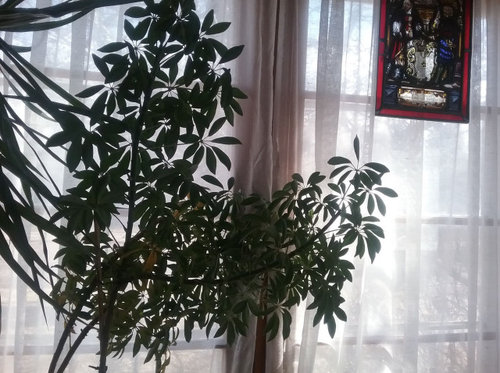
I bought this schefflera over 10 years ago from Walmart, when it was a scrappy little thing with just one trunk. Since then its thrived, but lately it's been a bit under the weather. My new cat (adopted a year and a half ago) had a bad habit of chewing on the leaves, so a few months ago my mom took it upon herself to pluck off a significant number of perfectly healthy leaves without asking me. For obvious reasons the plant didn't like that. It's still growing, but at a much slower rate than usual for this time of year. In addition, it shed a lot more leaves in this year's annual leaf drop than it has in past years and clearly isn't done yet.


Now, to address the elephant in the room. The potting situation is quite flawed since middle school me didn't bother to do any research before potting the schefflera up. There's no drainage holes in the pot, and I used a cheap, mediocre potting medium (I forget what exactly it is). 🤦🏻‍♀️ This summer I'm planning on doing a proper repotting, but if it keeps dropping leaves at this rate there won't be much left by the time I can take it outside for the repotting/checkup.


Any advice on what to do until this summer, as well as repotting tips, would be appreciated! The pictures aren't the best, but they're the best I can do with the devices I've got.


Thank you!


Comments (8)

  • 6 years ago

    I actually like the bending, especially the 90 degree one. I just wish there was something I could do to make the bottom half of the trunks look less barren without compromising the plant's growth/health and giving the cat irritating leaves to chew on. Poor floof looked rabid from the foaming in his mouth. 😕


    Is it OK for them to be that crooked? Would it make them any less stable when they're staked up like they are?

  • 6 years ago
    last modified: 6 years ago

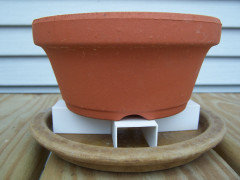
    If the plant doesn't wilt, you're not under-watering. I believe what you're seeing is a drought response caused by over-watering, or a high level of dissolved solids (salts from fertilizer solution and/or tapwater). Obviously there is no way for water or salts to escape the pot, and that always ends in disappointment for the grower. I would get a tall collection saucer. Drill or melt a hole through the sidewall of the pot AT the pot bottom. It's important that you remove at least a little of the inside bottom of the pot so there is no reservoir at the bottom of the pot to collect water. The pot should not sit on the bottom of the collection saucer as this allows a pathway by which the effluent flushed from the pot when you water can make it's way back into the soil.


    Something similar to what you see here. ^^^ I used a shallow collection saucer for a better view. There are some other tricks you can use to make your pot drain better, too. You could tip the pot after watering, which forces a lot of excess water from the pot. In the image below, the shaded area is saturated soil. Compare B to A for an idea of how much difference tipping the pot makes.


    You might also consider learning about how to use ballast in the bottom of the pot. Image D shows an overturned pot used very effectively as ballast. There's lots more to explore, but I don't know how interested you are, so I'll wait on questions or a response.

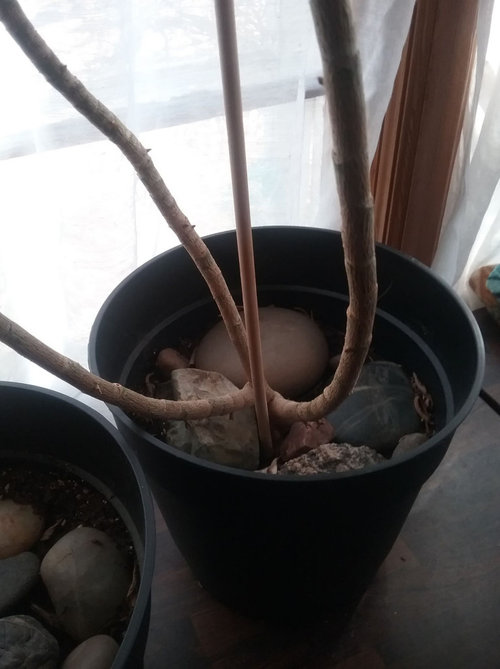
    FWIW - the rocks keeping your cat out of the pot should not be against the trunk. As the trunk thickens, it will grow around the rock. IOW, the trunk will thicken everywhere except where the rock is touching it. It wouldn't take long for sap and nutrients moving downward to roots immediately under where the rock is applying pressure to be affected.

    I applaud the plan to repot - good idea. Soil choice very very often makes the difference between success and bad news. Two things you might consider asap are flushing the soil, and start using a "tell" to "tell" you when it's time to water. I'll leave some info I wrote about using a tell and flushing the soil.

    Before you move ahead with pruning, maybe we could discuss some options?

    Using a 'tell'

    Over-watering saps vitality and is one of the most common plant assassins, so learning to avoid it is worth the small effort. Plants make and store their own energy source – photosynthate - (sugar/glucose). Functioning roots need energy to drive their metabolic processes, and in order to get it, they use oxygen to burn (oxidize) their food. From this, we can see that terrestrial plants need air (oxygen) in the soil to drive root function. Many off-the-shelf soils hold too much water and not enough air to support good root health, which is a prerequisite to a healthy plant. Watering in small sips leads to a build-up of dissolved solids (salts) in the soil, which limits a plant's ability to absorb water – so watering in sips simply moves us to the other horn of a dilemma. It creates another problem that requires resolution. Better, would be to simply adopt a soil that drains well enough to allow watering to beyond the saturation point, so we're flushing the soil of accumulating dissolved solids whenever we water; this, w/o the plant being forced to pay a tax in the form of reduced vitality, due to prolong periods of soil saturation. Sometimes, though, that's not a course we can immediately steer, which makes controlling how often we water a very important factor.

    In many cases, we can judge whether or not a planting needs watering by hefting the pot. This is especially true if the pot is made from light material, like plastic, but doesn't work (as) well when the pot is made from heavier material, like clay, or when the size/weight of the pot precludes grabbing it with one hand to judge its weight and gauge the need for water.

    Fingers stuck an inch or two into the soil work ok for shallow pots, but not for deep pots. Deep pots might have 3 or more inches of soil that feels totally dry, while the lower several inches of the soil is 100% saturated. Obviously, the lack of oxygen in the root zone situation can wreak havoc with root health and cause the loss of a very notable measure of your plant's potential. Inexpensive watering meters don't even measure moisture levels, they measure electrical conductivity. Clean the tip and insert it into a cup of distilled water and witness the fact it reads 'DRY'.

    One of the most reliable methods of checking a planting's need for water is using a 'tell'. You can use a bamboo skewer in a pinch, but a wooden dowel rod of about 5/16” (75-85mm) would work better. They usually come 48” (120cm) long and can usually be cut in half and serve as a pair. Sharpen all 4 ends in a pencil sharpener and slightly blunt the tip so it's about the diameter of the head on a straight pin. Push the wooden tell deep into the soil. Don't worry, it won't harm the root system. If the plant is quite root-bound, you might need to try several places until you find one where you can push it all the way to the pot's bottom. Leave it a few seconds, then withdraw it and inspect the tip for moisture. For most plantings, withhold water until the tell comes out dry or nearly so. If you see signs of wilting, adjust the interval between waterings so drought stress isn't a recurring issue.

    Flushing Soils

    When you water, you should be able to flush planting's soil to eliminate the potentiality of salts from fertilizers and tapwater accumulating in the soil, thereby limiting the plant's ability to take up water and the nutrients dissolved in the water. If you think you shouldn't flush the soil during your regular water applications for fear the soil will remain saturated for a lengthy period, limiting root function or worse, you should consider a different soil or take steps to reduce the amount of excess water your soil can hold. By whatever means necessary, getting to the point you can water correctly is going to make a very big difference in the opportunity to realize as much of it's genetic potential as possible. Once you can water correctly, you no longer have to do battle with a water-retentive medium over control of your plant's vitality. There are several methods of limiting how much water your planting can hold, all but 1 or 2 are completely passive, requiring no effort on your part other than set-up, which is monkey easy. I can help if you have interest in that, I'm continually improving my proficiency at monkey easy tasks.

    To flush the soil of a planting: Water with room temperature water until the soil is completely saturated. Allow the planting to rest for 15 minutes to an hour to allow as much of the salt accumulation as possible to go into solution, then pour a volume of room temp water equal to at least 10X the volume of the pot the plant is in slowly through the soil. This will remove most of any accumulation of offending salts and resolve any skewing of nutrient ratios.

    It's a good idea, no matter what time of year, to fertilize most plants immediately after flushing the soil. Try to be sure you're using a fertilizer that has a ratio as close as possible to the ratio at which the plant uses nutrients. The NPK % listed on fertilizer packaging is not its ratio. 7-7-7 and 14-14-14 are 1:1:1 ratios. 9-3-6, 12-4-8, and 24-8-16, are all 3:1:3 ratios. Container growers should try very hard to avoid use of fertilizers advertised as 'bloom-boosters', or any number with a middle number (Phosphorous) higher than either the first or third numbers (Nitrogen or Potassium). These fertilizers can badly skew nutrient ratios with even the first application). On average, plants use about 6x as much N as P, so there is NO potential for a positive outcome when supplying many times as much P as the plant requires. I, and a large number of other members, use Dyna-Gro's Foliage Pro 9-3-6. It's designed to closely mimic the uptake ratio of the average plant, and has many other attributes not commonly found in other fertilizers. It also has ALL of the nutrients essential to normal growth. Summarized, it makes fertilizing as easy as it can be, and from 1 container.

    Al

  • 6 years ago

    schefflera are toxic to cats, as a majority of plants are actually. gotta do some research if you have a pet that likes to nibble on leaves :(


    now, if you don't want to cut it back too much/ get rid of the leggy trunks, but you also want more leaves at the bottom, you can cut some stems and/or leaves and propagate them, once they are rooted enough you can add them to the bottom of this plant. propagating your plant and growing new ones is also a good idea if a plant seems to be going down hill, so that you're left with something. although, aside from the yellowing leaves that only seem to be at the bottom, which is a good sign, this plant looks fine, at least from what i can tell from the pics


    in my opinion you could probably cut where i marked and it would still look nice, and grow those to to add at the bottom. its early spring so now would be a good time to prune it anyway :) goodluck~

  • 6 years ago

    Thank you all for the responses! The schefflera predates Sommerfeld, the cat who nibbles leaves, by 8-10 years. Heisenberg, the cat we had before Sommerfeld, never ate the plants but did pee in the pots, hence the rocks. I thought about getting rid of the schefflera when I caught Sommerfeld chewing it, but I couldn't bring myself to do it. This plant, and scheffleras in general, are very sentimental to me.


    I'm definitely interested in learning more about things like ballasts (which I've never heard of before in relation to plants)!

  • 6 years ago

    what they all said ... with a few extra comments ....


    if those shear drapes are never opened .. it may have enough light to survive.. but not enough to thrive ... if you decide to open them ..... do it in stages... to harden off the plant to the new light levels ..


    i suspect the big rocks are in the pot so they dont tip over.. otherwise.. they do nothing for the plant .. but do indicate how much the soil had been used up .. without them.. it looks like the pot is half empty of media ... and that is not good for this giant houseplant ... used up media doesnt move or hold water like fresh media ... and can lead to all kinds of problems.. just like you are asking about ...


    on some level.. you are too emotionally attached to this plant .. IN THE FORM IT IS NOW ... i highly agree with the comments of not only cutting it back severely ... [which would really help with the repotting} ... but also propagating some of the cuttings .. and thereby making clones of the original ... exact duplicates ... sometimes plants ... especially houseplants.. just get too old .. and making a fresh copy is the way to go ... [we run across this often.. when people get grandmas old plant]....


    here are some videos about such: https://duckduckgo.com/?q=Schefflera+propagation&t=ffcm&iax=videos&ia=videos


    and yes.. a better pot would really help ... when you repot ...


    the problem with repotting a tall large plant ... is getting it to actually stand up .... in the new loose soil .. ergo.one of the reasons to shorten it ...


    what can i say about the cat .. crikey ... if the plant makes you foam at the mouth.. jeez dude.. stop eating it ...


    ken


    ps: you arent going to get it to releaf down low... unless you cut it back down low.. and let it regrow from there ... you could do it about 6 inches up form your favorite bends .. and see what happens.. and then propagate the cutting.. so if you screw it all up .. well.. you have a couple new ones ...

  • 6 years ago

    I'm definitely interested in learning more about things like ballasts (which I've never heard of before in relation to plants)!


    More about ballast.

    Al

  • 6 years ago

    Move it outdoors when it is warm enough. Do like Dave mentioned (maybe not all the way back but at least half). You will be amazed at how fast these grow.


    Here is my mother's in her basement the middle of Feb. I don't know how may times she has cut this back. She has let it get to 5 feet tall and can't take it anymore so off with its head(s). I think she gave it to one of my sisters as it got too big for her. She will be 88 later this year. I think the plant is probably 30+ years old by now and the trunks were probably 2 to 3 inches in diameter.


    Here is a bird's eye view on a courtyard of the hotel we stayed at in Puerto Rico. The red veins are the blooms of the mature plants.


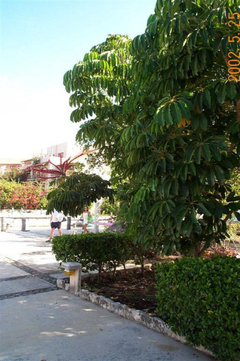
    A street tree in Cancun.


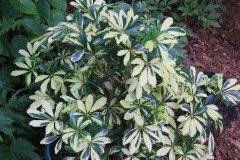
    the smaller variegated ones (S. arboricola) are treated like hedges in lots of tropical places such as Orlando in public access roads to hotels (and the hotels as well).


    I lost mine when I tried to bonsai it for growing it over a rock. I should've let it alone as it was in this last year I had it.