Software
Houzz Logo Print
kevin6958

Confounding Crape Myrtle (half sprouting, half not)

Curious what you think about half of the stems on this crape myrtle sprouting, and half not.


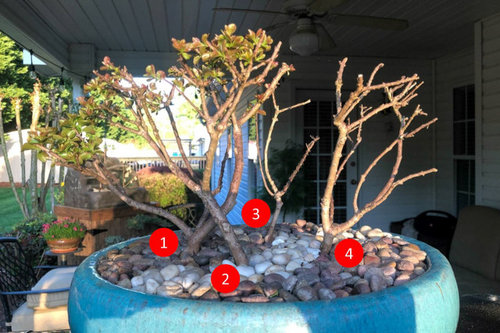
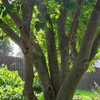
This plant was purchased as a 3-gallon variety and potted, as you see it, late last summer. I chose this particular plant because of the 4 stems having the appearance of 4 distinct/separate "trees" when viewed in a miniature setting. Aside from bottom-up root pruning, I made no other alterations to the root ball. In other words, I did not separate the 4 stems - they were already arranged/composed to my liking.


I did not attempt to shape/prune the plant when planted; I decided to wait to do all initial pruning at the same time I pruned my other ground-planted crape myrtles, which I did on February 9th this year. All 4 stems appeared equally healthy throughout last summer, through the fall and into early winter - all were equally leafy and each stem bloomed together as I would have expected.


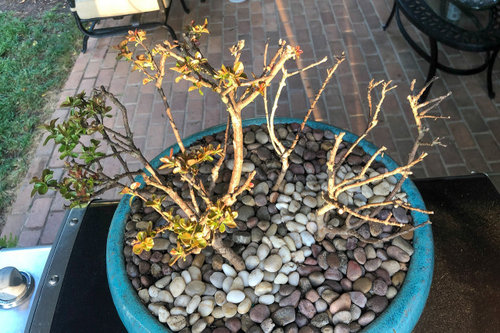
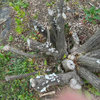
But I'm confounded that only stems #1 and #2 are sprouting. There is still not a sign of any sprouts on stems #3 and #4. Given that I never separated the stems, the entire root ball received the same treatment through the winter (same watering, etc.). What's got me really confused is that to the touch and feel, stems #3 and #4 are totally pliable when gently bending - no cracking and no breaking. Just to be sure they weren't dead, I pruned those stems again 4 or 5 days ago to see what the wood looked like, I cut each branch/twig back ~3/4" to 1" and every cut revealed green wood. To rephrase that, stems #3 and #4 are not dry wood.


Stems #1 and #2 are behaving exactly as I would expect by sprouting right on time along with every crape myrtle in my region.


Your thoughts?


Comments (9)

  • 6 years ago

    i wonder if they buried trunk material ... for visual impact .....???

  • 6 years ago

    Only theory, but maybe they're actually separate plants and just waking up on THEIR schedule, not yours.

    If they're actually one plant, then you may have planted roots deeper than they were originally and the plant is exhibiting suffocation symptoms.

  • 6 years ago
    last modified: 6 years ago

    ken_adrian, Can you rephrase your comment, please? Are you suggesting stems 3 and 4 were just stuck into the original 3-gallon pot to appear as live stems? No, its just a multi-stem crape myrtle that's grown its whole life as a single, contiguous root ball.


    dbarron, I suppose the theory is possible, although I do believe all 4 stems are the same species of crape myrtle. As I mentioned, the original root ball was in a 3-gallon pot (sourced from a local nursery) in which the overall "depth" of the roots/root ball was much "deeper" than what you see here ... the entire root ball was pruned bottom-up equally to fit this pot as a bonsai specimen.

  • 6 years ago

    If left in the container outdoors all winter, it is possible the plant experienced some cold damage. Plants grown in containers are much more vulnerable to cold temps because of the exposure to very low ambient air temps and the lack of any insulating soil mass.

  • 6 years ago

    gardengal48, Understood, and agreed. Yes, it lived outdoors through the winter.

  • 6 years ago

    Can you rephrase your comment, please? Are you suggesting stems 3 and 4 were just stuck into the original 3-gallon pot to appear as live stems?


    ===>>> ill try ... lol


    if you have a shrub or tree... that has one trunk at the root flare ...


    https://duckduckgo.com/?q=root+flare&t=ffcm&iax=images&ia=images


    you can not plant the trunk deeper ... its made to be in the air .. not underground ...


    i was thinking maybe they ... you clearly said it came this way ... buried it to deep ... to make it look like this ...


    BUT .... shrubs often grow like this ... and they are actually individual trunks.. properly planted ...


    i dont know ... so i asked you what if anything you observed if you repotted it ... i dont quite understand if it was potted as we see it.. or you repotted it???


    the only thing for sure.. in that it was fine last year.. but suffered after winter.. that winter was a big part of the equation ...


    i might take a tablespoon ... and look around the trunks a few inches down .. and see if anything is interesting ....


    ken

  • 6 years ago

    The same happened to me a few years back after we had a very hard frost in April. Be patient; I’ve also had one tree leaf out much later than the others.

  • 6 years ago

    It's not unusual for some roots to suffer cold injury or root rot that A) affect individual stems or branches on 1 shrub, or B) when there is a single trunk with several branches that appear to be individual trunks, affect only one or more of the branches.

    In some woody plants, like Thuja and Juniperus, there is a distinct/direct relationship between branches and roots, such that when the center rots out of very old trees, the live veins connecting roots to branches are all that remain. In other species, water is more often able to move more laterally in sapwood/xylem which tends to somewhat soften that direct hookup from root to branch (Acer). I thought I'd throw that in, even though I don't know how direct that relationship is in Lagerstroemia.

    Al