Software
Houzz Logo Print
delane_jenkins

Should I cut down this oak tree?

6 years ago
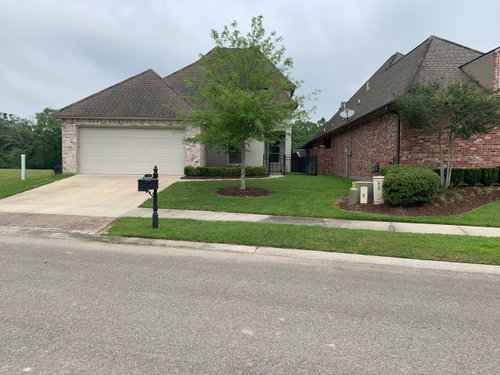
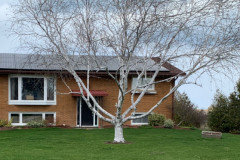
Hello everyone, I’m looking for ideas to increase the curb appeal of my new home. One thing I’m considering is cutting down the oak tree in the front because it blocks what little street view there is. What do you think?

Comments (25)

  • 6 years ago

    You might try cutting off some of the lower limbs first...

  • 6 years ago

    I wouldn't. As it grows and gets taller the view will open .

  • PRO
    6 years ago

    A tree getting taller does not change any limbs position. They remain in the same position relative to the trunk throughout the life of the tree. However, as limbs grow longer every year, they get heavier, bend and hang lower. For most cultivated trees, lower limbs should be removed every year as they grow. You can remove them from the lower trunk for up to 1/2 of the total height. By summer's end, the tree will be larger and the remaining branches hanging slightly lower ... so it won't be 1/2 clear trunk anymore even though you created it in the Spring.

  • 6 years ago

    No. Limb it up as it grows taller -- very easy to do. Eventually it will be tall enough to no long need limbing up, and it will be a valuable asset to you and your neighborhood. A well formed, mature, long-lived tree such as an oak is a great selling point!

  • 6 years ago

    Different trees act differently in different areas. Our oaks grow taller, the limbs don't bend or hang lower. Trees that survive in my area limbs grow up in a V shape. If not the heavy snow would break the branchs in the winter. Your oak is a baby. Give it time before you start cutting off branches.

  • PRO
    6 years ago

    "Different trees act differently in different areas. Our oaks grow taller, the limbs don't bend or hang lower." Apparently, the different area we are talking about is on another planet without gravity. Because here on earth, no wood, especially wet, green wood, resists bending when more length and weight is added to its unsupported end. Just looking at the tree above confirms that this is the case here, too. Its lower limbs started out, much like its upper limbs, in an upward direction, because that's how all plants grow. Now they're hanging downward. The problems with not dealing with removal of lower limbs on a timely schedule is that the job becomes harder with each passing year, and sometimes a limb or a branch coming off of it, will decide to compete with the trunk and grow skyward. This frequently decimates the tree's appearance when it finally must be limbed up.

  • 6 years ago

    Definitely do not cut down that tree. Let it grow, as it gets taller, remove the lower branches. It will take 15+ years, but it will get there, eventually. That tree is beautiful. Keep it. You can also add some landscaping around that tree. That would give you something beautiful to stare out at.

  • 6 years ago

    Also, maybe you could have a larger window installed in place of your current window? That would help with your view as well as natural lighting into your home.

  • PRO
    6 years ago
    last modified: 6 years ago

    As an example, here's a tree (copped from another thread) that needed then lower limbs removed many years ago ... when the limbs were young. There's no way it can be made good looking now. And its structural form wouldn't work well with any house.


  • 6 years ago

    Yardvaak, that is not a picture of an oak tree. And never around here do oak trees grow like that.

  • PRO
    6 years ago

    Of course it's not an oak. It's a birch. It's a picture of the worst limbing habit a tree could possibly have. It illustrates one of the major problems of neglecting lower limb removal as the tree grows. Had the lower 5 limbs been removed when the tree was 8'' or 9' tall, it could have been normal. Now, it's a pariah of the tree world until it's demise. This same condition happens with oaks, as it does with many other trees. We see it all over Florida and I'm sure, everywhere.

  • 6 years ago

    You are comparing apples to oranges. An oak is not a birch. Heck our birches even grow as your picture. There are 90 natural oaks varieties in the US . And lord know how many of the 900 varieties in the world that are not natural the US, but here. You can't compare a oak grown in the south to an oak in the north or any other region. It is like saying all rose species grow and look the same everywhere. Our oaks trunks grow up raising the tree canopy up. The OPs tree is a baby and a nice shape. He should wait. Then if he feels neccessary years down the road, have a professional trim any low branches. The tree presently offers at least some privacy in what looks like a over built neighborhood.


  • PRO
    6 years ago
    last modified: 6 years ago

    "The tree presently offers at least some privacy in what looks like a over built neighborhood." You mean a neighborhood like almost every one built today? And a tree that hides so much of the house, including important architectural details, that the garage door becomes the home's prime feature by default ...? No one's disagreeing that the tree is a nice shape. It's lovely. But it has job to do and is nowhere near its final shape and size. I'm not suggesting to change its shape. I'm suggesting to to use the tree's natural growth progression to transition the same shape into a larger size in a taller tree. If the tree is going to grow 3' taller this year (if left to its own devices) then by clearing the trunk of 12 to 18" of bottom branches, the tree will grow an additional 12" to 18" taller for a total yearly height increase of 4' or 4 1/2' ... instead of 3'. It is like taking from the bottom and putting onto the top. Instead of realizing at the end of the summer the tree is overdue for a haircut, it finishes the season by growing to a handsome proportion. I'm advocating anticipatory pruning as opposed to reactionary pruning. May way is physically easier as well as works better for correcting structural problems in the making.

    As far as the birch tree, it is a general tree FORM ANALOGY and has nothing to do with whether a tree is from the North, South or anything of that nature. It is simply about a pole with branches and how one wants those branches to form. Does one want a permanent canopy created from branches that come off of the trunk at a point below one's head height ...? I don't think so.

    "Our oaks trunks grow up raising the tree canopy up." Whatever does that even mean?? It doesn't comport with any tree physiology that I know of. You can't know what you're talking about here.

  • 6 years ago

    Do you know the type of Oak? They have different canopy shapes.

  • 6 years ago

    Hey I do feel your pain with the placement of that oak tree. That's not ideal, and you clearly wouldn't have chosen that spot. I think there are people on here who would literally pay you not to cut that tree down and I might even be one. Seriously though, aside from how important a shade tree like that is to the world, I think what others are suggesting on here about how it will grow taller and you'll be able to remove the lower limbs more successfully for a higher canopy and more open look is your way to win in the long run. And hey, it's an oak tree--the long run is the name of the game. Please, though, please please don't cut that tree down.

  • 6 years ago


    Yardvaark , I am going to make this as simple as possible so maybe you can understand how a tree grows.

    "Our oaks trunks grow up raising the tree canopy up." Whatever does that even mean??"

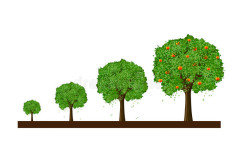
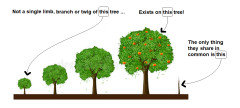
    OK, the brown part of the tree in the picture is called the trunk and the green part is called the canopy. As the tree grows through cell division the trunk expands and lengthens.. Same with the branches and through bud formation produces additional branches. Sorry, i should mention that the branches are the green part that makes up the canopy. Got that? As you can see by the picture as the truck lengthens the canopy raises up higher from the ground level.. See the difference from the first tree on the left to the last tree on the right. The trunk has lengthened and the canopy raised. If a 6 ft tree is planted and the lowest branch is only 3 ft from the ground the lower branches aren't always going to stay 3 ft from the ground.

    "If the tree is going to grow 3' taller this year, if no one does anything, then by clearing the trunk of 12 to 18" of bottom branches, the tree will instead grow 12" to 18" taller".

    Sorry, to inform you the lowest branches have nothing to do with the height of the tree. They only contribute to the width of the tree. If a tree grows 3 ft in a year, cutting off the lowest branches is still not going to effect the growth . It will of still grown 3 ft, part from the trunk and part from the formation of the top of the canopy. If you wanted to shorten the tree you will need to cut off the top of the canopy.


    " You mean a neighborhood like almost every one built today? "

    That is why areas are mandating hard spaces and green spaces. In our township a cookie cutter housing plan the frontage must at least be 75 ft. There is also a percentage of green space per lot to hard space. And # of green units per lot installed, plus open green space in the plan, and green buffers. These regulations must be meet before anyone can move in.

  • PRO
    6 years ago
    last modified: 6 years ago

    At least, Functionthenlook, you served one important function and brought to my attention a point I did not state well in my explanation of the rebalancing of a tree's stored energy, and I'll clarify it. It should have read: If the tree is going to grow 3' taller this year (if left to its own devices) then by clearing the trunk of 12 to 18" of bottom branches, the tree will grow an additional 12" to 18" taller for a total yearly height increase of 4' or 4 1/2' ... instead of 3'. (The numbers are arbitrary but reasonable and the principle holds true ... prune growth off of a tree with a fully developed root system and a proportional amount of growth will grow back on the tree somewhere else, usually at the top as that's where the action is. It may not be a 100% return, but it will be substantial.)

    "See the difference from the first tree on the left to the last tree on the right. The trunk has lengthened and the canopy raised. If a 6 ft tree is planted and the lowest branch is only 3 ft from the ground the lower branches aren't always going to stay 3 ft from the ground."

    Fortunately, you included a diagram and an explanation of the process of tree growth so I can better understand your thinking. However, you are as wrong as a ... uh, dirt milkshake!


    As a matter of fact, the only way the bottom of the canopy (the green part :-) appears to have moved farther away from the ground, is that someone cut branches off or some animals ate them off, or they might have been shaded out from the canopy and nearby trees, as would happen in a forest.

    Never before has it dawned on me that someone's complete misunderstanding of woody plant growth would be a prime motivation for their wanting to keep those lower branches .... waiting for the darn things to move up! But it does explain why they might want so badly to keep them.

    It's been a treat to have been punksplained!

  • PRO
    6 years ago
    last modified: 6 years ago

    Here we can literally watch a tree grow 5 years in one minute. Note that at 10 and again at 20 seconds, a year apart, all the lower branches are pruned off of the tree. Note that no branches move up from their original position of attachment on the trunk. Note that when the growth comes out in the Spring, the limbs and branches are aimed in an upwards orientation. Over the course of the growing season, all the branches gradually hang ever lower. (Visible during the last two years of the video when the branches are larger.)

    There is never any stretching of the trunk and a corresponding upward movement of a limb's position. (The only stretching/elongation that occurs is in the new, fresh tip growth of branches. As soon as it becomes woody, there's no more stretching.)


  • 6 years ago
    last modified: 6 years ago

    And we have a winner.....Yaaaaaardvaaaaaaark!


  • 6 years ago

    PS-please don’t cut the tree down. Hire someone who does this professionally- (hint: not the person says things like the “green part”) -and not just your regular yard person. I had a palm badly deformed by someone who did not know what they were doing! In a couple years I’ll be 8’ taller...and will look amazing. I’d buy that house for sure.

  • 6 years ago

    "Note that no branches move up from their original position of attachment on the trunk"

    Wow Yardvaark you missed your calling. You should of been a politician. No were did I say that the branch changes position of attachment on the trunk. Limbs just don't reposition themselves on trees. I said the trunk lengthens.

    Let just agree to disagree.

    Yes, sometimes branch do need to be removed to benefit the tree, but not for vanity purposes. Trees know what they are doing they have been growing and surviving very well in our great forests in the north long before you and me without someone coming along lopping off their branches.

    I bet you are also in favor of lopping off the bottom branches of pines also.

  • 6 years ago

    Although having major branches coming off the trunk all at the same level is not ideal the main problem with the birch shown here is it is missing a bunch of branches from the center, giving it a hollowed out appearance. Them being bark interest trees above all else - when used as decorative elements - birches should be grown to have as many branches as possible. Including often having a low forking habit. Same as with paperbark maple and so on - single trunks with elevated crowns do not produce the same level of visual impact, in terms of the bark.

    Also birches are not well adapted to branch loss, so that cutting branches of very much size at all produces lingering wounds that are not covered over very effectively by the tree.

  • 6 years ago

    Geez. Somebody’s been in quarantine too long.

  • PRO
    6 years ago
    last modified: 6 years ago

    "No were did I say that the branch changes position of attachment on the trunk. Limbs just don't reposition themselves on trees. I said the trunk lengthens." "Let just agree to disagree."

    We're disagreeing because you're wrong about your main thesis. When I said, "...change position of attachment ..." I'm making the point that branches do not move up FOR ANY REASON, be it the trunk lengthening or the branch taking a walk. I'm covering ALL the bases, in case you decide to land there next.

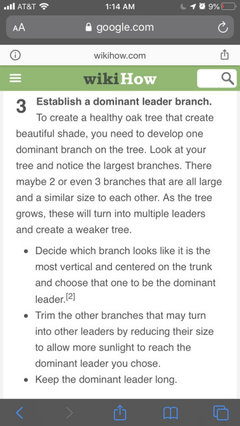
    "Yes, sometimes branch do need to be removed to benefit the tree, but not for vanity purposes." Let's make our disagreement here, clear, too. Appearance IS a major reason one removes lower tree limbs. The trees are working for the house. Their job is to shelter, frame and show it off as much as possible ... not screen off its most important features. And trees are working for people. They should be trying to stay out of their way as much as possible.

    "... cutting branches of very much size at all produces lingering wounds ..." This is explicitly another reason that the task of removing lower limbs on a timely basis, when their cross-section diameter is the smallest, is the best policy. Not only does it prevent low limbs from transitioning into awkward trunks, As soon it is recognized that the limb will not fit the final tree from, but is otherwise in the way of ground activity, and it's job is taken over by other limbs, it should go. Which would be true -- As a general rule, homeowners, A) keep up with tree maintenance on a timely basis, or B) They don't. ...? It's clearly the latter and by a wide margin. A hundred trees experiencing some level of neglect can be found for every one that is maintained on time. There's not much point in encouraging people to delay maintenance. They overwhelmingly already default to that position.

    I have to disagree that the birch problem is because it is missing limbs from its interior. Even if it had those, its form would still be defined by the existing limbs. It's ugly on account of being a single trunk tree starting its wide spreading canopy structure at 4' off of the ground ... centered in front of a sizable house. If compared in a line-up with other possible tree forms, its attractiveness level would rate at the bottom.