Software
Houzz Logo Print
jonathanmitchem

Leveling a shaded PNW lawn

6 years ago

I'm looking for some advice to level and reseed my backyard lawn in the PNW, Portland metro area. I have a somewhat acidic alluvial soil, with large river rocks interspersed here and there at least 2 feet down. (Fun to learn while preparing garden beds.)


Background:


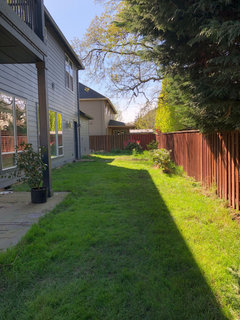
The lawn is 20' deep by 80' wide, on the north side of the house. The parts I care about most are in full shade except for midsummer. When the house was built 3 years ago, it was graded, got a small (4"?) layer of topsoil, and was sodded with TTTF. The first rainy winter, the whole yard was infected with leaf spot and the whole yard thinned considerably.


The following year I addressed some of the worst draining areas with a solid-tine aerator and plentiful sand, and then every three weeks did a light topdressing of sand, fertilizer and TTTF seed over the whole yard. This did work well to level and fill most things in. The areas that got tined and sanded have not had any problems since. This looked ok the first year.


The second and third winter the lawn thinned out again and a mix of poa trivialis and creeping bent moved in. A few remaining clumps of poa in the shade, and creeping bent everywhere front and back. The back lawn became increasingly bumpy each year.


I bought new seed awhile back; a mix of colonial/browntop bent, slender red fescue and chewing's fescue, working off agronomy research (home lawns, and golf fairway/rough) in Washington and Oregon, and referencing stuff from parts of the UK that match our climate well. I was afraid the bent might be too old but I got nearly 100% germination in my very unscientific paper towel in plastic bag test.


My wife prefers the thinner blades of a fine fescue and I'd rather work with bentgrasses than against them if I can. That mix should work as well in the sun and the shade in our climate, be relatively manageable up to about 2 or 2-1/2", and the color should be pretty close to the creeping bent if/when it does invade again.


Questions:


1. The only effective way so far to break up the high spots has been with a thatching rake. I tried using a roller but that's not doing the job on its own. Currently I'm thinking to mow low, break/crumble all the high spots with a thatching rake, topdress with 1/8 to 1/4" sand, and then roll all that down and reseed. It won't fix my drainage issues but it should smooth things out. Does the plan make sense? (Or would I be better off with aggressive core aeration and removing the cores, then topdressing? Or something else?)


2. Should I actually kill the existing creeping bent/TTTF before reseeding or am I fine just overseeding with the new mix? The leveling procedure above should do a number on it anyway, but if I need to kill it, I should probably do this first.


3. Once upon a time, I planned on trenching and putting drain tile in. Herringbone pattern to the back fence and tying into the existing french drain on the side. Was going to surround with pea gravel and top with sand, then topdress the rest of the yard with sand. However, I'm not sure I care enough about using the lawn during the winter and it's dry by spring, so I don't know if I still want to do this. But if I did do this, would it be better to do this before doing any of the above?


Thanks for any and all advice.

Comments (19)

  • 6 years ago
    last modified: 6 years ago

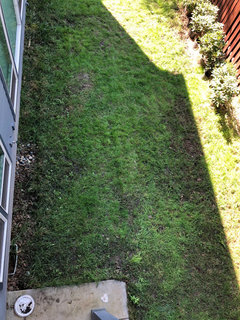
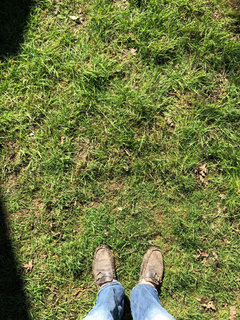
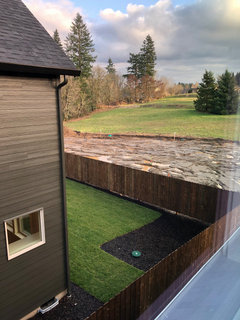
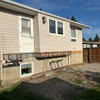
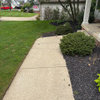
    I'm not sure why the resolution is so bad, but the swathes of dark green is TTTF, light green is creeping bentgrass, and the occasional clump of bright green (e.g., near the patio) is poa trivialis. And then the brown is exposed dirt.

    I couldn't capture a photo of any of the bumpiness, which is generally toward the back/top of the photos, but at its worst they are clods and depressions that are nearly 2" from top to bottom. Most is in the 1/2" to 1" range.

  • 6 years ago

    I was hoping Gardengal would pop in to help you. She's in the PNW and usually is first to catch posts like yours.

    Here's how they level bermuda grass lawns in the south. 1) Fertilize and water it in (Bemuda can use all the fertilizer it can get, so you might skip this step if you fertilized in late fall. If you did not, you could put down some organic fertilizer now). 2) Scalp as low as possible. 3) Cover with sand. 4) Spread sand with a drag (basically a board with some weights on it and maybe pulling some chain link fencing behind). Get it as level as you can filling the holes and knocking off the high spots. 5) Water the sand to settle it. You will notice some low spots. Remember where those were. 6) Add more sand to the low spots and water it again to settle. If you still have low spots, repeat 4-6 until you are happy. Then stay off of it until the grass returns. Sand is easily kicked around but once the grass is in, it cannot be moved.

    No rollers are needed.

    If you were to mix some seed into the sand, this project might work for you.

    For the central Midwest and east across to the Atlantic, this would not work this time of year, but for the PNW and the far north, it should work.

  • 6 years ago
    last modified: 6 years ago

    Consider replacing the grass in this full shade part of your lot with concrete pavers set in sand - you are never going to be able to maintain a dense lawn on the north side of a two story building in Portland. And that would give you a nice big outdoor sitting area for use during hot weather. With room for tables and chairs.

    Jonathan M thanked Embothrium
  • 6 years ago

    We had a light rainy day over the weekend that turned the worst bits back into a slippery muddy mess, so I decided I am going to start trenching and putting in drain tile anyway. So the plan is now, subsurface drainage first, then topdressing/leveling, then reseeding. With probably regular sand topdressing for awhile.


    @Embothrium I think you may be right. In the back of my mind, I already have plans for an outdoor sitting area, but that's still awhile off. I'm ok with the nice dense lawn by the street and something thinner, firmer, and "green enough" on the back side. We had to do our first easter egg hunt with our toddler in the park because our back lawn wasn't usable, and I'd like to make it more usable. Usable in this case meaning, mostly, not muddy and not bumpy.


    @dchall_san_antonio Thanks for the step by step. I'd picked up a good portion of that reading through old threads (which you appeared in often), but somehow missed the "drag" part of that. I'm having some trouble picturing how that looks with the chain link fence. The board with weights is definitely doable though; a bit trickier with such a narrow area but doable.

  • 6 years ago

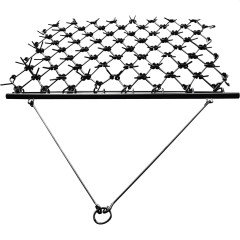
    Here's one that Northern Tool sells.

    The spiky things on the chain are meant to dig lightly into the surface, but in reality they immediately bend backwards creating a sled effect. If the soil is soft enough, the chain drag will still work.


    You should not need extra top dressing. That's a common mistake that even professionals make. I think they get paid extra for top dressing, so they include it.

    Jonathan M thanked dchall_san_antonio
  • 6 years ago

    Thanks. I learned they also go by the name drag/chain link harrows too. And I read that for cricket pitches, they sometimes literally just drag a weighted ladder across the surface to smooth things out too.


    For my project, I'm unfortunately way ahead of myself.


    After working on it on and off last week, I'm currently a bit more than halfway done putting in drain tile. It's been slow going. Hard clay and occasional large stones and working around sprinkler lines and heads.


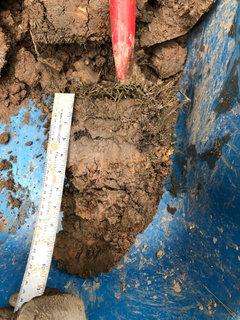
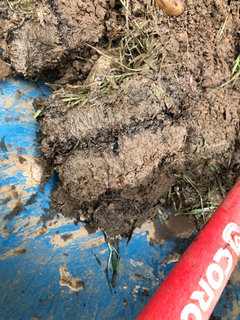
    In the process, I've discovered both how shallow and how impermeable the clay layer is. In some areas there's maybe no more than an inch between the surface and the hard clay The surface is muddy, then you can see the black layer where all the grass roots reached and died, and then it becomes much drier and crumbly. So I've got a lot more work ahead of me besides just leveling and reseeding once the drain lines are in since right now there's nowhere for the roots to even go.


    Brainstorming at this point:

    So I'm putting in the drain lines with a 4-5" sand cap to the surface. I'm probably going to then use my edger and make sand slits running across the lawn every 6-12" so the water can move laterally to the drain lines in the first place, since this current soil has so little water movement.
    And then top all of that off with a layer of sand to firm up the surface so the water doesn't have to move far to get to the sand slits in the first place. That should take care of the "drainage" bit.


    Then spend an annoyingly long time using my manual solid tine aerator to punch a layer of sand down and create some sand filled plugs for the roots to go down into. And then probably top all of that with more sand to get everything level. And then actually start the seeding and growing process. (Somewhere in there, I'll probably attempt to do a little work breaking up the high spots and leveling the existing soil before topdressing it.)


    This might all be an exercise in futility when it's said and done, but at least it gives me something to do.

  • 6 years ago

    I will just add that you are rapidly approaching the end of the window for successful spring seeding in the PNW, usually quoted as 5/15. Beyond that, it gets much warmer and drier than is best for seeding. It can be done but expect your water bill to rise astronomically!

    Jonathan M thanked gardengal48 (PNW Z8/9)
  • 6 years ago

    Thanks for the reminder. From a temperature standpoint I’m hoping the 7-10 degree lower soil temperature helps me out, but yeah, otherwise I’m expecting to be stuck with irrigating the thing for awhile. :-/

  • 6 years ago
    last modified: 6 years ago

    All right, so the drainage project is "done". I'm ready to level and seed.

    I have information on how to level, and I have information on how to reseed, but not a lot of information on how to do both.

    My concern is the sand shifting around while I'm waiting for the new seed to establish. If I keep it moist (which I'll be doing), that should help some.

    Since the creeping bentgrass survived all my traipsing and trenching and wheelbarrowing, I'm considering keeping it alive while I level, so that it can provide a substrate to help hold the sand in place. Then, after things are level and the grass has happily poked through, killing with glyphosate and reseeding.

    Ignoring timing and temperatures (I'm pretty confident I have an appropriate microclimate that it should be fine), is this a good idea?

    So I guess my options are:

    1) Grow out the creeping bentgrass, level, and then kill it and reseed.

    or

    2) Kill off everything, then level, then reseed.

    I guess there's a third option which is just to interseed the new grass into the creeping bentgrass since it's going to invade eventually anyway...

    Any suggestions?

  • 6 years ago

    That. Looks. Amazeballs. And should solve your problems nicely. Your neighbors might not thank you for the suddenly-dumped water on their property, but...well, screw 'em, they're the neighbors. :-) And if they're like me, they have so much OM in the soil they can take your runoff and thank you for it.

  • 6 years ago

    If I understand the geography of the area right, I basically live on hill that's a giant pile of sediment compacted by a giant lake several million years ago. I used to hold on hope that there was some more permeable soil layer underneath it all, and some amount of worms and organic matter could help improve things.


    Here's a photo from a new development a few miles away. This is just from normal winter rainfall, nothing abnormally heavy. It's formerly doug fir forest, and before that, oak savannah, so theoretically should have a few centuries of organic matter incorporated into it.


    (I feel bad for the new owner of that yard, thinking it will stay that way)


    Around here, about 1 lot out of every 20 or 30 is a designated for stormwater capture and recovery, rather than using sewers. The neighborhoods are graded to drain their roof and surface water to these lots, which are managed as marshes with cattails and grasses. Literally a biofilter to recapture the runoff into groundwater.


    As far as *my* yard, if my testing with a hose in the pipes at full blast shows anything, it looks like only a tiny bit of runoff makes it to the front corner of the neighbors lot; there's a 2 foot tall retaining wall with a french drain that I interfaced with. (Meanwhile, multiple lots are draining to the edge of mine.) The rest flows out front in an area that will be growing flowers, and then out to the street and a few blocks down for stormwater capture.


    I am using lots of OM after deeply digging the garden beds, just not the lawn.

  • 6 years ago
    last modified: 6 years ago

    The Myth of Soil Amendments, Part III “Healthy soil has high organic content”

    https://s3.wp.wsu.edu/uploads/sites/403/2015/03/soil-amendments-3.pdf

  • 6 years ago

    WOW! Finally, Linda Chalker-Scott wrote something I agree with.

  • 6 years ago

    Except for the clickbait headline where the text doesn't match the promise of the headline and which gives her a frowny face mark and would force her to top out at a C in any upper-level English writing class I ever took. :-)

    I even disagree with her on adding compost to annually-turned gardens, because the process of annually turning gardens is a bad one. It destroys water channels, aerates soil levels that shouldn't be aerated (damaging natural bacterial and fungal populations that aren't particularly oxygen-tolerant at the deeper layers), and tends to overload the soil in several nutrients while giving a false sense of security that the vegetables or flowers are being appropriately fed. They're not.

  • 6 years ago

    At the risk of leaving myself wide open to get verbally beat up yet again by certain nameless but extremely heavy handed posters, please do enlighten us on exactly where in that summary publication Chalker-Scott advocates an "annual turning" of any garden, vegetable or not. All she says is that an annual addition of OM can be appropriate in this case, provided one has " an idea of what the soil already contains before more material is added."

    btw, if anyone has ever maintained a vegetable garden, they would be aware it is pretty difficult to harvest and replant on an annual basis without some sort of cultivation being enacted on the soil. I guess that could be extrapolated into an "annual turning"...........

  • 6 years ago
    last modified: 6 years ago

    Classy as always. Have a lovely evening. Next you'll be claiming to be able to handle all the chemistry I do.

  • 6 years ago

    /shrug

    After reading through a bunch of other stuff of hers, it seems her focus is on management of “permanent landscape features” like shrubs and trees.

    I’m not sure it’s really appropriate extending what she suggests in those contexts to management of vegetable or flower gardens or... lawns.

    Managing vegetable garden organic matter per “agricultural models” doesn’t necessarily suggest using the same methods, but “incorporating compost” is hard to interpret as just topdressing/mulching.

    So /shrug.

  • 6 years ago

    So on topic, I don’t have a great grasp of the role of organic matter in lawns, beyond what the grass itself provides.

    Much of what I’ve run across in my reading is actually focused on organic matter as a problem that needs managed. Things like high organic matter affecting water infiltration rates so the use of wetting agents, sand top dressing to dilute it, aerating with hollow/solid/deep tines to break through it. Mostly it seems to be water infiltration as the problem though.

    Because a lot of that is in the context of golf/bowling greens/croquet and other “fine lawns” that are built on sand, maybe it’s more a problem that OM + sand don’t play well together? Or at least that additional OM is a problem when growing grass at such high densities?

    I haven’t seen a lot of info about “normal” lawn densities and organic matter, on soils that aren’t mostly or completely constructed.

    The forests I’ve seen don’t seem to grow grass very well though.