Software
Houzz Logo Print
linnea56chgo5b

Is Arum Italicum a thug?

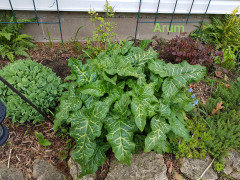
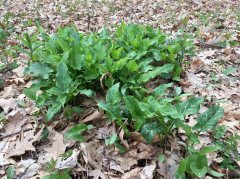
I saw a plant growing in a small city lot. I took a photo and had it identified.


I was thinking of using it as a hosta alternative. I have a lot of hostas, and this would give the beds some variety.


If it IS a thug, I won't put it in a bed with good plants.


But I do have a place where it's hard to get anything to grow: the parkway under my Norway maple. Even English ivy has struggled there. Would that be a good spot for it?


Thanks.


Comments (38)

  • 5 years ago

    Rather depends on space available and the gardener's discipline. It spreads and you'll have it for ever. Don't put it in with 'good' plants. But if you had a neglected corner where it can't escape and which you can keep under surveillance, it is a handsome plant. There was a reason it was first introduced into gardens.

    linnea56 (zone 5b Chicago) thanked floral_uk z.8/9 SW UK
  • 5 years ago

    First of all, the foliage comes up in fall and dies down in late spring. So there's nothing there for most of the season, although you do have the foliage all winter. Second, I've had a patch for years and while the original patch has enlarged very slowly, it's only the berries that make it a thug. I let the berries stand for a while to enjoy, but then cut them down and get rid of them. I've never had them spread in almost 2O years.

    linnea56 (zone 5b Chicago) thanked laceyvail 6A, WV
  • linnea56 (zone 5b Chicago) thanked gracie01 zone5 SW of Chicago
  • 5 years ago

    It is a thug for me in Birmingham, AL, zone 8a. It is beautiful in spring and then disappears. After five years I am still removing little plants from a shade bed that it overran.

    Susan


    linnea56 (zone 5b Chicago) thanked browneyedsusan_gw
  • 5 years ago

    Thank you. I'll give it a try in the parkway. It can't go anywhere there except into more bare dirt.


    Does it have a large root system? Because the maple roots make it hard to go far down.

  • 5 years ago

    If it's little plants popping up, they've come up from the berries. As I said, just don't let the berries seed around.

    linnea56 (zone 5b Chicago) thanked laceyvail 6A, WV
  • 5 years ago

    No. I have it, and I dug out most if it,no trouble at all.

  • 5 years ago
    last modified: 5 years ago

    I think this is too pretty to hide away in the parkway; Yellow fall blooming salvia: salvia koyamae . I read that it does well in root-y soil. Mine began to wilt after 3 months of drought; nevertheless it flowered! I just needed to tell someone about this unsung hero.

  • 5 years ago

    I fell in love with this plant after seeing it in a private garden I visited.

    I asked "what plant is that?" Unusual and pretty. I get a kick out of the fact that it is pretty tough in the winter and can withstand the frosts of the spring.

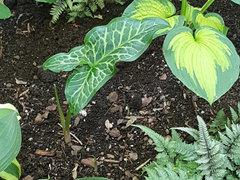
    Nevertheless, I almost lost it last summer. No orange berries. I waited and then dug it up. There were little bulblets! I replanted them and the plant began to grow again this September. Here it is now:

    I love the unusual shape and white veining. Removing the orange berries is a good idea to keep control, as laceyvail said.

  • 5 years ago

    Too pretty to get rid of completely. Just keep control of . 😁

  • 4 years ago

    Beautiful Hosta! 🤗

  • 4 years ago
    last modified: 4 years ago

    I think it's a terrible idea and I wouldn't use Arum italicum even in Chicago. Birds and animals spread the fruits to more places and you would be contributing to the alien plant invasion that's causing the current extinction event. Surely you can find something better. Here are 2 examples of Italian arum getting out of control in our northern latitude. In life, things happen and people get sick or busy and then the orange berries don't get picked and there goes the planet. You need to get rid of it completely and it's really not so pretty, when you consider what it's capable of destroying.

    http://hyg.ipm.illinois.edu/article.php?id=659

    https://www.nybg.org/blogs/science-talk/2017/05/unwelcome-import-new-invasive-plant-found-at-nybg-and-in-manhattan/

  • 4 years ago

    A plant that is invasive in one area does not mean it is invasive in another. I don't see any evidence that this plant is invasive in Canada.

  • 4 years ago

    Let's not get carried away here :-) A non-native plant that can be found to have naturalized in certain areas is hardly considered to be a ruthless invader! Even in WA state - the ONLY state where it is officially labeled as invasive/noxious - it is only a Class C or control optional plant and it's still widely sold and planted. It has not "destroyed" anything here to and tbh, I have never seen it growing outside of a cultivated environment but to make that list it must be somewhere.

    As a comparison, Arum italicum is considered overall much less of a invasive threat than is butterfly bush, Buddleja davidii, and yet that plant is extremely popular and also widely planted.

    Let's keep a proper perspective on things :-)

    Removing the stalks of red berries in late summer will remove much of the aggressive behavior. And it is strikingly attractive!

  • 4 years ago
    last modified: 4 years ago

    Completely agree with GG on this one. (but then, that probably didn't surprise anyone based on my avatar!) After having one very nice form for 15 years in my garden sold by the old Seneca Hill Perennials - I FINALLY found a single seedling of it last spring. Mind you, my climate might not be PNW mild, but it is mild enough that more than one Camellia bush has self-seeded. I think they are more aggressive in milder and/or more maritime climates, that more closely match its native haunts. Also although I don't super aggressively remove the seed stalks, but I feel like most years I do just because they blow over in the wind and look messy.

  • 4 years ago

    Well, I'm really enjoying this plant. We've been experiencing really cold temperatures (around 10 degrees F). Whatever the temperature, it still seems to survive. When there's snow, it may get buried. When the snow melts, it seems to resurface and say "here I am!"


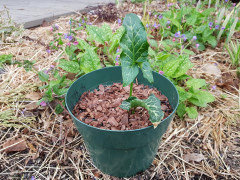
    I'm doing an experiment. I took one or two of the bulblets I found in the late summer and planted in a pot. It did begin to grow, I decided to put it in our small homemade greenhouse for overwintering. Only problem is that this greenhouse faces south so the greenhouse can heat up. I insulated the pot. So far it's looking just fine! I wonder if it will survive until next growing season.

    linnea56 (zone 5b Chicago) thanked newhostalady Z6 ON, Canada
  • 4 years ago

    It WONT go away!!!!!!

  • 4 years ago

    So I overwintered a small arum plant in my south facing mini greenhouse. Early April the greenhouse was overheating so I had to remove the plant from that location on sunny days. I am happy to report that the plant survived the winter.


  • 3 years ago
  • 3 years ago

    ^^^ For the same reasons why anyone plants anything........they like the look, it suits their gardening needs, they are unaware of its thuggish nature or it is just not an issue for them.

    FWIW, while it IS a garden thug, it is not a listed invasive except in a very limited handful of states and even then it is not a restricted invasive nor is its sale prohibited. And there are MANY more plants that are far more toxic than Arum italicum that we grow in gardens every day.

  • 3 years ago

    It IS on many states "watch list" and I suspect WILL wind up on the no-plant list. It is horribly toxic - all parts of the plant. Again, I don't get it. Don't people research plants before they plant?? Apparently not.

  • 3 years ago

    And another reason: if you have large trees with a lot of surface roots, then they grow at a very slow pace! My backyard is filled with tree roots. Growth of most plants is stunted after a couple of years due to the roots and lack of sunlight. Some plants just get smaller and smaller until they disappear. So even invasive plants have a hard time growing.

    I've had sweet woodruff (another invasive) in my backyard for a very long time. It doesn't grow much. Last year I took a small piece of it and planted it in my front yard where there is less root competition. What a difference in growth! I can see how it could be invasive---but it's not in my backyard!

  • 3 years ago

    It's not invasive in Ontario, Canada where I am. It's toxic only if ingested.

  • 3 years ago

    "Don't people research plants before they plant?? Apparently not."

    Some do. Some don't. Depends where they live and how critical the issue may be. I'd be far more concerned about all those growers, nurseries and consumers that still purchase and plant far more concerning plants like burning bush or callery pears!

  • 3 years ago

    newhostalady Z6 ON, CanadaI


    Not so.


    https://www.columbiagorgenews.com/news/italian-arum-is-aprils-weed-of-the-month/article_c0e0c7e2-555f-11e9-bb50-f3aff3faf9fd.html


    "Italian Arum is also toxic to humans and animals. All parts of Italian Arum are poisonous. Handling of the plant can cause skin irritation and ingestion can cause swelling of the mouth, tongue and throat. Breathing difficulties can follow, as well as burning pain and stomach upset."

  • 3 years ago

    @Chessie sometimes people don't plant a plant. it can be inherited from a previous owner or be a volunteer from a bird....

  • 3 years ago

    I trust you are aware that 100's of common garden plants are toxic if ingested? Including a bunch that we grow as vegetables? Just don't eat the wrong part!! And an equal amount of plants, if not more, can create phytotoxic or dermatoxic reactions in those that maybe sensitive to them.

    No need to really single out arums when so many other plants have the same attributes.

  • 3 years ago

    Mamaham_NC_Zone7

    " sometimes people don't plant a plant. it can be inherited from a previous owner or be a volunteer from a bird..."


    Well of course. I would think that is pretty basic knowledge LOL.

  • 3 years ago

    "100's of common garden plants are toxic if ingested? Sure, but not all of them are as horribly invasive as this one. Look. You want to plant things that are causing problems? Go ahead. Some people still buy and plan Bradford Pear trees too. I guess you are in good company.

  • 3 years ago
    last modified: 3 years ago

    But Chessie, that's exactly the point. It hasn't been established that arum IS "horribly invasive". DH and I hike regularly on northern Virginia trails in winter and I've never seen arum growing in a wild area. I work as a gardener at a 45 acre property in northern Virginia and I haven't seen arum growing there either. I don't know why Lewis Ginter staff rated it among their top invasives. Callery pear, autumn olive, barberry, privets of all description, nandina, stiltgrass, wineberries, multiflora rose, porcelain berry and English ivy are highly problematic around here but arum not so much.

  • 3 years ago

    You can find all the info you need online. I think anyone that plants it needs to have their head examined. And that is all I will say here. Obviously people will do what they want.


    https://www.nwcb.wa.gov/weeds/italian-arum

    https://www.invasiveplantatlas.org/subject.html?sub=13931

    https://plants.ces.ncsu.edu/plants/arum-italicum/

    https://www.phytoneuron.net/2017Phytoneuron/31PhytoN-ArumitalicumNYBG.pdf

    https://weedwise.conservationdistrict.org/arit-2


  • 3 years ago
    last modified: 3 years ago

    Chessie, you are only giving information as it pertains to certain parts of the U.S. The plant is not invasive in Canada. This forum includes people from different countries, like me.

    Why can't I grow this plant without being criticized for doing so? I don't have small children or pets using the garden. I consider myself a responsible person,

    What I don't like is seeing plant nurseries selling invasives. That, I think is irresponsible!

  • 3 years ago

    "It is horribly toxic - all parts of the plant." So are yews and daffodils. Not to mention Aconitums.

  • 3 years ago
    last modified: 3 years ago

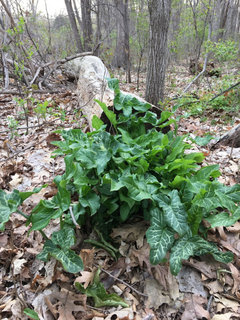
    I think the question here in the eastern half of the US (as well as southern Ontario) is whether it has the potential to invade natural areas to the degree that it outcompetes native vegetation (as it apparently does in the PNW per the online info). And it's been reported in the Vancouver and Victoria, BC area. Jay included a link from Illinois above (dated 2015) that mentioned it showing up in "land within and adjacent to urban areas". Because the seeds can be spread by birds, even if it's not an issue on someone's own property, it could still have the potential to become established in surrounding areas. These photos (4/27/21) are from a mature wooded area here in southeast Michigan (where trilliums and other native spring wildflowers are present).


  • 3 years ago

    Re ’horribly toxic.’ Afik yew and daffodils have never been used as a food source. Arum italicum and its very close relative, A maculatum, after the correct preparation, have been.


    I think a key phrase here is “outcompetes native vegetation”. Many plants escape cultivation but do not become an environmental problem. So it’s possible that A italicum could appear in natural environments in some regions but not be considered invasive.


  • 3 years ago
    last modified: 3 years ago

    https://www.timescolonist.com/local-news/toxic-invasive-plant-from-us-spreading-in-greater-victoria-5027256

    "The Horticulture Centre of the Pacific is warning gardeners to be on the lookout for Italian arum, or Arum italicum, an attractive but extremely invasive poisonous plant that’s jumped the border from Washington state and is quickly spreading through Greater ­Victoria.

    Although it’s pretty, with its arrowhead leaves with silver veins, yellow flowers and orange-red clusters of fruits — depending on the season — Arum italicum is a toxic and noxious weed. Once established, it’s extremely difficult to ­eradicate. It can be poisonous if ingested and cause skin irritations when touched.

    In areas of Washington state, including parts of the San Juan Islands, Italian arum is escaping from gardens into natural areas, and shading and pushing out native plants. The state reports that controlling it is a high ­priority, as the plant is jumping from urban areas into forests and along streams."

    “So far infestations around Washington and Oregon have proven nearly impossible to kill,” said Washington’s Noxious Weed Control Board. “A two-acre infestation on Lopez Island actually worsened after it was repeatedly mowed, dug, torched [in winter], and then covered with a heavy tarp.”


    Here is an ages-long thread right here on this site about how far this thing has spread and how hard it is to eradicate. Seriously - stop planting it.


    https://www.gardenweb.com/discussions/2038404/arum-italicum-how-to-eradicate

  • 2 years ago

    Arum italicum is invasive and there is no way to control it in the Pacific Northwest. It has slowly taken over my back yard beds and lawn and now spreading to the neighbors house. I've tried ALL the ways to get rid of it and nothing has worked over 5 years. Now It's just depressing to look at it and I have to wait for it to disappear to get any sort of gardening motivation.