Software
Houzz Logo Print
hzdeleted_36387784

Soil ok for these trees?

6 years ago
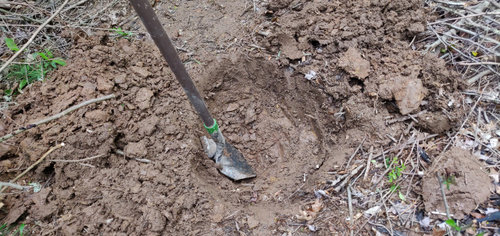


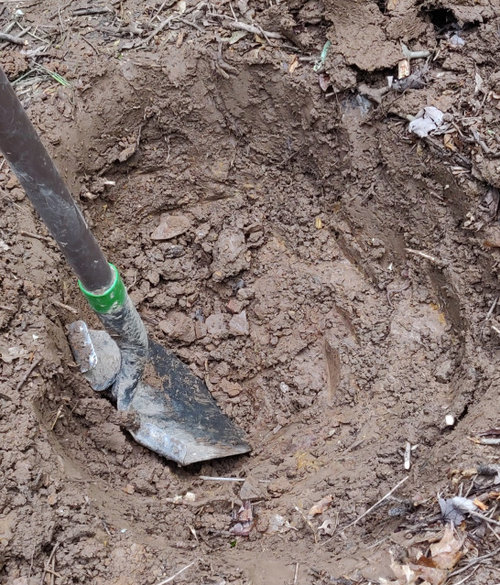
I want to plant white pine in this northern NJ soil. Nearby it was muddy, very poorly draining clay at the surface but it varies from one spot to another. Soil is moist but not waterlogged as I thought it would be. Lots of worms at the first 7 inches or so and roots and then it gets a bit rocky.


Btw, all those twigs are from clearing the area of invasive bush honeysuckle. The area is kind of on top of a slight hill with a trickle of water about 20 ft away in the lower area. Will the trees do ok here?

Comments (41)

  • 6 years ago

    fill the hole with a bucket of water.. and time how long it takes to drain ...


    this is a way to predict drainage ...


    its so wet from spring.. it hard to just look at it and say such ...


    when you do plant.. dont leave the sides ... whats the word ... maybe if i keep typing it will.. 'glazed' like that .. not good if its clay.. you are basically creating an inground clay pot ... which might impact drainage ...


    but might not be an issue.. if it drains..


    report back ...


    ken

    User thanked ken_adrian Adrian MI cold Z5
  • 6 years ago

    Ken meant to say , fill the hole with water ,, after it drains , fill again ,,then time how long it takes to drain,,,,if it is more than a couple hours , you are in trouble

    Always plant shallow ,,,, with the root flare above surrounding level

    ron

    User thanked plantkiller_il_5
  • 6 years ago

    hmmm.. never knew you had to repeat it ... go figure ...


    of course.. in my sand.. it almost disappears as fast as i pour it in ... except when sodden this time of year ... or in august.. when its bone dry water repellent ... then it take 5 mins to lose surface adhesion ...


    ken

    User thanked ken_adrian Adrian MI cold Z5
  • 6 years ago

    As for the glazed sides, when you plant it is best to dig a shallow dish that gently slopes all around to the bottom of the hole.

    tj

    User thanked tsugajunkie z5 SE WI ♱
  • 6 years ago
    last modified: 6 years ago

    Horticultural Techniques for Successful Plant Establishment

    https://s3.wp.wsu.edu/uploads/sites/403/2015/03/Planting-fact-sheet.pdf

    White pine grows on nearly all the soils within its range (71), but generally competes best on well drained sandy soils of low to medium site quality. These soils permit fair growth of white pine but not hardwoods. On these sandy sites, white pine regenerates naturally, competes easily, and can be managed most effectively and economically (40,47). On medium-textured soils (sandy loams), it will outproduce most other native commercial species in both volume and value (47). White pine also grows on fine sandy loams and silt-loam soils with either good or impeded drainage when there is no hardwood competition during the establishment period-as on old fields and pastures, bums, and blowdowns. It has been found on clay soils and on poorly drained or very poorly drained soils with surface mounds. It can be very productive on these sites but usually occurs only as individual trees or in small groups (47). This pine should not be planted in heavy clay soils. Poorly drained bottom land sites and upland depressions are also poor choices for planting (6).

    Eastern White Pine

    https://www.srs.fs.usda.gov/pubs/misc/ag_654/volume_1/pinus/strobus.htm

    User thanked Embothrium
  • 6 years ago

    The USDA report is scary; but I see white pines here in my clay. My clay is a little redder than your is. for what that's worth. I'd amend the soil in your hole with almost any kind of organic matter. From that USDA report I'd avoid hardwood leafs or leaf mulch and hardwood wood chips.

    User thanked John D Zn6a PIT Pa
  • 6 years ago

    Lordy!! You never want to amend a clay based planting hole!! All that will do is create an even more water retentive bucket and compromise drainage further.

    If you need to plant in a clay based soil, just raise up the planting. Dig a very wide but quite shallow planting hole and site the tree so that a portion of the root ball (and especially the root flare) is above grade. Then mound the unamended backfill up to the top of the root ball, creating a small berm or mound. The elevation will increase drainage ability and the roots will eventually grow and anchor into the indigenous soil.

    FWIW, it s not recommended to ever amend a planting hole for any woody plant. Use only the indigenous soil - what goes in the planting hole is only what was removed.

    User thanked gardengal48 (PNW Z8/9)
  • 6 years ago

    I already dug a hole way too deep according to that wsu. edu link and gardengal48.


    It's been over 2 hours and it's still about half full. It has been rainy here and it did rain a little after I poured a bucket in.


    So nothing, not even perlite in the backfill?

  • 6 years ago

    Then dig the tree back up and raise the planting hole. Too deep a planting and especially in a poorly or slowly draining clay soil is a fast track to tree failure.

    And no, add NOTHING to the planting hole except what was dug out of it.

    User thanked gardengal48 (PNW Z8/9)
  • 6 years ago

    I haven't planted yet. Ok, thanks. I won't add anything to it.

  • 6 years ago

    I repeat:

    I'D AMEND the soil in your hole with almost any kind of organic matter.

    You need to create a situation that can create the situation where your tree will attain the following: "It can be very productive on these sites but usually occurs only as individual trees or in small groups (47).

    The USDA report above stated: "This pine should not be planted in heavy clay soils. "

    User thanked John D Zn6a PIT Pa
  • 6 years ago

    John, you can repeat it all you like but anyone with any experience with heavy clay soil and ALL reputable horticultural sites will say the same exact thing....DO not amend individual planting holes!!

    User thanked gardengal48 (PNW Z8/9)
  • 6 years ago

    If you amend a hole surrounded by clay you create a bathtub that water collects in.

    tj

    User thanked tsugajunkie z5 SE WI ♱
  • 6 years ago

    I'll repeat it again:

    "I'D AMEND the hole"

    I once drilled 84 post holes with an auger in clay. About half of them filled almost to the top with water. There was no particular order to which filled and which didn't. When you grow in clay that soil retains water. But you can grow wonderful crops in clay soil. Especially if you improve that soil.

    You either amend the soil organically or you buy lots of bags of fertilizer. I must be a lucky guy being able to grow in a bathtub!


    Let's think about the rule of never amending a hole "cause it'll make a tub". That rule would preclude you from buying a potted tree and digging a hole for the root ball.

    User thanked John D Zn6a PIT Pa
  • 6 years ago
    last modified: 6 years ago

    Well, when planting a potted tree you should tease out the roots top, bottom and all around to make sure you see the root flare and correct circling roots. A fair amount of the potting material falls away and the teased out roots can be splayed out into the native soil. Then you only have a sink instead of a bathtub. ;-)

    tj

    User thanked tsugajunkie z5 SE WI ♱
  • 6 years ago

    crikey .. lol..


    the base idea.. is that a tree can grow itself in a myriad of conditions ... problems usually occur when we try to overthink it all and screw it up .. lol ..


    what will kill a lot of transplants.. is us ..


    the base idea.. is to plant high ... so you can allow drainage.. and allow the tree to put its roots down into native soil ... in other words.. do as little damage as possible creating a bad situation ...


    ill double down on not putting bog materials like peat in a clay hole .... hoping to add drainage.. when in fact all it does is add more water holding potential ...


    so fill that hole back in ... dig maybe a one foot hole.. to loosen the soil .. then set the plant above it ... maybe on a cone if bare root .... .. and fill around it with more loosened native soil ... then mulch it good ... then..hopefully .. the part above ground.. will naturally drain .. allowing the plant to settle in and get established.. meanwhile growing roots down into the native soil .. im trying to create a picture in your mind.. not write a thesis on how to do it ... and i cant find any image to show you ...


    ken


    User thanked ken_adrian Adrian MI cold Z5
  • 6 years ago

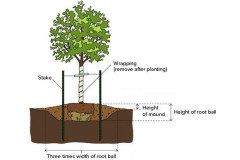
    Ken, maybe something like this is what you are looking for:

    Planting in poorly drained or heavy lay soils.


    Because it is very difficult for many plants to survive in sites where the soil is compacted or poorly drained, it is important to choose trees and shrubs that are adapted to these conditions.

    If you want to try your hand with other plants that are not adapted to such sites, you will need to correct the situation by installing a drainage system or reworking the soil. Because all of these operations are usually complicated and very costly, you might like to try another approach: raised beds.

    1. If your tree or shrub is growing in a container, remove it and prune any root-bound roots.
    2. Open up the top of the root ball to expose the plant’s collar. Measure the height of the root ball to this point. Also measure the width of the root ball.
    3. Dig a hole about 2/3 as deep and three times as wide as the root ball, with sloping sides.
    4. Do not add any amendments or fertilizer to the soil you remove from the hole, and do not place any gravel in the base of the hole.
    5. Place the tree in the planting hole, making sure that it is straight.
    6. Expose the top half of the root ball, if you are planting a balled and burlapped specimen (see the appropriate section).
    7. Stake the tree, if necessary.
    8. Backfill the hole, in layers, using the soil you set aside when you dug it. Add extra soil if necessary to form a small mound, not more than 1/3 the height of the root ball, to prevent the roots from drying out too quickly. Do not cover the collar.
    9. Do not form a saucer to trap water, but do water the plant thoroughly and deeply. Add more soil if necessary.
    10. To avoid aggravating soil aeration and drainage problems, do not add any mulch.
    11. Remove the wrapping and anything on the trunk (twine, tags, etc.).
    User thanked gardengal48 (PNW Z8/9)
  • 6 years ago

    I planted a gorgeous Stewartia three years ago and broke all the rules---all of them. The tree struggled last summer, but it is looking really fine right now---not a dead twig on it and leafing out nicely. The problem is, because I slightly amended the ill-advised gravel/rock location I chose for it, I created a basin around the base of the tree when the compost degraded. Obviously, I can't lift the tree at this late date, but can I somehow fill the basin around the trunk without rotting it? The tree is doomed, I imagine, but I'd like to try to make amends.

    And b.) may I briefly hijack your thread, Adri?

  • 6 years ago
    last modified: 6 years ago

    annpat, of course. Plus your question is relevant and I am curious too. I just planted a Vitex tree last week and now I think I'm going to lift it up a couple inches after reading all of this advice!

  • 6 years ago
    last modified: 6 years ago

    Annpat- You should be ok with your rocky gravel. Just make sure you can see the root flare even if it’s below grade. Maybe top dress a 4-6 foot area around it with some of your copious, world renown compost to encourage the roots to spread out and widening the area as time goes by.

    tj


  • 6 years ago

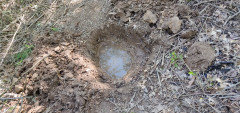
    20 hours later and there is still water at the lower end from the first bucket of water..


  • 6 years ago

    20 hours and still with water remaining indicates very slow drainage. This is a classic case of where you want to plant high and with NO soil amendments. Only water loving plants, which white pines are NOT, will tolerate these conditions

    User thanked gardengal48 (PNW Z8/9)
  • 6 years ago

    Here we call that 'mucky', 'sticky' clay. :-)


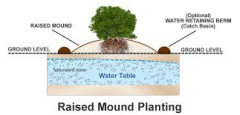
    gg, that is about the best picture I have seen describing a raised planting yet I've seen others who plant almost on top of the ground and then mound the native soil around the root ball.


    Adri, I don't know how cold it gets there but any disturbed soil in my part of the world will freeze during the winter. This causes the soil to 'settle' and return to normal consistency when it thaws again in the spring. So this season will most likely be the worst for 'bathtub effect' but a raised planting will help keep rains from draining directly into the planting area.

    User thanked User
  • 6 years ago

    Bill, have also done that in some conditions. That is typically referred to as 'mound planting'. Same exact principles apply....just at a higher raised level :)

    This diagram not quite as good as it shows the mounded soil covering the top of the rootball. You only want to bring the soil mound to the edge of the top of the rootball, never across the top of it.

    User thanked gardengal48 (PNW Z8/9)
  • 6 years ago

    Sigh, I really wanted a fast growing open evergreen there but I think I'm going to put a bald cypress in that hole and test out another hole for white pine..

  • 6 years ago
    last modified: 6 years ago

    Yes, and that water retaining 'Berm' would also be unnecessary in Adris case, unless it would get very dry in summer and one would have to water (which doesn't seem likely).

    Adi, anything you can do to channel water 'away' from the planting area, like during heavy rains, will improve the situation.

    User thanked User
  • 6 years ago
    last modified: 6 years ago

    Adri,

    It's hard to tell from your pictures but if the surrounding area around the planting hole, slants slightly towards the hole or at least tends to keep water from draining away, it may not be a great place for pine. Although many do plant on mounds in wet areas and have good success.

    I know nothing about 'Bald Cypress' but I think it may be a better choice for a wet area.

    Pine would do better in heavy soil if it was located on higher ground (hill top, hill side etc.) where water runs away from the planting site.

    User thanked User
  • 6 years ago

    Surface topography has little effect on internal soil drainage. For instance the would be planting hole shown here is at the top of a raised area yet the drainage has been found to be quite poor.

    User thanked Embothrium
  • 6 years ago
    last modified: 6 years ago

    I'm aware of that Embo. What I was saying was a high spot, where water runs away from, will absorb less water during a rain, than a low depression where water pools and soaks in at that area.

    I see no picture on this thread, unless I missed it, that shows anything remotely related to topography or how high or low the planting area is.

    User thanked User
  • 6 years ago
    last modified: 6 years ago

    I will try to get a picture of the slope. While clearing the area I discovered a northern cardinal's nest so I am waiting for the babies to fledge. Then I will clear some more.

  • 6 years ago

    From my experience drilling post holes clay soil will be saturated with water to the level of the water table on that day. As it drys out the soil drys out. At that point we start watering the plants in our clay soil. The fact that we can grow in clay soil indicates that the plants can withstand having a water table up as high as their roots; some more than others.

    If the water table is a few inches below the surface then the fact that there's a spot where someone amended the soil will have no bearing on how soon the entire area drains. The spot with some organic mater will not dry out as soon as the surrounding soil; which is excellent for the plant there.

    I have some question whether the topography will matter as to how fast the soil will drain. I think it would be interesting to have a well driller relate his experiences with drilling on the edge of a steep slope. It wouldn't surprise me to have a situation where the flow of water is up along a steep slope.

    The plants growing on a mound will have roots that dive down into the surrounding soil as the plant grows; so any benefit to the plant will be short lived in tree years.

  • 6 years ago

    " The plants growing on a mound will have roots that dive down into the surrounding soil as the plant grows; so any benefit to the plant will be short lived in tree years. "

    This is simply not borne out by reality. The vast majority - as much as 85% - of a tree's roots are aligned laterally and are located just below the soil surface. Planting on a mound only allows the few necessary anchorage roots to establish without being drowned. The other roots will populate whatever the surrounding soil may be without issue. And without concern that they will be rotted away by being confined to a soggy amended bucket of a hole before they have time to establish and spread.

  • 6 years ago

    I seriously doubt the roots will grow "laterally" as then we'd see them sticking out and trying to wring moisture and nutrition out of the air.

  • 6 years ago

    Oy!! John, have you ever seen a diagram of how tree roots grow? If not, I'd suggest you do more research before coming out with these inaccurate and just plain silly comments.

    Did you not read the portion of my comment that included " located just below the soil surface "? Of course they don't grow in open air.....but many come darn close to it with production of very surface oriented roots.

  • 6 years ago

    I think you can do much better.

  • 6 years ago

    CAN'T DO MUCH BETTER THAN GARDENGAL !

  • 6 years ago

    I've been reading about ripping hardpan for trees. There's an interesting Youtube video by California Farmer which gives a rare glimpse of what some soil looks like 6ft underground. It's certainly NOT something I can do but interesting others can with apparent good results.


    Out of curiosity I might keep digging (until I'm too tired to dig/chisel more) to see how far it goes down in that spot or others.


  • 6 years ago

    When I lived in the Twin cities, we had hard pan 15-20 ft down.

    Don't let the hole cave in on you, That can happen and you would be missed. :-)

    User thanked User
  • 6 years ago

    You overestimate my digging. I might dig one more foot tops lol!

  • 6 years ago

    I live in clay. That's right, I'm in it. My skin has been permanently stained red-brown. Clay is never the right moisture - it's either too wet or too dry. There is something unnatural about things that grow natively in it. So I put away my shovel years ago. I just plop stuff on the ground and pile dirt around it. And then mulch. And pine straw. And water, water, water. This whole process is easiest for small plants, which is good, since it provides a disincentive for me to buy bigger ones.

    User thanked DeanW45
Sponsored
High Point Cabinets
Average rating: 5 out of 5 stars21 Reviews
Columbus' Experienced Custom Cabinet Builder | 4x Best of Houzz Winner