Software
Houzz Logo Print
everdebz

Hello. Excited to see something different - is it possible

6 years ago
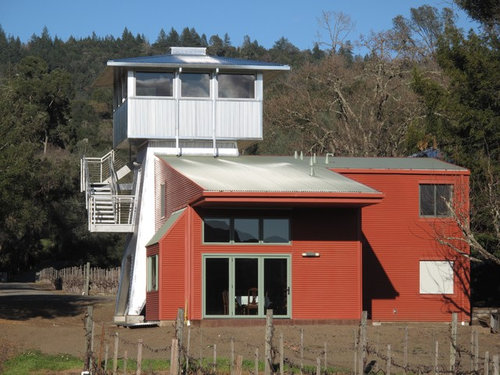
to share about this home - materials? I saw it on your site, was called Agriboard Residence. Did you have to 'treat' corrugated metal - is it painted? wow. Thanks.
Diaz Farm Family Unit · More Info

Comments (6)

  • PRO
    6 years ago

    Thank you for checking it out. If memory serves this 7/8” deep corrugated product was made by Metal Sales and has a painted Kynar finish.

    Since the advent of stricter environmental regulations the traditional 1/2” corrugated galvanized cladding we are used to seeing on agricultural buildings in California has become more difficult to source.

    The popular color choice to replace this look is a “old town gray”. Most manufacturers will make a similar color even if it’s called something else and the 7/8” deep corrugation also gives it more strength, reducing the need for fasteners.

    These clients were braver than most and we used a couple colors on their house. I was lucky to have them and really enjoy working with people who are willing to take a well considered risk.

    This building was one of a pair of buildings I designed a few years ago using the “Agriboard”product. This is a SIP panel product that uses the straw waste product associated with the rice harvest as the compressed insulating core at the center of the sandwich panel as an alternative to the usual styrofoam core.

    Because Agriboard had never been built in California before, and had never been through the expensive testing process that Is relatively unique to our state, it was necessary to get a “alternative materials and methods“ building permit for these two buildings to circumvent that costly process.

    We have such an abundance of rice in the central valley, I would love to see the concept of this product becomes something that could be locally sourced and locally manufactured in California someday.

    This specific Agriboard product was manufactured in Texas. Unfortunately Agriboard folded after a fire swept through the town of Electra Texas where the Agriboard plant was. It was my understanding the original idea for producing the Agriboard panel was associated with acquiring a grant from the USDA. Absent this incentive, it is not clear how compelling the business model was for this product in Texas.

    California on the other hand, with its abundance of rice in the central valley, historic propensity for things “granola“ and it’s predilection for things pre-fabricated, always struck me as a natural resting place for this product if we could ever get over the regulatory hurdles.

    Thank you checking out the project. It is a labor of love and always a pleasure to share the project narrative with someone who is curious.

    everdebz thanked Michael Cobb
  • 6 years ago

    Thank you much for a wonderful response. Recycling is here to stay, and so I hope there's a future for such an industry, that involves using 'waste', short route to manufacturer, etc.... good for you! I've grown to like the metal shine of corrugated.

  • 6 years ago

    If you want to respond - why stairs outside? My hubby and I call our "dream" a cupola room. How large is the upper room? I suppose it's insulated, etc...

  • 6 years ago
    last modified: 6 years ago

    In some awe of the design, and thought put into it. I notice an outlet: electric, plumbing?

  • PRO
    6 years ago

    That outlet is a “port” in the panel to make a seismic all-thread connection to the top of the panel.

    As a construction technology, SIP panels’ main challenge in California is the manner in which it is attached to the foundation. Even styrofoam SIP panels have this issue. Sheet metal stirrups anchored to the foundation and attached to the base of the panel worked elsewhere but did not perform well in a major seismic event like we see here in California.

    Our path to compliance was largely accomplished by exploiting the vertical electrical chases that typically occur in the panel. Instead we ran a threaded tension rod from the foundation to the top of the panel where it was capped with a large nutted washer.

    Having these threaded rods in place prior to panel installation would have been a logistical nightmare, so instead we simply stubbed up the anchor bolts about 18” and came back later with a longer all thread to get us to the top of the panel and connected it to the anchor bolt with a coupler at the port.

    Thanks again for your interest.

    everdebz thanked Michael Cobb