Software
Houzz Logo Print
westes

Help Analyze This Sandy Loam

6 years ago
last modified: 6 years ago
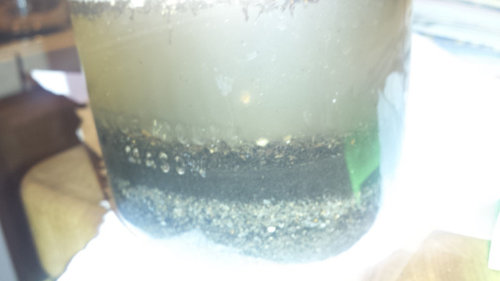
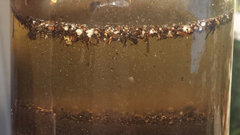
A few years ago a landscaper created a container planting soil for a few of my containers that worked out amazingly well for the plants in those containers. It feels like a sandy loam to the touch, but I wanted to characterize it further so I put some of the soil into a Ball jar with water and let it settle. Looking at the attached photo, I see about 60% sand, 30% silt, and I am not sure what the 10% at the top is. That does not look like clay, so I am thinking it might be another type of silt. How do others here read this soil?
I do understand that container soil should not be made of sandy loam. I am not arguing for or against this soil. I am simply trying to understand what it is, and anecdotally I am reporting that many plants did well with it.


Comments (10)

  • 6 years ago

    How big were the containers? All the stuff floating at the top is organic matter, like compost. The grainy stuff is coarse sand or crushed granite, the dark part looks like silt. The silt from the ground in my yard is not that dark, I dont know what you would use for the silt component in a manufactured soil like that.

    westes Zone 9b California SF Bay thanked Skip1909
  • 6 years ago

    I'm not sure you can determine anything from that sample test.....or nothing that I would sign off on :-)

    The mason jar soil test is intended to provide a rough analysis of inground soil to determine the percentages of the three soil types it might contain (sand, silt and clay). Since nearly all potting soils or engineered container soils contain NO real soil at all - so no sand, no silt and no clay - what is the test of soil-less mix intended to illustrate?

    Even if the container soil you had manufactured contained some actual garden soil ('dirt'), the jar test is still not going to provide accurate results because of other non-soil ingredients that may be included.

    You are attempting to compare apples to oranges.

    westes Zone 9b California SF Bay thanked gardengal48 (PNW Z8/9)
  • 6 years ago

    As a general observation you can say that about half of it is very coarse sand. It could make a good container mix for succulents, according to what I've read lately.

    westes Zone 9b California SF Bay thanked toxcrusadr
  • 6 years ago

    westes:

    I like the curiosity evinced by your mason jar test.

    The photo is a little fuzzy. Are you seeing a third layer ( roughly between the top of “mason” and the indistinct lettering above it)? You do refer to the ”10% at the top”; does this refer to material floating on top of the water, or a third layer immediately above the lowest 2?


    westes Zone 9b California SF Bay thanked rifis (zone 6b-7a NJ)
  • 6 years ago
    last modified: 6 years ago

    @rifis I took a better photo now that I have daylight, attached.

    I think the layer above the silt is just organic compost that has sunk to the soil surface. So my conclusion is that most of this sample is coarse sand and silt. The silt is indeed dark. There was a lot of compost I had to scrape out of the top of the jar. But that compost was not the horrible sawdust material you find in nursery soil. It was very small particles of bark and other organic matter that had maintained its structure. That organic material may have been imparting some nutrition to the soil, and those containers were not getting fertilizer.

    Regarding the other poster who said this would be a good container soil: you should be aware that this is a controversial topic in the container gardening forum. Most of the purists will insist that coarse sand - added in too high a percentage of the soil - will create strong capillary action and raise the perched water table. My experience has been that plants largely thrive in sandy soils, as long as you do not mix in substantial amounts of microscopic compost and manure. That said, I use sand for experiments and my main soils for containers are gritty mix, 5-1-1, and I have experimented with various other mixes depending on whether the plant loves wet feet or not. For cactus and many Euphorbia I use pure pumice.


  • 6 years ago

    Just to reiterate......the Mason jar soil texture test has NO relevance with any kind of engineered potting soil!! I'm not sure what you are expecting to measure with this, as it is not designed for this purpose - only for garden or inground soil (aka "dirt") - and the results with potting soil will be meaningless.

  • 6 years ago

    @gardengal48 relevance to what? The physics of sand, silt, and clay are laws of science. And engineered soil with those components is going to display a layering of some kind.


    Where I think you have a point is if the soil contains mostly components that are not sand, silt, or clay. Then much of your soil is going to float away. But I was trying to characterize the sand/silt/clay part of the soil, and I think this test does that.

  • 6 years ago

    You seem to be intent with that conclusion so I'll leave you to it. I guess I would need to see this so called container soil to see exactly what its consistency is. Commercial container or potting soils generally have no actual soil in them at all as that has clearly been proven to adversely affect drainage due to its density and tiny particle size. There is a reason they refer to them as "soil-less mixes".

    westes Zone 9b California SF Bay thanked gardengal48 (PNW Z8/9)
  • 6 years ago

    Maybe a different way to say this is that I wanted to know how much sand, silt, and clay was in my soil mix. You make a very important point that the soil-in-jar test will not properly summarize the composition of a soil mix that is not made almost entirely from sand, silt, and clay.