Software
Houzz Logo Print
trapezemit

Tank water heater recommendations

6 years ago

Hi All, I'm located in Southern CA and looking for a new tank water heater for a family of 4~5 with two baths. From local plumbers I heard about Bradford White, Ruud, Rheem and wonder if anyone has more insights. I would like to get one that 's reliable and efficient and zero to no maintenance. Thanks.

Comments (28)

  • 6 years ago

    I DO NOT recommend A.O. Smith or Whirlpool hot water heaters due to personal experience with ours leaking after 3 years. We were required to pay for labor, installment, property damage, etc. However, they did provide an exchange for a new one at Lowes, thankfully. Good luck!

    R J thanked doreycrouse
  • 6 years ago

    R J You may want to research Heat Pump Hot Water Heaters also... be careful of info from folks that do not have one... they sometimes, while well intentioned, don't have good info.

    R J thanked Stax
  • 6 years ago
    last modified: 6 years ago

    RJ,

    You didn't mention gas or electric. Do you have any high water use situations? (big soaking tub, multi-head showers, several people who shower at the same time in the morning)

    Brand isn't as important as getting the right type of heater.

    R J thanked Jake The Wonderdog
  • 6 years ago

    Thanks Stax. What's good about Heat Pump Hot Water Heaters ? The bad ?

  • 6 years ago

    Thanks Jake The Wonderdog. I would be open to either gas or electric as long as long term energy cost is low. I don't plan on doing anything solar on the roof at this point.

  • 6 years ago

    Typically a sizeable electric energy savings compared to electric element heaters. Noisier... fine in basement or in mild temps possibly attic or garage.

    They produce condensation by water coming from the surrounding air - will need access to a drain or condensate pump. (Under one gal a day... more like a quart a day where I am in MD.)

    We have two adults in my home - no kids. My monthly electric bill is maybe $40 a month less with the Heat Pump hot water. Adequate hot water in heat pump mode... when grandkids come to visit, switch to normal electric.

  • 6 years ago

    What are your gas and electricity rates? I imagine Southern California has high electricity costs so gas is the better option if you have a gas connection currently available at the hot water tank. A 50 gallon tank with a 50K BTU input should be sufficient for a family of 5. If you want simple and reliable then an atmospheric type is the lowest cost option. This type operates during power outages if that is an issue in Southern CA. The power vent type is a more efficient and requires power at all times. You may not have a choice if there are minimum efficiency requirements in your location.

    R J thanked mike_home
  • 6 years ago
    last modified: 6 years ago

    In S. California I would also recommend a heat pump water heater such as the rheem in an 80 gal for your house - assuming you have a basement, garage or someplace from which to pull air (closet install requires you vent to a larger area). The unit will discharge cooler dry air - so helps with cooling / dehumidifying a basement. With these, the larger unit will generally cost less to run because they stay in heat pump mode more.

    These are the lowest cost to operate of any water heater based on the DOE sticker.

    In addition, there's no need for a flue like there is with a gas water heater. Hybrid electric are a good companion with solar PV also.

    If you are designing / building a new house, you potentially can avoid installing gas at all - which can save you a bundle.


    There is also generally a very large energy credit from your electric provider - $500 isn't unheard of.

    R J thanked Jake The Wonderdog
  • 6 years ago

    I installed a Bradford White 50 gal gas power vent water heater a few months ago. It was part of a renovation and I picked the power vent because it allowed me to use 2" PVC for the flue pipe. The only objection I have is that the power vent is relatively noisy when it comes on. My utility room has a louvered door, so the sound carries out into the rest of the basement.

    If I was doing it again I would also take a close look at heat pump water heaters. However, I'm not aware of any significant energy credit in my area, and they were more expensive.

    Bruce

    R J thanked Bruce in Northern Virginia
  • 6 years ago

    @Bruce in Northern Virginia Thanks. I am not sure the differences between Hybrid vs heat pump. I have existing gas lines and exiting 220V receptacle both on the same wall which is where my existing gas tank water heater is strapped to. I plan to just put the new water heater there as well.

  • 6 years ago

    Tank water heater recommendations

    https://www.air-conditioning-heating.org/


    Replacing your Water Heater

    If you’re like most people, you’re unlikely to go out looking for a water heater until your existing one fails. That will happen at the worst possible time — like just after guests arrive for a week-long visit. You’ll have to rush out and put in whatever is available, without taking the time to look for a water heater that best fits your needs and offers real energy efficiency. A much better approach is to do some research now.


    Explore the options and decide what type of water heater you want — gas or electric, storage or demand, stand-alone or integrated with your heating system, etc. Figure out the proper size for your household, not just in terms of gallon capacity, but first-hour rating as well. This is particularly important with newer energy-efficient technologies. (See “Sizing Your Water Heater.”)


    If possible, replace your existing water heater before it fails. Most water heaters have a lifespan of 10–15 years. If yours is up there in age, have your plumber take a look at it and advise you on how much useful life it has left. If it’s in bad shape, replace it now before it starts leaking or the burner stops working. In fact, it often makes sense to replace an inefficient water heater even if it’s in good shape. The energy savings alone could pay for the new water heater after just a few years, and you’ll be happy knowing that you are dumping fewer pollutants into the air and less money down the drain.


    Fuel Options

    If you are looking to replace your water heater, first determine what type of fuel makes the most sense for your home. If you currently have an electric water heater and natural gas is available in your area, a switch might save you money. Oil- and propane-fired water heaters also may cost less to operate than electric models, although the upfront costs can be substantially higher, particularly for oil-fired models.


    Before you rule out electricity, though, check with your utility company. It may offer special off-peak rates that make electricity a more attractive option. With off-peak electricity for water heating, the utility company puts in a separate meter with a timer in it. You can only draw electricity through that meter during off-peak periods, when the utility company has more capacity than it needs and is willing to sell it less expensively.


    Selecting a New Water Heater

    Whether you’re replacing a worn-out existing water heater or looking for the best model for a new house you’re building, choose carefully. Look for a water heater that satisfies your hot water needs and uses as little energy as possible. Often you can substantially reduce your hot water needs through water conservation efforts (see “Conserve Water”).


    Efficiency and tank size. The energy efficiency of a storage water heater is indicated by its energy factor (EF), an overall measure of efficiency based on the assumed use of 64 gallons of hot water per day, regardless of tank size.

  • 6 years ago
    last modified: 6 years ago

    You need to do some reading on your own re Heat Pump Hot water heaters - goto Lowes or similar and do some reading.

  • 6 years ago
    last modified: 6 years ago

    I've bought 3 Bradford White conventionally vented tank models in the last 5 years - one house that has two units and one (in Socal) that has one. Two personal dwellings in two different areas of California and it was the same recommendation from two different highly rated plumbers, surprisingly for same reason why.

    They're a bit more expensive than others but these two different contractors both said they'll install nothing else because of reduced callbacks (happy customers) and durability.That sold me, all three units have functioned well.

  • 6 years ago

    Bradford White are not sold through retail channels. Plumbers like them because the customer isn't seeing the price-tag online or at Big Box and thus have to explain their big markup. All plumbers give the same line about Bradford White, but the customers tell a different story. Many customers talk about early failures.


    My guess is that Bradford White has a similar failure rate as others - but has a different set of expectations from the customer because they were told what a great heater this was by the installer - to justify the higher price.


  • 6 years ago
    last modified: 6 years ago

    Bradford White prices are no secret. They're easily obtained online. The two plumbers I used told me the prices paid and each had the same practice, to add a small markup to cover their time to go pick it up, nothing more.

    Build quality is poor these days for many brands and failure rates can be high. I was more than satisfied that the rationale both used to recommend Bradford White was sound and my experience has been excellent. Both, in fact, said they will not install other brands.

    Skeptics or people who shop by price tag alone will always convince themselves that their views are correct. That's fine, no skin off my nose. I have experiences to share, nothing more.

  • 6 years ago

    lol

  • 6 years ago

    I have an AO Smith electric tank heater; the house is about 6 years old and have had no trouble, but when it fails, should I consider a heat pump instead? We are only two people with no high use consumers.

  • 6 years ago
    last modified: 6 years ago

    mtvhike,

    You should make the comparison. In my state, for example, the Power Company would give me a $500 Rebate on the Heat Pump. Also, the State forgives the Sales Tax on the Heat Pumps versions. Generally the Heat Pump version has a life expectancy of 12-13 years compared to maybe 10 years on a conventional electric.

    Some of the drawbacks are discussed below - need for condensate disposal, noise, need for ventilation.

    We are two people, with a 50 Gallon GE Hybrid. Save maybe $40 per month vs electric. I think I'll up to 80 Gallon when I replace... my wife enjoys the long luxurious showers. lol

  • 6 years ago

    I looked into the Rheem hybrid 50 gallon version that Jake The Wonderdog mentioned earlier and the energy guide says it costs about 110 annually to run. The conventional gas 50 gallon looks to cost between 200~300 annually to run. Yet the Rheem hybrid 50 gallon version needs 240V and I think gas is cheaper than electricity. Does it sound about right to everyone or am I missing anything ? Also, a rep at Home Depot told me gas is faster to provide hot water.

  • 6 years ago

    " Yet the Rheem hybrid 50 gallon version needs 240V and I think gas is cheaper than electricity."

    You say that the Hybrid uses ~$110 per year and the gas ~$200-$300. Those numbers would be for the same usage. That means gas is more expensive than electricity in your case.

  • 6 years ago
    last modified: 6 years ago

    You have to be careful when comparing the operating costs of the hybrid hot water heater. The operating costs are low when it operates in heat pump mode. The problem is the heat pump my not be able to supply enough heat to keep up with the hot water demands. When that happens the hot water heater switches to conventional electric mode.

    The input BTUs on a gas hot water heater is higher than a conventional electric or hybrid hot water heater. This higher input produces a faster recovery time.

    Do you know your gas and electric rates? You will need them if you want to do an accurate operating cost comparison.

    What are people installing in Southern CA these days? There are generous utility and local rebates for hybrid hot water heaters on the East Coast. Are you being encouraged to use more electricity and less natural gas?

  • 6 years ago
    last modified: 6 years ago

    mike_home,

    Of course if a Hybrid Hot Water Heater is not operated in Heat Pump mode it will not be any different than a plain electric heater. However, that is something that the OP must research before hand while making the comparison of various options.

    There are two of us in my home and we have a GE 50 Gallon Hybrid - we only operate it in Heat Pump mode and it provides our needs just fine. That said, over the Christmas Holidays we have my sons and their families with us for a week - including four teenager granddaughters. For that week we switch the operation from Heat Pump to:

    High Demand/Boost Mode

    "The perfect mode for when homeowners have house guests or anticipate having higher-than-average hot water usage. In this mode, the unit will utilize the back-up electric elements sooner to recover the tank faster and for a longer duration of time to ensure they have plenty of hot water."

    When in this mode, back up hot water comes from two 4500 Watt electric elements - just like any conventional electric unit.

    Bottom line, if you buy a Heat Pump hot water heater that is undersized for your usage, it will obviously not give you the savings you want. Doh!


    PS I hope that I have not given the OP the impression that NG is not a likely good choice ALSO. Usually a comparison of NG vs Heat Pump is close - depending on local utility rates and how well you can predict the future. In my particular case, NG is not available and I will not have a propane tank. YMMV

  • 6 years ago

    I tried to look into the energy cost a bit more. I think it really depends on the utility rates in your areas as some of you have mentioned. After looking into my energy bills, the rough numbers for me are 1.7/therm for gas and 0.6/kwh for electricity. So I should only look at how many kwh's or therm's one unit is estimated to use for a year instead of the annual dollar cost on the energy label as they use different rates. I likely will stick to a conventional gas tank heater after running some numbers.

  • 6 years ago

    In my case, the relative rates don't make any difference because I have no NG or propane. It's either electric resistance (I have a 50 gallon, 4500 watt) and I was just wondering about the capitol cost of the heat pump or hybrid. The two of us don't have a high demand and rarely have high usage guests for our two showers. I'll check on local rebates. My electric rates are about.$.10/kWh.

  • 6 years ago

    RJ, first and foremost to consider is the cost of changing the infrastructure that's already there. If there's a gas tank heater there now, changing to a tankless gas type will involve a fair amount of plumbing, including oftentimes the need to put in a larger gas pipe. If you have a gas tank and want to switch to an electric unit, you'll need to have electrical work done both in your box and to run 240 volt supply wires. Depending on the layout and distances, it may run from easy (cheap) to a bit more difficult (more expensive) to do that. Will you recover the costs to change though lower operating costs? No.


    Next is operating cost. Except for homes with existing solar panels or In all but the cheapest of electricity regions (which is not SoCal), natural gas is a cheaper heat source for water than electricity. Period.


    Next is operating characteristics. A gas tank model can recover (reheat a used up tank containing cold water) in little more than an hour. You can get models with higher BTU output for a given tank size that are faster if it matters. Electrical tanks using the heat pump technology can take hours and hours and hours to return a cold tank to expected temps for hot water. Click in the resistance boost and it still will take many hours, longer than a gas model. More hours than most people want to spend waiting.


    Tankless of course offer unlimited hot water, if that's what you're looking for. In your shoes, I'd stick with gas.

  • 6 years ago

    @Elmer J Fudd What Bradford White conventional tank heater models did you buy in the last 5 years if you could share ? Did your contractors recommend other Bradford White models as well ? Thanks.

  • 6 years ago
    last modified: 6 years ago

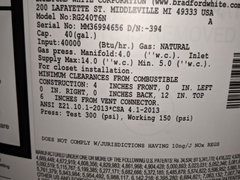
    I'm currently at the place with two 40 gallon, 40K BTU atmospherically vented units. Standard efficiency, standard venting up vent stacks. We're very happy with them, recovery time after a lot of hot water use is quite fast. Here's a photo of the label


    Edit to add -

    I missed one of your questions. We discussed the size I wanted. At this location, each replaced a 40 gal and the prior 40 (though leaking) was large enough. I think I was given choice of how many BTUs for the 40 gal size and I said I wanted a reasonably fast recovery capability. At the other location, I replaced a 50 with a BW 50 and there, because it's smaller home, I asked him to pick a model in the mid-range of output if there was a choice.

    R J thanked Elmer J Fudd