Software
Houzz Logo Print
brutus_sanchez

Ceiling Fan Doesn't Run On High

5 years ago

I have two outdoor ceiling fans. I can't swear that they are Minkas, but all the other house fans are. The outdoor fans are controlled by a Minka Aire wall control, either WCS212 or 213. The fan lights work fine. The fans work fine on low or medium. On high, they stay the same as medium, or possibly slow down just a little. I took one of the remotes from indoors and reprogrammed it to run the outdoor fans. Same result. Low and medium don't come close to giving the air movement I need out there. There's no such thing as a two speed fan, is there? Can anyone offer advice? Thanks in advance.

Comments (12)

  • PRO
    5 years ago

    Minka Aire does provide tech support, but you are going to need to know what fans you have in order for them to help you. If you can some pictures of your fans I may be able to identify them. Otherwise, all Minka Aire fans should have a label on the top of the motor that identifies them.


    And no, Minka Aire does not make any 2 speed ceiling fans.


    Here's a link to Minka's contact page:

    https://www.minkagroup.net/help.php?section=contactus


  • 5 years ago

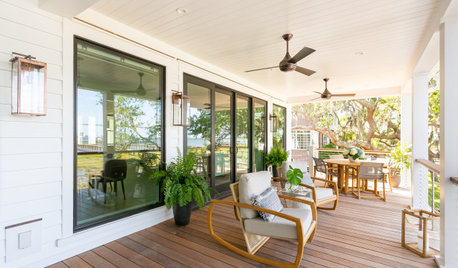
    Thank you very much. Here are two photos. As far as the stickers go, there were several on the top of the shroud that covers the motor. The only one that seemed to be relevant said, "Rhine Mfg. Co." Thanks again!


  • PRO
    5 years ago

    I have identified the ceiling fan as the Minka Aire Magellan. Either model F579-BNW or F579-L-BNW depending on the year they were produced.


    It looks like the fans were installed too close to the ceiling, which will dramatically reduce the airflow. Also, outdoor fans will not seem to move nearly as much air when installed outdoors as opposed to indoors because the airflow is not constrained by walls. So outdoor fans generally need to move a lot more air than indoor fans to be sufficient and they need to have at least 12" from the ceiling to the blades.


    My recollection of the Magellan fans is that there were complaints about lack of airflow. It is also not uncommon for there to be little difference in RPM between medium and high speeds.


    How high is that ceiling?

    How far are the blades from the ceiling?

    What are the dimensions of the area?


    I would still suggest you contact Minka Aire to discuss your issue, but ultimately you may want to replace the fans with higher performance fans.


    If you want recommendations, please answer the above questions and post some pictures of the space.


  • 5 years ago

    Checking for the Proper Lubrication

    Larger ceiling fans use oil contained in a reservoir that lubricates the bearing. A small hole located in the upper part of the motor housing allows for additional oil to be added to the fan when needed. Normally the hole is marked "add oil" by the manufacturer. Put plastic sheeting below the fan to avoid any oil getting on furniture or carpet and using a step ladder locate the "add oil" hole. Start off spraying a little light oil into the hole and let the fan run for 20 minutes. Then stop the fan and add ceiling fan oil until the reservoir overflows slightly. This will normally be SAE 15 or SAE 10 oil. Wipe the fan housing off to avoid any drips. Some fans are made with permanently lubricated sealed bearings and oil cannot be added. Make sure you know whether your fan has an oil reservoir by consulting your manual or the manufacturer.


    Balancing for Improved Operation

    Poorly balanced blades can cause wobble that results in slower-than-normal operation. To check the balance, you should measure from the tip of each blade to the ceiling with the fan turned off. Each blade tip should be the same distance to the ceiling if the ceiling is level. If there is more than 1/4 of an inch difference, the blades are out of balance. Tape a standard metal washer or coin to the top side of the blade that is closest to the ceiling. Make sure the top of the blade is clean of dust and use about 3 inches of tape to make sure the washer stays in place. Experiment with washers on various blades until all of the blades are level with each other and the ceiling. If your ceiling is sloped or otherwise unlevel, use a building level to measure levelness between the blades.

    https://www.heating-air-conditioning.net/

    Identifying a Defective Capacitor

    Ceiling fans are single phase motors and rely on capacitors to start and run. Some fans have a combination start-stop capacitor and some have a capacitor for each. Other fans use multiple capacitors for speed changes. In your breaker box, flip the breaker that powers your fan to the "off" position. Use a stepladder and remove the lower cap on the fan that usually houses the capacitors. While the disassembly process is slightly different on various fans, the capacitors are easy to identify. They are small black cubes or silver cylinders and will have a micro farad rating printed on the side. The capacitor rating will be a number followed by the letters "uf." Look for any distortion in the cube or cylinder indicating capacitor failure and replace any that are discolored or swollen. The capacitors are either connected to screw terminals or have wire nuts connecting them to other wires. Disconnect the suspect capacitor and use the information on the label to obtain the correct replacement.

    https://www.cooling-heating.net/

    Inspecting the Motor for a Damaged Winding

    Partially shorted windings are the final possibility that could cause a slow-running fan. Windings are sometimes damaged when a start capacitor fails causing the fan to stall and heat the coils beyond their limits. To check for winding failures the fan must be removed and completely disassembled. Visually inspect the windings for heat discoloration or any burn marks. If the copper is badly discolored by heat, replace the motor and associated capacitors.


  • 5 years ago

    I can't thank you enough for the help you have been already. Yes, I will contact Minka. I would be satisfied if I could get a decent airflow directly underneath the fans. The area is quite large- 36' long, 9'6" deep, 8'4" high. Two of the four boundaries are screened, with the screens generally open during fan season. The top of the fan blade is 7.25" from the ceiling. I've never thought the sail-shaped blades looked very efficient. This is in SC, where the humidity is as bad as the heat.


  • PRO
    5 years ago

    I looked up the specs for the Magellan in our database and found this:


    Blade Height: 7.75" from ceiling to bottom of blades

    Span: 60"

    CFM High: 6200

    MPH High: 2.79 MPH Wind Speed


    I also recall issues about customers complaining these fans did not move enough air. The above specs somewhat confirm this. The testing method prior to 2019 did not have the fan installed on a ceiling, but hanging open in a room over a cylinder. So when this fan is installed with the standard mount, it puts the blades too close to the ceiling. There should be at least 12" from the top of the blades to the ceiling for a fan to perform to it's maximum potential.


    The airflow would improve if you replace the current downrods with 12" downrods. Building codes require the blades to be at least 7' from the floor, so I would need to know how long the current downrod is in order to do the math to see if a 12" downrod would be too long. I looked at my data and could not find the standard downrod length, but it looks like it's 3" to 4".


    With that said, even at optimal performance, 2.79 MPH Wind Speed (6200 CFM) is not very good for a 60" ceiling fan, particularly when installed outdoors.


    We recommend a Wind Speed as close to 4 MPH as possible and there are not that many outdoor fans that can do that.


    Here's a link to: 57" to 72" outdoor ceiling fans sorted by highest wind speed.


    BTW: Marc Well mentioned oiling a ceiling fan. There is only 1 model of ceiling fans that can be oiled and has a hole for oil as he described. That is the cast iron Hunter Original fan. So that does not apply to you. The information about Capacitors or motor windings may apply and is something you would want to discuss with a tech at Minka Aire.


  • 5 years ago

    The flat bottom of the fixture is 7'1" above the floor. The blade, at the lowest point, is 7'7" above the floor.

  • PRO
    5 years ago

    The rule is 7' from the bottom of the blades to the floor. There is no rule on the height of the light or bottom of the fan, that is up to whatever you are comfortable with. So technically, the longest downrod you can add would be 7" longer than your existing downrod, which is why I wanted to know the length of the existing downrod.


    Available downrods are: 6", 12", 18", 24" etc.


    A 6" downrod would not be sufficient since it would only add 3" or 4". A 12" downrod is likely 1" or 2" too long, so you would have to cut and redrill the hole on the end.


    As I mentioned before, that would only get those fans to operate at their optimum level, which is still not enough to suit your needs in my opinion.

  • 5 years ago

    Assuming that replacing the downrod is not a brutal task, I think that's the way for me to go, even if I have to cut it and redrill. It sounds the most cost-effective. If it doesn't work out, I will only be in for the cost of the downrod. Downrods are kinda standard, right? I mean I don't have to find a Minka Aire downrod? So I think we are getting toward the end of our conversation. Your generosity has been magnificent. Do you own the company? Can I thank your boss on your behalf? In any case, THANK YOU.

  • PRO
    5 years ago

    Brutus,


    It certainly makes sense to try changing the downrods first. If the result is satisfactory, then you have done well. Just know that there are fans that will provide nearly double the cooling effect as those Magellan fans even after you replace the downrods.


    Downrods are often specific to the brand, so you take a chance of it not fitting if you don't buy a Minka Aire downrod. You can order them from us here:

    https://www.hansenwholesale.com/minka-aire-dr512-bnw-12-downrod-extension-brushed-nickel-wet


    I don't own the company, I've just been doing this for nearly 30 years, so sometimes I chime in on Houzz when a post pertains to my knowledge. No need for praise from the boss, he knows what I do.

  • 5 years ago

    Uh oh. I looked at the link for the 12" downroad. The drawing isn't clear, but it looks threaded on both ends. Is that correct? Wouldn't that be a problem - more than cutting and drilling a new hole?

  • PRO
    5 years ago

    The drawing is generic for all downrods on our site. The Minka downrods are not threaded on the end. They just have a hole.