Software
Houzz Logo Print
whaas_5a

Lawn scorched and dying

6 years ago
last modified: 6 years ago

So it’s fairly warm, windy and dry. To make matters worse this is full all day sun and extremely well drained.

Is there anything I might be missing that is accelerating the die out?


If I get rain it grows well. No rain after two weeks you see it discoloring and by three weeks it browns out completely.


Soil doesn’t yield any glaring issues other than soil ph 7.8 and low in calcium.


Anything I might be missing?


If anything I’ll start applying Purple Cow compost.

Comments (23)

  • 6 years ago

    That's actually the correct response for most lawns. After three weeks without rain (kind of a long time, actually!) most lawns will brown out.

    Mine is browning out right now and I'm the accused King of the Lawn Forum or some such. (inside joke). I don't irrigate and rainfall has been spotty during a very warm June. It's turning brown and, in the southwest corner that faces into the sun, it's going dormant.

    By all means, if you want to add compost? Add compost! It's great for the soil. A quarter inch layer at a time is wonderful. Let it work in, then do it again, as many times as you like. The worms like it, the soil bacteria like it, the natural soil fungi like it, it'll hold water, it'll hold nutrients, and it makes your soil pH (which really isn't that bad, btw) matter less.


    I'm not sure how a pH of 7.8 could be low in calcium without being a very odd soil indeed, but...I'd need to see the soil test to diagnose that one. Extraordinary misbalances are certainly possible.

    whaas_5a thanked User
  • 6 years ago

    Would adding shredded leaves be helpful or must they be composted?

    whaas_5a thanked kitasei2
  • 6 years ago

    The King's Lawn is Dead! Long Live the King's Lawn!

    whaas_5a thanked armoured
  • 6 years ago

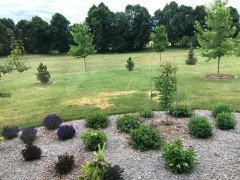
    What’s odd to me is that the severity is spotty. Here is another view. Majority of other lawns in the area don’t have this issue - although a couple do.


  • 6 years ago

    My lawn looks like that, and I know the reason. There are rocks near the surface in some areas and I spread milorganite unevenly.

    whaas_5a thanked kitasei2
  • 6 years ago

    Here is the last soil test I did August 2019. After this test there was a gypsum application in fall and this spring.


    This test is from the area shown above. The original pictures from this post have same data except ph is higher at 7.8.


  • 6 years ago

    When you collected the sample to be analyzed it was a composite from several small grabs througnout the area of interest, correct?

    As was mentioned above, I would not be surprised if there was something below the surface in that area that was interfering with root growth in that area. Buried rocks, in my parent's house an area like that found a bunch of bricks......buried construction debris leftover from when the house was built.

    Could just be the topsoil is much shallower there. Is this newer construction? Often the topsoil is removed or barely existant in newer constuction and there may be clay or whatever subsoil you have not far below the surface. Dig into it a bit (literally) and see what you find.

    whaas_5a thanked woodnative
  • 6 years ago

    I may try leaves but it might be easier, although more expensive, to do the compost.


    The lawn is half way through year 4. I’m fairly well versed with gardening and spent some time learning from Trey Rogers so I’m just perplexed at this point.


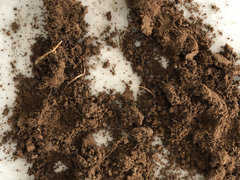
    I had dug into this area and it just becomes more sandy, gritty with some plum sized rocks worst case.


    Here are sample plugs I just pulled. It’s a bit dry so I only got 4” down then started hitting that dry grit.


    What do you all think? Is it just has simple as excessive drainage and sun then goes dormant?


  • 6 years ago

    I'd need a close-up to be sure, but it could just be thin soil right there. I don't (from a distance) see any evidence of other problems, and the color sure looks like dry grass. That hay color is characteristic!


    Leaves--composted or just mowed in--are always good and I'm always a fan of any organic material from any source. Leaves are one of the best, but, unfortunately, rare in June. If that area is usually a problem, I'd take note of it and concentrate on mowing leaves in on that patch in fall, though.

    I have a few areas I concentrate on, then, as they improve, I move on to other areas I've noted that were secondary. Over time, everything evens out to dry out all at once.

    whaas_5a thanked User
  • 6 years ago

    We had a 1/4” of rain a few days ago and none of it greened up. I’m just dumb founded and to what is happening.


    The grass has to regrow from the crown.

  • 6 years ago

    I didn't see your photo and post before I posted.


    "I had dug into this area and it just becomes more sandy, gritty with some plum sized rocks worst case."


    Thin soil, then. I have that in my southwest corner (the worst area for sun and heat in my lawn as well, so I'm doubly borked). Water more in that area, although I wouldn't go crazy or anything. Keep to deep and infrequent watering but, if you happen to water twice a week right there, that would be fine. If not, the grass will certainly recover in fall.

    I let mine recover in fall. I don't irrigate my lawn except for small amounts during extended dry spells.

    Over the years, mow fall leaves in on that spot and build up organic matter. This is not a sprint, it's a very long run, so don't think it has to be done in a summer. It doesn't and it won't be. :-) As the years pass, you'll notice the spot shrinking slowly although it'll probably always be a little more dry and a little harder to deal with than the surrounding grass.

    There's always That Spot.

    Even I, Self-Declared King of the Lawn Forum, have That Spot.

    Several, in fact. It's been a dry June and my lawn looks so much worse than yours.

  • 6 years ago
    last modified: 6 years ago

    That certainly looks sandy!! I imagine water runs right through that. Now the obvious, when you dig into right after, one day after, two days after, three days after a rain (or watering) how moist is it? I imagine most of the water is running through that pretty quickly (?). I am guessing organic matter would help (well, extra organic matter is always good), but it would have to be a LOT of it. You may have to with frequent irrigation, or stop fighting it and make a nice bed there of drought tolerant plants.

  • 6 years ago
    last modified: 6 years ago

    Can you tell I’m impatient? lol

    I actually have plant killing wafter. Ph is between 8.2 and 8.8 with 180 to 200 ppm alkalinity. After a deep watering and no greening I ended up putting down milorganite and then had greening.

    It’s fast draining and starts to dry out n 3-5 days. But its not all that sandy - my sandy soil maintains more moisture.

  • 6 years ago

    Do you dig your soil to bake cakes, 'cause that's baking soda. :-) It's not too horrible, grasses don't really care about excess calcium and magnesium except in terms of soil tightness, fortunately. And your response was correct; dump organics.

    You certainly could drop 1/4" of compost and let it work in (more than that would smother the grass crowns). Then do it again once the compost disappears as the worms and other critters move it into the soil. Repeat. And so on. Eventually the soil will transform.

  • 6 years ago
    last modified: 6 years ago

    How high are you cutting the grass?

    tj

  • 6 years ago

    morph, you mentioned excess calcium and mag. I have a deficency in Calcium but excess magnesium. Any thoughts on reducing magnesium?


    tj, I cut to 3" in spring and then go to 3.25 or 3.5 during the growing season.

  • 6 years ago

    You do have those other issues but higher mowing promotes deeper roots. Mich State suggests the highest setting, usually 4 inches.

    tj

    whaas_5a thanked tsugajunkie z5 SE WI ♱
  • 6 years ago

    Tj, I used to cut higher but what happens as the grass drys out it flattens and doesn't bounce back until fall or sometimes the next year if the fall is dry too. You should see the entrance to our subdivision. Guy mows its close to 2.5" and there isn't a green blade of grass to be seen.

  • 6 years ago

    "morph, you mentioned excess calcium and mag. I have a deficency in Calcium but excess magnesium. Any thoughts on reducing magnesium?"


    Gypsum. There are several kinds nowadays (fast, partially humate bound, and the old, slower stuff).


    Without a very recent soil test from Logan Labs, I wouldn't be able to make recommendations on which to use, how often or for how long to do this, however, to rebalance the soil. I'd need pretty precise numbers on your soil EC, calcium amounts, magnesium amounts, potassium amounts, sodium amounts, and the percent saturations in the soil for each.


    The last thing you want is to mis-balance the soil.

    whaas_5a thanked User
  • 6 years ago

    Morph, didn't you see his post of his LL soil test dated last August? Scroll slowly down this thread.

    whaas_5a thanked dchall_san_antonio
  • 6 years ago

    There has got to be something else going on. Being in WI with limited rain shouldn‘t kill the top growth. I’d expect dormancy but not top growth dieback in a matter of 2-3 weeks?


    Is they anything else I should be looking for?


    This happened last year as well. I recall watering in milorganite and it regrew.

  • 6 years ago

    Yep, saw the LL test.


    Limited rain in 2 weeks? Topgrowth dieback? Sure. It happens here in Pennylvania in 12-15 days, no problem, particularly in any areas where soils are thinner, or where the areas are pitched into the sun. My southwest section, which features pretty much every problem you can imagine, fries if we don't get consistent rain.

    Three weeks? 100% absolutely.

    Dormancy actually does involve complete dieback of the top growth--that's the initiation. What you mean is cessation of growth, which stops when soil temperatures rise over about seventy and soil moisture drops under about half saturated.