Software
Houzz Logo Print
webuser_76802794041

Help me bring my Rhododendron back!

6 years ago
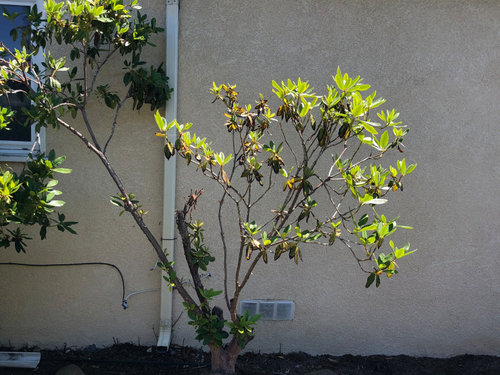
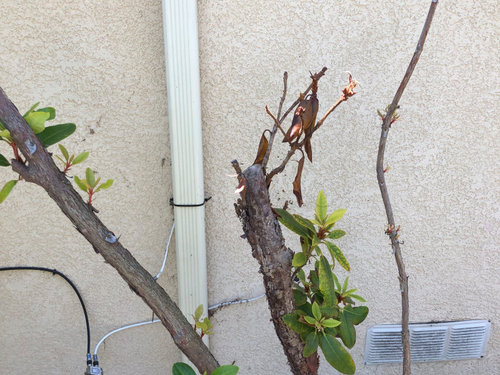
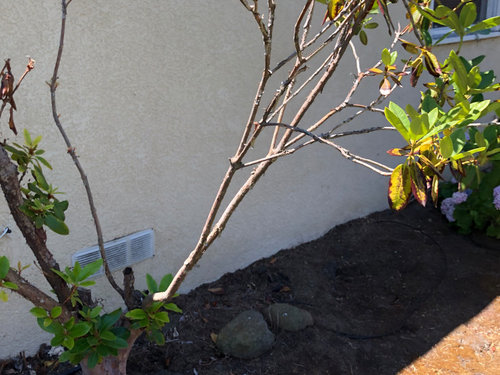
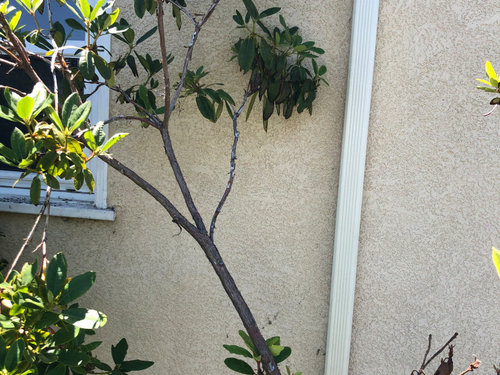
I have a very old and established Rhododendron that has some sort of disease and has been trimmed back a few times by my gardener. It is located next to the house in the shade most of the day next to a different species of Rhododendron that does fairly well. It is a few feet from the lawn which gets watered a few times a week. I am wondering if it would be OK to cut off all the longer branches to see if it will sprout more new growth at the base. Also was wondering where the best place to cut it back would be. Can I cut both "side branches off" at the same time? Where should I cut them, a few inches below the area they split into multiple branches? I realize it may take a few years to come back, but want to get this process going!


.

Comments (13)

  • 6 years ago

    Has weed killer been used around it? I see nothing growing in the bed. It also looks very dry and compacted. Has it ever been mulched or watered? And what is the geographical location?

  • 6 years ago

    "And what is the geographical location?"

    It's pathetic that at this point, Houzz doesn't have some kind of banner that appears for new posters in the old GW forums, stating "for plant questions, state your general location".

  • 6 years ago

    I don't see why you couldn't. There are plenty of leaves coming from the trunk, and cutting those trunks down will force the plant to grow new branches and leaves. Be sure you are giving the plant nutritionally what it wants and you should be fine. No experience with that particular plant, but every other plant in my world has reacted in the same way when pruned like this.

  • 6 years ago

    This is cross-posted to the California Gardening forum so would assume the OP is located somewhere there :-)

    Rhododendrons can be cut back hard - nearly to ground level - and they will typically respond well. It will take awhile but latent buds located just under the bark will be stimulated into growth and you will get new healthy green leaves. Have done this before any number of times. But will also caution that this is NOT a practice I would recommend for all other shrubs....some will indeed respond similarly but not all :-) With the wrong plant you could just get a dead stump!

    The growing environment does look very challenging for a rhododendron and the siting is very tight. I'd look to improve the growing conditions if I wanted to prevent this happening again.

  • 6 years ago

    Thanks Gardengal and Susan Yes, I am in the SF Bay Area. Any advice for improving the growing conditions? I am not exactly sure what you mean by "sitting tight". The root area is small?

  • 6 years ago

    "Siting" - not sitting :-)) It means it is a large growing plant placed in an area that is too small for its mature growth.

    Rhododendrons grow best in an acidic soil that is loose, fertile and well draining. They prefer some shade, need deep but infrequent watering during dry spells and especially in late summer into fall when they are setting next spring's flower buds. They need to be planted quite shallowly and mulched lightly......don't pile up soil or mulch deeply over their root system.

    They can also suffer if planted too close to concrete foundations or sidewalks. Concrete leaches lime indefinitely over its lifetime and that will alter soil pH and deprive the plant of accessing required nutrients. You may have to fertilize more to offset.

  • 6 years ago

    Is that a dryer vent on the wall, to the right of the downspout? I don't know that that's a contributing factor, but am curious.

  • 6 years ago
    last modified: 6 years ago

    Looks like a rhododendron with a foliage mildew problem. Complete with the attempt to grow back from farther down the trunk. So you should take a hand lens and look for mildew on the leaf undersides - when this is present there is a clearly visible moldy appearance. This comparatively recent (~1990s onward) bane is quite prevalent up here in the PNW.

    Otherwise another thing that produces similar leaf damage is rhododendron lace bug. If you have that the small winged bugs will be visible on the leaf undersides. In both cases the answer is to either undertake routine pesticide applications using the correct (as in proven effective) chemicals, in the correct concentrations at the correct times - or to discard the plant, if you don't want to spray it every year on indefinitely into the future.

    If it does have mildew (or lace bugs) it's not going to be able to come roaring back via replacement sprouts lower down the stems, after hard pruning - unless these are kept sprayed. Because these growths will be attacked also.

  • 6 years ago

    i dont understand whats going on at the root flare ... where the plant meets the ground ... is there landscape fabric in there???


    so .. if i understand .. when it was small .. and fully in shade... it did just fine ... and then when it gor tall enough to grow out into the sun .. it started having trouble... coincidence??? ...


    you can cut it down ... if the root mass is intact ... no problems down there .. it should return with some vigor.. but it sure doesnt look like it is doing that .. so why would it with a hard cutback ...


    its probably time for it to go ... its just old and spent ... and you can replace it with a new vigorous plant ...


    lawn irrigation is rarely sufficient for transplants .. so if you go that route.. try to water it properly for a few years ...


    other than that.. a mature plant.. shouldnt need all that much watering ... except perhaps in drought ...


    soooo.. if it were mine.. i would cut it back to under a foot.. and see what happens.. and if it didnt get its act together.. i would replace it in fall or spring.. whenever the next proper planting season is ... wherever you might be ..


    this is a good primer on planting: https://sites.google.com/site/tnarboretum/Home/planting-a-tree-or-shrub


    ken


    ps: i think you use the term gardener loosely...

  • 6 years ago

    cut it back to under a foot.. and see what happens

    This would be a waste of time if the plant is infested, which it very much looks to be. Unless a well chosen and consistently undertaken spray program is made part of the process. Instead of leaping into the chopping down the plant should be inspected first for mildew or lace bugs.

  • 6 years ago

    Reducing the height of the taller growing limbs will immediately improve the appearance, regardless of any "infestation", not that I can see clearly any signs of problems in this regard. Neither the powdery mildew nor lace bugs - if they exist at all - are systemic in nature so there is no guarantee or certainty that they will reappear with any new growth.

    btw, I've grown rhododendrons in assorted gardens all my adult life and I have yet to ever encounter a need to spray for anything!! I believe the OP's rhody is just suffering from some previous bad pruning and less than optimum growing conditions.....nothing more sinister than that.

  • 6 years ago
    last modified: 6 years ago

    Discoloring and premature dropping of older leaves quite visible in the photos posted here - while most recent, outermost set hangs on - very characteristic of a mildew infestation. Along with concurrent attempt to grow back from farther down.

    With plant asked about here looking just like a formerly handsome, decades old 'Unique' - one of many quite mildew susceptible cultivars present in the local area - that I had here. After the outer shell was spoiled the fungus started working on the trunk sprouts and then that was all she wrote.

  • 6 years ago

    btw ... welcome to the forums ...


    second btw ... in my world.. warped as it is ... words mean things ... and this is a shrub.. and not a tree ... so if you were researching pruning.. i would lean toward info on shrubs.. rather than trees ...


    its a minor thing ... but hey.. why not learn something new ...


    no need to post in the shrub forum.. its the same peeps as the shrub people ..


    ken