Software
Houzz Logo Print
kim_le65

Harmless or harmful mould ?

6 years ago
last modified: 6 years ago
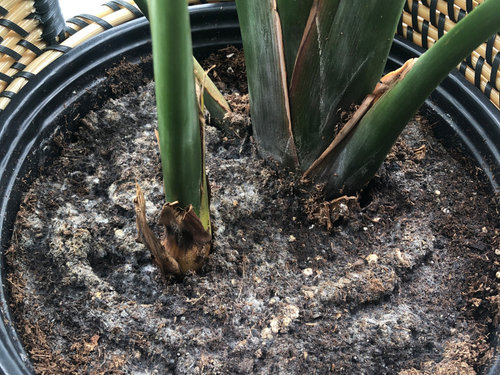
Hi everyone. I recently repotted several of my plants with a bag of sterilized indoor potting soil. So far, so good. However I sprinkled some nitrogen on the top soil a few days ago and the top soil it turning a strange colour that looks like mould... do I need to repot? is it harmless? Is it just the nitrogen turning a wonky colour? Thank you in advance!


Comments (12)

  • 6 years ago

    Mold - actually fungal mycelium - on potting soil is very common and completely harmless.

    But please tell us about the nitrogen you applied....what was it and in what form?

    Kim Le thanked gardengal48 (PNW Z8/9)
  • 6 years ago
    last modified: 6 years ago

    Hi gardengal48! This is the nitrogen I used. It directs you to sprinkle some ontop of the soil and then water. Should I be concerned at all the the top looks a little crusted and dark as opposed to loose? It’s the first time I’m applying nitrogen to my plants so this is completely new to me! I was very worried there was some sort of infection as I’ve never seen this on any of my house plants before. What a relief!


  • 6 years ago

    Probably the plant asking; why did you do sprinkle nitrogen fertilizer on my roots, and I am thirsty.

    What we’re the fertilizer directions?

    I might sprinkle a 1/4”/8cm layer of potting soil over the chemicals, and give the plant an extra drink for a few weeks.

    Kim Le thanked User
  • 6 years ago
    last modified: 6 years ago

    Blood meal and other organics are really intended to be used on plants growing in the ground. Plants in containers - like houseplants - need a different approach, typically a liquid or water soluble synthetic. And one that contains a full range of necessary plant nutrients, not just N.

    Kim Le thanked gardengal48 (PNW Z8/9)
  • 6 years ago

    Actually, molds and fungi of any type, including disease fungi, can grow on and in any potting soil (witness the issues people have with damping off and diseases with their plants on many forums). While this doesn't seem to be an issue for right now, it's wise to keep an eye on things to assure that your plant remains unharmed--and it's certainly not possible to ID a fungus by eye for the most part. 99% chance you're good, but do keep an eye on that. A quick spray of a bit of sodium carbonate in water, then wash it through very thoroughly an hour or two later will get rid of that.


    Plants grown in potting soil have access to all the nutrients in the soil which will be whatever it has available. Soil isn't magic, and soil in pots is the same as soil in the garden--except it's often enhanced when you get it, such as many of the Miracle-Gro potting soils out there (I have some minor issues with those for plants that don't require feeding, or for seedlings, actually).


    If your plant isn't potbound or a particularly heavy feeder, follow the proper feeding instructions. Organics are actually just fine for pots and I've been using them on my potted plants, indoors and outdoors, for years. And over the course of time, if kept at the right level of moistness, they'll develop a wonderful tilth. It's a bit of a practiced hand, but lots of us do it.


    Blood meal is a great fast nitrogen source and the bacteria to activate it are always available in any soil, including your pot. I'd suggest "easier to digest" organics for phosphorus, so I tend to use small amounts of Milorganite left over from the lawn, gently raked in as I don't personally care for the scent--but the dogs do.


    Potassium is always a bit harder organically but fortunately, most soils have ample amounts of it. I like to use liquid kelp, personally, as it also provides some gibberellins to encourage growth!

    Kim Le thanked User
  • 6 years ago
    last modified: 6 years ago

    Thank you @gardengal48 (PNW Z8/9) I’ll visit the garden centre and get something for my potted plants then. My boyfriend happened to have this blood meal and suggested I used it. I should Have done a little more research. @User i will follow your advice. Thank you both! Have a lovely day :)

  • 6 years ago

    Thank you @User! I’ll look into it a more before I dive in head first next time ☺️ do you ever use blood meal in your potted plants? Is there a friendlier way to use it for potted plants?

  • 6 years ago

    You can pre-dissolve it before pouring it on and that will get it into the soil rather than letting it sit up top and distribute it through the soil. It's a moderately big N boost (12-0-0) for the plant, but certainly not bigger than dropping Miracle-Gro on your plants at 24-8-16.

    My "magic" (there's no enchantment included!) formula for my indoor plants is as follows:

    A sprinkle of Milo worked into the soil every month or so, or if I used soybean meal, I'll use that. I'm not at all adverse to using ammonium phosphate if I have to, though, and during the winter I tend to run out of stuff and do keep some synthetics on-hand. I'm bad about keeping enough around and tend to run dry in March.

    Out in the gardens, I toss whatever I'm feeding the gardens with (Milo or soy) right into the pots in a large handful. That's more than enough to keep those going and the pots get huge.


    A wee pinch of blood meal in a quart of water, with a tiny (and I mean tiny) pinch of soluble kelp from a place like Kelp4Less or anywhere else that sells it would keep your plants absolutely thrilled for ages. Let dissolve. You shouldn't really see the blood in there, but the kelp should be moderately brown. Put some Milorganite on top of the soil (if you use it on the lawn or outside pots) once every two months or so during the growing season for a good kick. Dig in a bit (don't disturb the roots) to hide the scent. Or, if you can't stand that (and some people can't), pick up some soybean meal at the grocery store, it smells a bit like beans. Corn meal will also do OK, although it's a terrible feed at 1.5-0.6-0.4. Mix in a tad so it stays a bit damper--indoor plants don't stay as moist as outdoor ones do, that's for sure.


    But there's as many magic formulae as there are gardeners. And you can see that mine changes with what I can get. Skunked beer? Well, it's kind of organic...maybe a little, sure, but I'd dilute that down some. I'd pass on most fecal material, however, for obvious reasons...


    Like I said, it's not as certain-sure as garden organics, but pot organics absolutely can be done. Been there, done that, impressed with the results. I have some that are 100% organic (slower growers), some hybrid organic-synthetic (annuals, mostly). Over the years, the soils in those pots actually continues to get better.

  • 6 years ago

    Oh, and I skipped the important question. Yes, I have a large bag of dried blood. I use a small pinch, diluted in a quart of water, when I feel a given plant is Disappointing Me and Needs To Perform Better. If you saw (or read) Good Omens, picture Crowley when he saw the leaf spot. I'll combine that with kelp (which I use quite often anyway and swear by).

  • 6 years ago

    In the olden days, blood meal had an odor, wasn’t recommend for containers.


  • 6 years ago

    It still has a slight odor (hence the pre-dilution) and they still technically don't recommend it for containers. There's a lot of things they technically don't recommend for containers that you can use in containers.

    I can't say it bothers me, but it might bother others. Milorganite bothers me but might not bother others. Kelp I don't even notice and can't find too many other people who can detect it when diluted.

  • 6 years ago

    Comparing NPK numbers of various materials is only valid if you take into account how much you use. I know morph knows that but just for anyone else: 2 spoonfuls of 12-0-0 blood meal and 1 spoonful of 24-8-16 both have the same amount of N. And so on. The extreme case is compost, which is around 1-1-1 but you use a ton of it (as opposed to fertilizers) on the soil and it is very slow release.