Software
Houzz Logo Print
anj_45

Corn meal for fungicide

6 years ago

I have done lots of research on using corn meal *not corn meal GLUTEN* as a fungicide on my St. Augustine lawn. I would like to give it a try, but I cannot seem to find some answers, hopefully someone can help! I am wondering---


1. Does the time of year/season matter for application? I live in Texas. It is currently July with temps in high 90s, little rain (I am water once about every 5 days, or so). I know fungal infections, especially brown patch grows in cooler seasons. Will it be affective if I apply it now?


2. Will it burn grass? Concerned with hot weather here. I read a review on amazon where a women claimed in burned her entire lawn and regretted using it. Has anyone had this experience? I also know that it can be used as a mild fertilizer. I already fertilized in March with MicroLife organic 5-1-3. I do not want to over fertilize also. So that leads to another question...


3. If I apply corn meal, will I over fertilize, if I have done so in March?


4. An finally, can Corn Meal be used as a preventive for Brown Patch? I currently have Take All Root (which I have gotten under control pretty well), but I am hoping to avoid other fungal infections on my turf as my lawn is susceptible to them. Ex- shade, clay soil, St. augustine, etc..


Thanks in advance for any advice!

Comments (43)

  • 6 years ago

    Might wanna read this first: Cornmeal Myth.

  • 6 years ago

    I've already looked into the myths and research with corn meal not working. I've also read many stories of gardeners swearing by it. That's why I am willing to try it, if it is not harmful. As long as it is not harmful, then I only would have wasted some money. As much research as I have done, I have not found any information to answer my above questions.

  • 6 years ago

    We have a meyer zoysia grass in the front yard, due west facing. It developed "something". Kinda of a low spot and near a tree and flower bed. Grass was thinning and brown. Easy to pull up. I had food grade yellow cornmeal. Not a mix with the flour and salt/baking powder I usually use. I think I bought it for pizza. Five pounds less a handfull. I scattered it over the top of the area in question. It worked.

    Was it a myth, maybe. It did not hurt the grass, obviously. We haven't had any more problems. I didn't even have to buy any, since I already had it.

    ANJ thanked Sherry8aNorthAL
  • 6 years ago

    Thanks so much Sherry. Very helpful to know! Do you happen to remember if it was summer, or hot when you applied it? I love zoysia by the way!

  • 6 years ago
    last modified: 6 years ago

    Probably, because the lawn was green. That is why the spot that wasn't growing stood out. It probably went away on it's own, but like I said, I already had a bag of the yellow cornmeal. It was most likely a local stone ground kind, since that is what the pizza recipe said to use to crisp the crust. (Which DID NOT work, by the way. LOL.)

    Maybe it just fertilized it?

  • 6 years ago

    It won't hurt the grass any time of year. There's about no nitrogen in it, FYI. I used to apply it at 15 to 20 lb/ksf to improve organic content. I personally never saw it do anything for fungal issues, but others report success. It is not likely to help with an outbreak. It might help as a preventative (or it might not). If it is cheap I'd say go for it. Nothing to lose and good for organics.

  • 6 years ago

    Thank you for the advice! I was thinking the same way as you, good to be reassured with the nitrogen info. How often did you apply corn meal? I'm thinking I may use it in fall or spring as a preventive, probably once a year

  • 6 years ago

    If used as a preventative, once a year, about 10 pounds per thousand square feet, in spring. or very early summer. You can certainly apply it now, and it'll work through the rest of fall, though. Cracked corn may be easier for you to handle and is also just fine.


    Yes, we've all heard the "it's a myth thing," but the provided link actually doesn't contain any quoted science in and of itself, so that's kind of a big problem. I won't go into the quality or tone of the article, both of which are extremely poor.

    Nobody really studies these things very much due to the problem of there not being much money in it if it works and none if it doesn't. There's not a lot of money in tossing around (cheap) corn meal and as soon as somebody gets wind of what your product is, they can get it at the store. I can source cracked corn


    As I often say, try it for yourself and decide. I'm not going to say it's a strong deterrent to severe lawn diseases. It's not. If you have the occasional tendency to sometimes get a little fungus, it may help. That was the level of interference I personally noticed.

    Others report better effects but I, personally, cannot state those definitively, of course. :-)


  • 6 years ago

    I've used both cornmeal and cracked corn. Some like cracked because they found that the cornmeal caked up on them. I used cornmeal numerous times and never had that issue. I know morpheus disagrees with me on this, but I would not use cracked corn again unless it was really, really cheap. The debate is over birds. Whenever I used cracked corn the birds would find it. morpheus, if I recall correctly (don't want to put words in his mouth) wasn't concerned with the birds because they couldn't get enough of the corn to cause a problem. I disagree. I counted 65 birds pecking at corn in my back yard off and on for the next couple of days. This only happened with cracked corn. With cornmeal I had 0 birds, plus the cornmeal probably breaks down quicker than the cracked corn. When I put down 50 lb of cornmeal that's what ended up in the soil. With cracked corn I wouldn't be surprised if the birds got more than half of it. Just my opinion. Use whatever you can get but try the cornmeal first! lol.

  • 6 years ago

    It's more that I enjoy the birds and I'm using much, much more than 10 per K for the soil conditioning properties. Whether I get that from the corn or from the digested corn is all the same to me.

    Besides, if I don't feed the crows, they report my doings to the Institute. (Fallout 4 reference)

  • PRO
    6 years ago

    If one owned a corn meal mill, wouldn't it be great to get a rumor started about how corn meal was the new, safe lawn weed killer? Think of how much cornmeal could be harmlessly dumped on lawns! In the 20 years it took for the rumor to run its course, you'd sell a lot of corn meal that people wouldn't have otherwise bought. It would be just as good for corn meal selling as the idea that baking soda, sitting around in an open box, could clean the air and remove refrigerator odors, is good for baking soda selling!

  • 6 years ago

    I don't know how that is

  • 6 years ago

    That...seems far-fetched and the sort of conspiracy theory that would require some proof.


    Imagine you were a worker for a chemical company and came onto large online boards claiming that cheap methods didn't work so people would run out and buy more expensive chemical solutions, some of which would be yours.


    See?


    Incidentally, sodium bicarbonate really should work. Again, there's no percentage in studying it--why bother? There's no money in it--but it'll neatly react with butyric acid, which stinks, to form sodium butyrate, which doesn't. In the refrigerator, where such things can concentrate and the air circulates internally, that should work. I wouldn't bother doing it in large spaces. That's not the only useful reaction or simple odor-masking.


    Yes, yes, the next argument is "but...large cake." You really should be mixing or shaking that container of bicarb regularly. People don't.


    Simple kitchen chemistry can be far more creative than most imagine. Now ask me about the transformation of sodium bicarbonate to washing soda. Been there, ran out of washing soda, done that, got the Scout badge. Figuratively speaking.

  • 6 years ago

    "That happens at about 80 pounds per 1,000 square feet."


    Disagree. :-) I was dumping corn plus leaf mass in October at double that and still couldn't manage. That lawn just...glowed.

    That was the year I was dropping a total of 1,300 pounds per thousand square feet (yes, 1.3 pounds per square foot) just to see if I could overdo. I couldn't. October was the last and heaviest attempt at that. The only thing I overdid was my back.


    You might set off some nasty odors with higher-nitrogen feeds at high rates, but I didn't try that. I kept to low-N stuff I knew wouldn't get nasty. Even so, there was often a minor odor of decay hanging over the property that year. Total equivalent N was 37 pounds.

  • 6 years ago

    high amounts of nitrogen can smell like ammonia or manure

  • 6 years ago

    I give my seedlings a nitrogen boost by making a liquid fertilizer from grass clippings

  • 6 years ago

    High amounts of nitrogen can smell like death on a pogo stick. When I've overshot in the compost bin, it's been gaggingly bad and I've had to shred newspaper to absorb the stink in a high-carbon mass.


    "I give my seedlings a nitrogen boost by making a liquid fertilizer from grass clippings"


    I never thought of it, but yeah, it would work! You could also put them in a blender to make a light slurry or just a nice juice and use that. It works out as a 4-1-2 equivalent fertilizer (dry weight, which is not much compared to mowed weight), plus some more stable organic compounds.

    The one thing I'd be careful of is that the grass in question is not suffering a fungal disease, but that's not a major issue, and was not treated with an herbicide any time recently.

  • 6 years ago

    ok I just soak the grass clippings in water a few days

  • 6 years ago

    and my soil is clay in a flowerpot

  • 6 years ago

    dchall- Thank you! That really helped. And no, your name did not come up in my research...wish it would have! So my plan in early September is to lay down some corn meal to prevent brown patch and later in the month use MicroLife 5-1-3. Does that seem reasonable to you? Or should I just do one or the other?


    Also, I will create a new thread once I test my soil. I believe it is clay because it is thick and cracks...leads to lots of water logging. In fact, half my grass died last year in areas where water was just sitting. At first I thought it was dying due to take all root (which was diagnosed at a nursery...they looked at it under a microscope). But then the grass came back this spring after I aerated the lawn and applied poultry compost! A local gardener that works at a nursery near by said this area has a lot of clay. Will get it tested though! Have been wanting to do that anyways to also check for pH. I also apply peat moss here and there to make it more acidic to suppress take all root. Thanks again for the advice!

  • 6 years ago

    Sherry- I am glad your yard turned out!! I'm sorry your pizza did not. The corn meal did not go to waster lol :)

  • 6 years ago

    clay will not easily drain well and sometimes water lays there for days

  • 6 years ago
    last modified: 6 years ago

    There's something even better than cornmeal for fungicide, just pray that the fungus goes away. Or even better, apply preventive prayer starting early spring so you don't get it to start with. That's what I do, and I have no fungus. So 100% guaranteed, and no need for nasty chemicals either. Doesn't hurt anything, so why not try it.

  • 6 years ago

    Howard- that's what I am thinking could have started this whole fungus thing. Water sitting

  • 6 years ago

    Lawniac- I spray Actinovate monthly and compost tea monthly. What preventative sprayer do you use? Was thinking about try Serenade too. My lawn has greatly improved!! It's been lots of work though for sure. Lots of figuring out too. Have lots of things I am dealing with. I almost just went for sedges/ mulch/ and stones. But I have a little dog who loves grass lol

  • 6 years ago

    No no, I said preventive prayer, not sprayer. Just pray the fungus away. Won't hurt anything, so why not try it.

  • 6 years ago

    Serenade actually is an excellent preventative as well.

  • 6 years ago

    sometimes chemicals used In commercial herbicides can kill your garden and lawn but i know no alternative to fungicides the corneal could have made food source for the fungus

  • 6 years ago

    Serenade isn't a chemical--it's a bred bacteria that eats fungi for lunch, proverbially speaking. It's quite effective in surface disease control and, so far, nobody's found negative side effects.

  • 6 years ago

    Okay then use it some fungicides yu have to be careful with

  • 6 years ago

    I used to be a huge compost tea proponent. I even built a website that showed about 100 thousand people how to build a really nice actively aerated compost tea maker with aquarium parts. Then the compost tea guru, Dr Elaine Ingham, got into a urinating match with a professor from Arizona who claimed that compost tea was completely dead and had no microbes in it. After they went back and forth a few times, Dr Ingham finally decided that of course the AZ prof had no microbes, she was using tap water in the AZ summer and no beneficial microbes can live at all in water warmer than 80 degrees F. What??? For me in San Antonio (at the time), that meant the only time compost tea had any microbes would be November through March. This was a big, big deal for the two doctors in the spat. 80 degree water contains so little oxygen that it cannot support many microbes at all. Then if you feed them, they try to multiply and the dissolved oxygen goes to zero immediately. That leaves you with a mess of non-beneficial anerobic microbes in your tea. The, more or less, ideal temperature for compost tea is 55 degrees.

    I also used Actinovate once. The "unbelievable results after one use" never appeared for me. I sprayed more and really, nothing happened.

    One thing you might not have found directly in your literature search is the origin story for cornmeal as a fungal suppressant. The original website at Texas A&M Stephenville has been taken down. Before Stephenville was in the TAMU universe, they posted a laundry list of fungal suppressants for farmers with a paragraph about each one. The earliest reference I found went back to the 90s and remained unchanged until about 2010. The post claimed that peanut farmers had discovered that ordinary cornmeal had the same effect as crop rotation for fungal control, and they named all the diseases. That obtuse wording did not come out and say "use cornmeal to control disease." It said cornmeal had the same effect as rotation. I think that verbiage kept this information from getting discovered earlier. It wasn't until about 2003 that someone in the gardening industry brought it to light. Crop rotation is something farmers do when the soil becomes "poisoned" or diseased or just plain wore out. They bring in a different crop or let the soil fallow for a year until it gets better. Obviously they would rather continue selling their crop all the time, but sometimes they had to stop. So cornmeal had the same effect as crop rotation. That meant that farmers could grow peanuts year after year without stopping if they only used cornmeal. I might add that this information was buried in the middle of a long article of fungicides.

    If you're west of East Texas, your pH is likely 8.0. The test will tell.

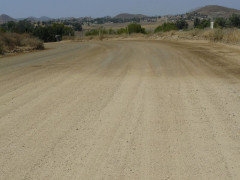
    Excess magnesium can make your soil act like clay. Here is a picture showing the line where mag chloride was sprayed as a dust suppressant on a dirt road in California.


    The mag chloride absorbs dew and moisture thus keeping the dust down. If you or your predecessors used Epsom salts or other magnesium product, this could be the cause of your water retention. That can be fixed once it's diagnosed in a lab.

    One thing you can do without any further diagnosis is to spray the lawn with shampoo at a rate of 3 ounces per 1,000 square feet. Any clear shampoo will work as long as it has no conditioners. Conditioners make it cloudy, so any clear shampoo. Follow that with 1/2 to 1 inch of water to take the shampoo down into the soil. If you get runoff, stop watering, let it sit for 15 to 30 minutes, and continue until you get at least 1/2 inch. The surfactant effect of the shampoo should allow the water to penetrate all the time. It takes about 3 weeks to see the effect happening. You'll notice that the soil is soft to walk on after you water or it rains. You'll never have to aerate again after the shampoo.

  • 6 years ago

    because corn gets the fungus smut

  • 6 years ago

    Smut's really only an issue in low-light, high-stagnation, high-humidity areas.

    Fun fact: For a while I was on a really nasty and dangerous medication made from smut to treat migraines. It worked, but the side effects weren't exactly what I'd call fun. Medications in the '20's are much better.


    You shouldn't get smut in the lawn...hopefully. Your warehouse, maybe. If you do, the witches aren't real and you don't have to start a witch hunt.

  • 6 years ago

    Yes, corn gets fungus disease, too. The reason corn works against lawn disease is that it gets some unnamed fungus, which attracts the Trichoderma fungus already in the soil, which is a predatory fungus feeding on other fungal species. With a large population of Trichoderma, it also wipes out the other lawn disease.

  • 6 years ago

    morpheus- I think I will apply the 10 lb/ 1000 sq feet as a preventive! Thanks for your suggestion, I think it is worth a try. And I agree about that posted article.

  • 6 years ago

    dchall- I'm glad you mentioned your findings on compost tea...but how sad! I've been using compost tea once a month all summer :(

    If I choose to have an optimistic view, now I can save money. I definitely live west of east Texas. I guess I will only apply compost tea in cool months now. It really perked up my Yaupons last spring!


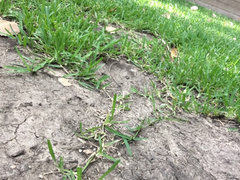
    That's a photo of where the grass is still coming back. Maybe I have more of a silty loam, or clay loam? Will keep you posted and try the shampoo thing next time I water!

  • 6 years ago

    Howard- I have not used corn meal of my St. Augustine yet, so it definitely did not get take all root from that. I think it was a mix of compacted soil and shade that contributed to fungus growth. Unless it came contaminated? I did notice a yellow patch early, which I treated with Actinovate and it took care of the problem in that area immediately. But I have not used any type of chemical in my lawn. Only organic stuff. My grandma has fungus in her St. Augustine as well. She has treated her yard with chemical fungicides and weed killer. Mine is coming back nicely and hers continues to die. I really think with fungus, it is important to modify the environment through an organic process. For me that has been changing pH, de-compacting soil and correcting my watering method. I have used compost tea, aeration w/ poultry compost, actinovate, neamatodes, peat moss, seaweed w/ iron. :)

  • 6 years ago

    good you are doing something about it I didn't say it caused the whole problem

  • 6 years ago

    must have been from other sources

  • 5 years ago

    Hey guys! I decided to lay down the corn meal. I did 10lbs/ sq ft for preventative measures. I did it later then planned due to my crazy schedule right now. It ended up raining a ton since a hurricane came to the gulf. Now with low sunlight the areas that clumped a bit of corn meal, now have mold growing. I picked up the leaves in my yard and sprayed actinovate. Should I be concerned? Or anything else I should do? Thanks in advance!

    @User @dchall_san_antonio @danielj_2009

  • 5 years ago

    Not really, no. I get blossoms and "flowers" of mold around Milorganite and soy every time I spread it. It's normal, and what's going to decay the stuff into food for the lawn. It's also definitely not going to attack your lawn. Those are decay fungi, not disease fungi.


    We're hopefully up for some of that sweet, sweet Beta rainfall in the next few days. It's been a dry September and we'd actually like some soaking rain, thank you very much.

  • 5 years ago

    Thank you! The rain was definitely nice!

Sponsored
Custom Home Works
Average rating: 4.6 out of 5 stars10 Reviews
Franklin County's Award-Winning Design, Build and Remodeling Expert