Software
Houzz Logo Print
eric__86

What is wrong with my lawn?

6 years ago
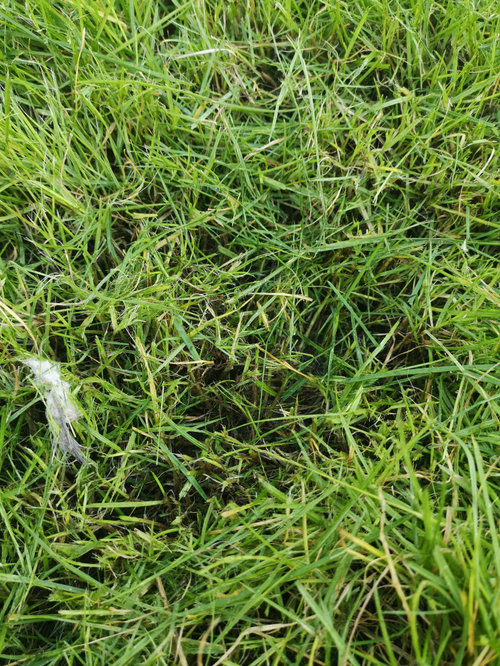
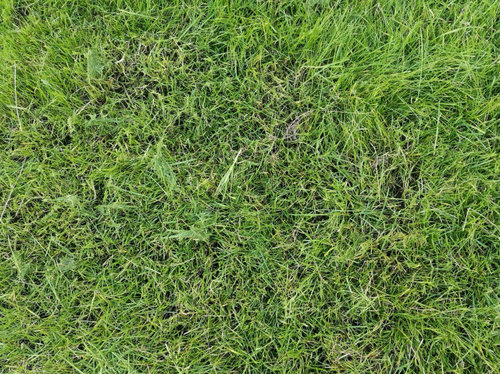
I recently had new lawn turf laid at the end of May. I watered it well and let it grow for 3/4 weeks before mowing it at the mower's highest cutting height. As advised I left plenty of the grass cuttings on the lawn. All was well at this stage. Since then weather has been really, really wet and between one thing and another I hadn't mowed the grass in about 5/6 weeks. I mowed a patch yesterday and noticed that the grass seemed "patchy", as I could see the dark of the soil underneath clearly. It's as if the grass has thinned out or something, which wasn't obvious when the grass was longer. I've attached some photographs here which hopefully will describe what I'm seeing (not as obvious in these photos unfortunately).

Is the problem excess moisture from the constant rain? I was thinking with the grass being left long maybe this kept everything shaded and on the occasional hot days the shade from the long grass prevented it from drying? Or maybe it's something else entirely?

Appreciate your help!


Comments (9)

  • 6 years ago

    I suspect a fungal disease. Where do you live and what kind of grass do you have?

    eric__86 thanked dchall_san_antonio
  • 6 years ago

    Was it seeded or sodded? I suspect it's just taking it's time filling in. I see no evidence of disease.

    eric__86 thanked lindac92
  • 6 years ago

    I'm based in Ireland. I'm not sure on the kind of grass but it was sodded around 8/9 weeks ago.

  • 6 years ago

    Thanks so much for the detailed response. I'm very close to Dublin so the weather you will have pulled up will be accurate. Regarding the white/gray markings, if you are referring to the first picture, the area on the left that's actually a feather that's out of focus. Do you still see signs of a fungus in the pictures aside from that? And would your advice around feeding still be applicable regardless? Thanks again

  • 6 years ago

    That was obviously a feather. :-) There are gray and white markings around the bases of the grasses in the center-right and right-ish parts of the bottom photo, if I'm reading that right.

    Plus...grass intuition. It just doesn't...feel right.


    The feeding thing was actually pretty standard advice. I skipped the watering advice because...well, Ireland. Your idea of summer is early May for me (it's currently 94 F, 34 C and that's pretty reasonable for July). If it does need to be watered at all, do so deeply and weekly during droughts. Or skip it, it should be fine.

    That looks like a mixed fescue (European variants do differ so that's a tough read for me), so it should be fairly drought-tolerant once established. It can survive longer dry periods but, once it goes fully brown, it should be watered. Unlike bluegrass, it can't go dormant for very extended periods of months.

    Regardless, it's not that demanding a grass and should reward you with good basic care. Coddle it now during establishment and it'll make you pretty happy for decades.

  • 6 years ago

    I guess your grass has a fungal infection.

  • 6 years ago

    I'm having trouble finding fungicide here in Ireland. It seems most are restricted and can't be purchased over the counter. However I did come across this one -

    https://www.thegardenshop.ie/fungicide/

    What that be suitable for a lawn (if print the fact that it's a spray)?


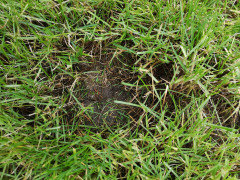
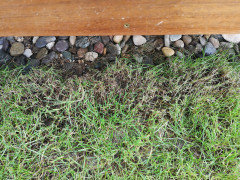
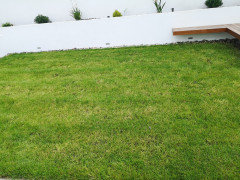
    I've also attached some updated photos of the most concerning parts of the lawn. The first photo shows a small section which is almost grass-less. The second photo shows brown discolouration on the lower parts of grass near the soil (interestingly when this section of grass grows longer it's much greener at the top; I thought it had cleared up until I mowed the lawn again and saw it was still brown at the bottom). The last shows the lawn overall and the subtle yellowish patches here and there across the lawn.


    Is there a common issue linking all of this or am I dealing with different problems in different areas? Does this still seem to be a fungus issue?


  • 6 years ago

    If you absolutely had to, I'd spot-spray with that in the worst areas to see if it helped (and a region around to treat those as well). If it did, that would prove it was a fungus issue. This isn't a particularly wide-spectrum fungicide, nor is it rated for grasses, so I'd test it in a small area first and let it sit for a few days to make sure it doesn't do any harm (it shouldn't). If I absolutely had to. But...read on first. And sorry for the book.


    There are three other fungicides you should be able to get because two are not rated as fungicides but work admirably. The third is, but is generally available anywhere as it's not a biochemical. If I were you, I'd probably start with the copper (regardless of the warnings, one or two uses is not going to be an issue), then move to the baking soda, and use the iron sulfate just as a mild preventative.


    I don't think you can get Serenade over there (it's a bacteria that gobbles disease fungi and some harmful bacteria for lunch). If so, that's another prevention option. It's not a great curative as it's not a fast worker, but for prevention--sure, and it's non-chemical and harmless to humans and animals.


    Copper sulfate--aka Bordeaux mixture, commonly available as an "organic" fungicide or a micronutrient or you can order it as a stand-alone chemical for a variety of uses, Dilution rate is about 3 tbsp copper sulfate into 1 gallon water, with about 1 tbsp soap (the amount of soap is not that important so long as it gets the stuff to stick to the lawn). Spray on the lawn until fully damp, so that gallon should cover about 1,000 square feet. Many mixes add hydrated lime, but I don't recommend this.

    Toxicity to you: Don't drink it, because it tastes bad, but as far as the spray is concerned, it's harmless. You'll smell like copper (crab blood) after you apply it. Plan to shower afterward.

    Yes, this sounds like a touch of magic in a world obsessed by science. Now, a warning. (I love the movie "Death Becomes Her"). Copper is mildly toxic in larger quantities and toxic in gigantic ones. While 3 tbsp is not a larger amount, it shouldn't be used in soils that have large amounts of copper already, used repeatedly over the season (more than about 3 times), or used season after season (more than about 3 to 4 years) without a soil test showing that your copper levels are still OK. One or two uses are not a problem.

    This is also a very wide-spectrum antifungal, it'll take out the good with the bad on the surface.

    On the up side, it also generally increases the lawn's resistance the fungal diseases over time. Long story.


    Baking Soda--Sodium Bicarbonate, from the grocery store. Arm & Hammer around here, about the only brand you can get because they're essentially got a monopoly in the Northeastern United States, at least. Not washing soda, which is different, the stuff you use to bake with.

    1 tbsp in 1 gallon water, with 1 tsp to 1 tbsp soap (again, the soap amount isn't important). It should cover a couple hundred square feet as, in this case, you do want to damp it down good with your sprayer. Use can be repeated every 2 weeks if necessary, although if the first 2 aren't working, it's wise to try something else.

    Toxicity to you: None, you bake with the stuff. Except for the soap, it's scentless.

    This is a very wide-spectrum antifungal that will also knock out everything it touches via two mechanisms--pH shift toward the alkaline, and the fact that the sodium is toxic to fungi.

    Warnings: Overuse will damage the soil over time due to the sodium levels, although that takes a lot of use very often to happen and isn't anything to worry about in most areas. Ireland isn't a locale where I'd be concerned about a couple or five uses, the sodium will leach out easily in your rainy climate. And if not, a bit of gypsum will clear that right up. Sodium is no particular challenge.


    Iron sulfate--aka Copperas, not to be confused with copper sulfate, and not listed as a fungicide because it's an indirect killer, the weakest of the three, and not very reliable (and probably not going to work as well in your case). Available in most garden shops to green lawns or can be ordered as a chemical for a variety of purposes with no restrictions.

    Dilute at 2 oz in 1 gallon water with about 1 tbsp liquid soap. Spray until damp, or about 1,000 square feet.

    This kills existing fungi by shifting the pH at the blade and soil surface sharply in to the acidic and isn't perfect, but often helpful.

    Toxicity: Don't drink it, although it actually wouldn't hurt you. Iron does smell so again, plan on showering afterward.

    Warnings: Grass reactions including turning the blades darker green. The lawn absorbs the iron and uses it to synthesize more chlorophyll. We use it here to green our lawns. It is a wide-spectrum fungus killer, but none of us worry about it much because, again, it's not that strong. In your cooler, wetter climate, using iron sulfate occasionally might provide a bit of a shield against fungus once you get the problem under control. Monthly, maybe, for a year or so during the growing season until the issue's past?

    Soil considerations: None, really. Iron soil levels can go to 50,000 PPM without being a problem. Just by looking, I can see that yours are nowhere near that.


    eric__86 thanked User
Sponsored
Custom Home Works
Average rating: 4.6 out of 5 stars10 Reviews
Franklin County's Award-Winning Design, Build and Remodeling Expert