Software
Houzz Logo Print
kam03

Electric Tankless Hot Water Heater

6 years ago

Hey All! I am thinking about installing an ELECTRIC Tankless Hotwater heater. In the past our homes have always had gas so, and we loved our GAS tankless water heater. I have no experience with the efficiency or quality of an electric tankless water heater. Does anyone have one currently or has had one? I would love to know some thoughts on the quality, and if it's worth it.


Thank you!

Comments (42)

  • 6 years ago

    They work just fine if you buy from a quality manufacturer. Just be aware that even the small ones require runs of heavy gauge cable and have large amperage/breaker needs.

  • 6 years ago
    last modified: 6 years ago

    A whole-house electric tankless requires a 100 to 120 amp electric circuit. That's 4x more than an electric dryer, 2+x more than an electric range. They're easy to plan and install on a new construction. Not so much on an existing home if the power infrastructure isn't in-place.

  • 6 years ago

    Usually don’t need to increase size of supply lines to the home, but agree that internal parts of the home electrical system may need changeout/upgrade.

  • 6 years ago

    If you have gas there's no place for resistance electric water heating.

  • 6 years ago

    I’m going to chime in - could someone please explain at a third grader level what exactly has to happen to do the necessary upgrades to allow for a tankless electric install? Last time I had an electrician over he said it was doable, but on here I keep reading that it’s complicated and I’d like to be able to ask the right questions. We’re in a condo building, not sure if that helps or makes things more difficult!

  • 6 years ago

    recordaras-

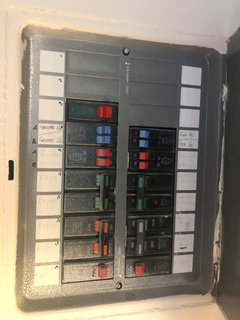
    1. You need to have room in your breaker box for 2-3 additional, large double breakers.

    2. You need to have a large enough breaker box to handle the additional electrical load.

    3. You need to run heavy gauge wiring from the breaker box to the tankless unit.

    All of these things may be easy or may be complicated depending on what electrical capacity you already have in your place and how hard it will be to get the wires run to the tankless unit. Just bear in mind that these units aren't something that have a cord that can be plugged in to any old outlet in your house; they need dedicated wiring that runs directly to the appliance. Take a look at the online install manual for any tankless unit to understand what size wires you need and what breakers are required. Many manufacturers also have sizing tools on their sites that tell you how big a unit you need to buy to meet the demands you will place on it.

  • 6 years ago

    Thanks kudzu9! Looks like 3 might be an issue, but we do have 2 double breaker spots available if my math is correct. And water heater is right under the breaker box on the lower level. Another stupid question - I’d need to get input from a plumber and an electrician, correct? Or is the plumbing fairly straightforward? Our main reason for wanting to switch is that it would free up a whole giant “under the stairs” tech closet that we could use to house bikes, suitcases, tools etc. and free up a lot of bedroom storage.

  • 6 years ago
    last modified: 6 years ago

    The electric feed coming into the house must also have enough capacity to carry the electric tankless along with whatever else may be operating at the same time. An older house with 100 amp incoming service or less would need to be upgraded.

  • 6 years ago

    Thanks dadoes. That’s probably where the whole condo thing gets complicated. Sorry for all the dumb questions, but would that be something the electrician can determine by just looking? I know our shared building electric “stuff” can only be accessed with someone from maintenance, so looks like I’d need to arrange that ahead of time.

  • 6 years ago

    And if it makes any difference, these are buildings built in the 40s and converted to condos in the 80s. Six units to a building.

  • 6 years ago
    last modified: 6 years ago

    recordaras-

    The plumbing is straightforward. If you've done any sweat soldering, you should be able to do it. The only thing besides running hot and cold lines to the unit is that you should also plumb in a service valve kit which allows you to easily isolate the unit to do maintenance, like an annual flush:

    https://www.amazon.com/gp/product/B0046ECKS6/ref=ppx_yo_dt_b_search_asin_title?ie=UTF8&psc=1

    We can only speculate whether your breaker box can handle the load, but any licensed electrician will quickly be able to assess the situation.

  • 6 years ago

    Thanks! Did a search on our local listserv and apparently the closest anyone has gotten to an answer is management saying some units might not have the proper “amperage capacity”. So not getting my hopes up but will still try to investigate if it’s at all an option.

  • 6 years ago

    Sigh. Yeah none of this is sounding like I’ll be able to get that extra storage space. Thanks for spelling it out Jake!

  • 6 years ago

    All the various parameters regarding electric tankless depends on the very specific details of the circumstances. My incoming tap water in the summer (on the TX coast) can be 80°F+. Checking it a few mins ago running the cold tap at the kitchen sink into a glass for several mins with an instant-read thermometer, 86°F. 103°F is my normal set temp (for a shower), a 17°F rise under the conditions at the moment. My shower flow-rate is typically less than 2 GPM.

    There is no natural gas in my neighborhood a couple miles outside town. The builder opted to go all-electric instead of propane.

    Electric tankless, of course, absolutely is not suitable for every situation.

  • 6 years ago

    Don't mistake the above scenario to mean that I have a small-capacity
    tankless on a little electric circuit. It's a whole-house unit on a 120
    amp circuit (two 60 amp breakers). It can pull full power when needed
    such as if I want to wash a load of kitchen towels in 140°F water in
    January.

  • 6 years ago
    last modified: 6 years ago

    @dadoes,

    You obviously are not wrong... but it's important to put some numbers to things to avoid magical thinking. Without knowing specific information to the contrary, we use 105 as the output temp, 2.5 gpm for a shower, 4 gpm for a standard tub, 1 gpm for a bathroom sink and 2 gpm for a kitchen sink. Typical water temp supplied from an underground waterline, even in the summer, is around 60. In my neck of the woods (Central Indiana) water can be 35 in winter.

    And you do have to design for reasonable performance in worst case - you can't have a water heater that only supplies enough hot water for showers in the summer.

  • 6 years ago

    "dadoes: Electric tankless, of course, absolutely is not suitable for every situation."

  • 6 years ago

    I have not yet in 15-2/3 years had an occasion in which I couldn't get sufficient heated water. Except the incident when the flow-meter on the tankless went bad (sourced the part and DIYed it) and the other incident when the well pump went down (bad capacitor).

    See post immediately above.

  • 6 years ago

    I feel like someone needs to start a tankless electric heater consultant service, ha. You’d think that since they’ve been around for a while the decision making process would be more streamlined, but as a regular consumer I am still very confused by all of it!

  • 6 years ago
    last modified: 6 years ago

    @recordaras

    I understand. And I try to cut through the confusion with my summary statement: "I don't ever recommend whole-house tankless electric water heaters." And I've given my reasoning.

    Even if electricity is your only choice, there are still generally better options such as hybrid electric or standard electric tank. You don't have the power available to run the 24kw heater in my example, and you sure don't have the wiring from the breaker box to the water heater (doable, but would add cost).

    I'm not trying to negate @dadoes experience, but living in S. Texas and only electricity available, a hybrid would be great - granted hybrid wasn't really a thing almost 16 years ago.

  • 6 years ago

    Thanks again Jake! I had actually never even heard of hybrid water heaters - off to google to research. We have no gas available in our area and the current heater is from the 90s so it’s been running on borrowed time for a while now and if it dies before next year’s planned bathroom remodel I want to be prepared.

  • 6 years ago
    last modified: 6 years ago

    @recordaras

    A hybrid uses heat from the surrounding air to heat the water.

    The advantages are:

    1. It's one of the least expensive to operate - even slightly cheaper than gas tankless
    2. It outputs cool, dehumidified air (great for hot climate locations or basements)
    3. It plays very nicely with Solar PV
    4. It doesn't have some of the drawbacks of tankless (such as slow to get hot water to faucet).
    5. There are often very significant utility rebates ($500)


    The disadvantages are:

    1. It's larger (taller) than a standard electric tank
    2. It's more expensive to buy - and slightly more expensive to install than standard tank
    3. It does make some noise (about as much as a refrigerator)
    4. It has more parts and complexity than a standard tank
    5. Since it takes its heat from the surrounding air, it requires access to air. Not a problem in a basement, utility room, attic or garage, but these don't go in a closet, for example, without ducting.
  • 6 years ago

    Aw man, everything was going so well till we got to the last bullet! Ours is in fact in a closet. Since we’re in a condo making any holes in the exterior walls requires committee approval. Not impossible, but definitely not an option in a “heater died and I need to be able to shower and wash dishes ASAP” kind of situation.

  • 6 years ago

    My water heater is in a 2'6" (depth) x 2'2" (width) broom closet in my laundry room. The 42-slot breaker panel for all the branch circuits is on the right wall, bottom of the door is 4' from the floor. Would a tank unit (hybrid or traditional) of sufficient capacity fit in there (two whirlpool/jacuzzi tubs in the house) and not block opening the breaker panel? @Jake The Wonderdog, what do you recommend when the tankless goes kablooey?

  • 6 years ago
    last modified: 6 years ago

    dadoes- In most code areas having the breaker box in a closet of that size could already violate code regarding working clearances without anything else in the closet. And you may have trouble finding a hybrid of adequate size that only reaches the bottom of that breaker door.

    https://www.hunker.com/12553432/are-there-restrictions-on-where-to-mount-a-residential-circuit-breaker-box

  • 6 years ago
    last modified: 6 years ago

    @recordaras

    They don't vent to the outside, they just need to vent to a larger interior space.

    In what part of the country do you live?


    @dadoes - I think the issue for you will be space. If you had a tank heater, a hybrid would usually go back in its place. But if you have a tankless and no extra room, it can be a problem.

  • 6 years ago

    We’re in DC. The heater is currently in a large closet - accessed from the bathroom, but the closet goes all the way under our stairs so it’s fairly large, but still a closet. Our condo layout is reversed: kitchen/living/dining is upstairs and bedrooms and full baths are downstairs. Thanks for helping me wrap my head around this!

  • 6 years ago

    @recordaras


    See page 6 of the install manual.

    The requirement is a room 700 sq ft without any venting. Then there are various options for louvered doors and / or venting to another interior room.

  • 6 years ago

    That actually makes me wonder if in our situation ducting to the outside and having the intake go through a louvered door would be optimal... That way we’d avoid having cool air blown into our master bath (gets chilly there already, I want to add insulation as part of our remodel). Heater is next to an exterior wall, but that wall is brick which makes me think it would be expensive, but then again several of our neighbors have added kitchen and bathroom vents so probably not exorbitant. Sorry for all the extra details, thinking out loud.

  • 6 years ago

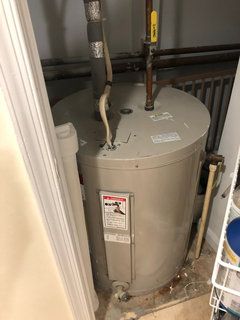
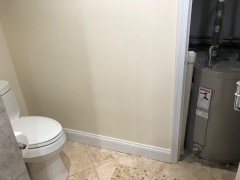
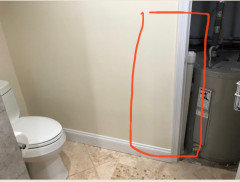
    This is our current setup. Wall behind the toilet is exterior. Kind of makes me wonder what’s between the drywall by the heater and the exterior - fun surprises I’m sure!

  • 6 years ago

    recordaras-

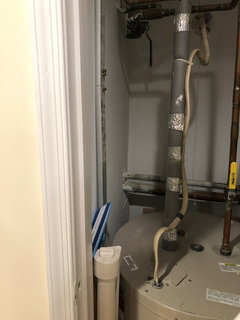
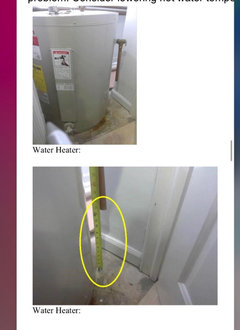
    Side issue: the down pipe from the pressure relief valve just ends at the floor and is not piped outside?

  • 6 years ago

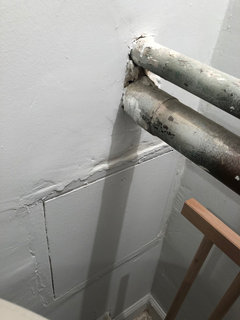
    Okay, so having looked at the dimensions if only I could open up mystery wall and position it a little closer to the exterior wall all my problems would be solved. I could use/access the under stair storage space without going tankless. However if the only option is to plop in a new unit in the exact spot of the old one, that is a problem: it would cover access to the main water shutoff. Now the million dollar question: who on earth do I go to to help figure this out? I’m guessing checking the Home Depot “Get expert in-home installation” box is not going to cut it. Also, any idea what would normally be hidden behind this kind of access panel?

  • 6 years ago
    last modified: 6 years ago

    Kudzu - yes. In fact it was actually originally too short (inspection) and was fixed before we moved in along with a few other things, but the fact that it wasn’t piped wasn’t noted as an issue. Is it?


  • 6 years ago

    recordaras-

    I don't know what your local code specifies, but, where I live, if the water heater isn't in a garage or basement, but within a habitable space, the pipe is typically through a wall to the outside or directed to a floor drain (which you don't appear to have). I do believe that code requires that when the pipe terminates like yours does it must be at least 1-1/2" off the ground which helps you get a bucket under it if it drips, which is not uncommon. And if it blows, which isn't common, you have a mess of water with nowhere to go but all over the floor.

  • 6 years ago

    Our inspector was quite thorough (and the plumber didn’t mention anything even though I had a lot of questions about why the replacement pipe wasn’t copper) so I’m going to guess that local code allows it. I wonder if we’re considered a basement since it’s just concrete slab below the lower level?..

  • 6 years ago

    Yes, the pipe material is fine...doesn't have to be copper.

  • 6 years ago

    @Kudzu9, the house was built in 2004 and presumably was to-code at that time.

    Am I required to have the breaker panel moved and the house rewired in order to replace the water heater at some point (whether with another tankless or not)?

  • 6 years ago

    dadoes-

    Hard to say, but that would be extreme. It's not a re-model, so I would presume it would be grandfathered in. In any case, I suspect that you could get a replacement of the water heater without triggering a code inspection, and even if you did have to have it inspected I would think they wouldn't raise a fuss. Water heater replacement is so common that they often just have a plumber pull a permit but don't come around to do any inspection. I didn't mean to alarm you; I just thought you should know.

  • 6 years ago

    Question to all you knowledgeable folks - are hybrid heaters more difficult to work with? Trying to get someone to come in and so far 2/2 plumbers have said that they will gladly give me a standard electric tank but don’t want to mess with a hybrid. Wondering if they are also more difficult to repair/service after install, or if it’s just a matter of nobody wanting to deal with my mystery wall situation.