Software
Houzz Logo Print
kristen_janae

Hi! Maple tree sapling help

6 years ago


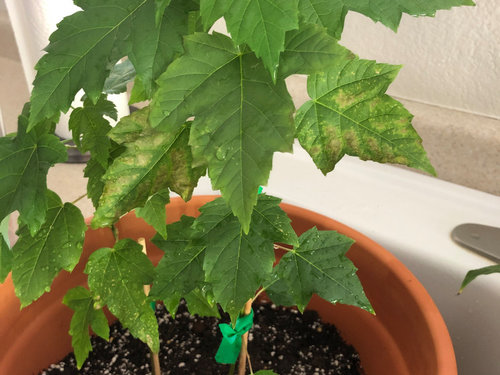
I have a maple tree sapling I’m trying to grow in a pot, it’s done very well so far but a few of my leafs have a strange discoloration on them, any ideas or thoughts?

Comments (7)

  • 6 years ago

    Get a magnifier and look for sucking pests on leaf underside

  • 6 years ago

    It's a physiological order called oedema/ edema, primarily driven by over-watering, but exacerbated by any cultural condition that slows movement of the nutrient stream. Fix it by using a 'tell' to 'tell' you when the soil is getting dry at the bottom of the pot. Water only then. More about oedema and using a 'tell' below.

    Oedema

    Oedema is a physiological
    disorder that can affect all plants. It occurs when the plant takes
    up more water than it can rid itself of via the process of
    transpiration. The word itself means 'swelling', which is usually the
    first symptom, and comes in the form of pale blisters or water-filled
    bumps on foliage. Under a variety of circumstances/cultural
    conditions, a plant's internal water pressure (turgidity) can become
    so high that some leaf cells rupture and leak their contents into
    inter-cellular spaces in leaf tissue, creating wet or weepy areas.
    Symptoms vary by plant, but as the malady progresses, areas of the
    leaf turn yellow, brown, brown with reddish overtones or even black,
    with older damage appearing as corky/ scaly/ ridged patches, or
    wart/gall-like bumpy growth. Symptoms are seen more frequently in
    plants that are fleshy, are usually more pronounced on the underside
    of leaves, and older/lower leaves are more likely to be affected than
    younger/upper leaves.

    Oedema is most common in
    houseplants during the winter/early spring months, is driven
    primarily by excessive water retention in the soil, and can be
    intensified via several additional cultural influences. Cool
    temperatures, high humidity levels, low light conditions, or partial
    defoliation can individually or collectively act to intensify the
    problem, as can anything else that slows transpiration. Nutritional
    deficiencies of Ca and Mg are also known contributors to the malady.

    Some things that can help you
    prevent oedema:

    * Increase light levels and
    temperature

    * Monitor water needs
    carefully – avoid over-watering. I'd heartily recommend a soil with
    drainage so sharp (fast) that when you to water to beyond the
    saturation point you needn't worry about prolonged periods of soil
    saturation wrecking root health/function. Your soil choice should be
    a key that unlocks the solutions to many potential problems.

    * Avoid misting or getting
    water on foliage. It slows transpiration and increases turgidity.

    * Water as soon as you get up
    in the AM. When stomata close in preparation for the dark cycle,
    turgidity builds. If you water early in the day, it gives the plant
    an opportunity to remove (for its own needs) some of the excess water
    in the soil.

    * Put a fan in the room or otherwise increase air
    flow/circulation. Avoid over-crowding your plants.


    Using a 'tell'

    Over-watering saps vitality
    and is one of the most common plant assassins, so learning to avoid
    it is worth the small effort. Plants make and store their own energy
    source – photosynthate - (sugar/glucose). Functioning roots need
    energy to drive their metabolic processes, and in order to get it,
    they use oxygen to burn (oxidize) their food. From this, we can see
    that terrestrial plants need plenty of air (oxygen) in the soil to
    drive root function. Many off-the-shelf soils hold too much water and
    not enough air to support the kind of root health most growers would
    like to see; and, a healthy root system is a prerequisite to a
    healthy plant.

    Watering in small sips leads
    to avoid over-watering leads to a residual build-up of dissolved
    solids (salts) in the soil from tapwater and fertilizer solutions,
    which limits a plant's ability to absorb water – so watering in
    sips simply moves us to the other horn of a dilemma. It creates
    another problem that requires resolution. Better, would be to simply
    adopt a soil that drains well enough to allow watering to beyond the
    saturation point, so we're flushing the soil of accumulating
    dissolved solids whenever we water; this, w/o the plant being forced
    to pay a tax in the form of reduced vitality, due to prolong periods
    of soil saturation. Sometimes, though, that's not a course we can
    immediately steer, which makes controlling how often we water a very
    important factor.

    In many cases, we can judge
    whether or not a planting needs watering by hefting the pot. This is
    especially true if the pot is made from light material, like plastic,
    but doesn't work (as) well when the pot is made from heavier
    material, like clay, or when the size/weight of the pot precludes
    grabbing it with one hand to judge its weight and gauge the need for
    water.

    Fingers stuck an inch or two
    into the soil work ok for shallow pots, but not for deep pots. Deep
    pots might have 3 or more inches of soil that feels totally dry,
    while the lower several inches of the soil is 100% saturated.
    Obviously, the lack of oxygen in the root zone situation can wreak
    havoc with root health and cause the loss of a very notable measure
    of your plant's potential. Inexpensive watering meters don't even
    measure moisture levels, they measure electrical conductivity. Clean
    the tip and insert it into a cup of distilled water and witness the
    fact it reads 'DRY'.

    One of the most reliable
    methods of checking a planting's need for water is using a 'tell'.
    You can use a bamboo skewer in a pinch, but a wooden dowel rod of
    about 5/16” (75-85mm) would work better. They usually come 48”
    (120cm) long and can usually be cut in half and serve as a pair.
    Sharpen all 4 ends in a pencil sharpener and slightly blunt the tip
    so it's about the diameter of the head on a straight pin. Push the
    wooden tell deep into the soil. Don't worry, it won't harm the root
    system. If the plant is quite root-bound, you might need to try
    several places until you find one where you can push it all the way
    to the pot's bottom. Leave it a few seconds, then withdraw it and
    inspect the tip for moisture. For most plantings, withhold water
    until the tell comes out dry or nearly so. If you see signs of
    wilting, adjust the interval between waterings so drought stress
    isn't a recurring issue.


    Al

  • 6 years ago

    Wow thank you so much!

  • 6 years ago

    I live in the desert and always think my plants are thirsty, very helpful!

  • 6 years ago

    wow al ... bazinga ...


    here is a shorter version ... do not water it like a houseplant ... most of those are water hogs .. trees are not ...


    let a tree in houseplant media near dry before another sip of water ...


    do you have any plans for planting it outside ... its going to get more and more problematic as time goes by ... indoors ...


    ken

  • 6 years ago

    I moved from the Midwest to Las Vegas and wanted to take a piece of home with me. I’m hopeful I can keep it alive until it’s strong enough to be transplanted but the weathers so harsh I’m scared to plant it in the sand/rock. maybe I’ll just have a full blown maple tree in my living room 😅

  • 6 years ago

    "maybe I’ll just have a full blown maple tree in my living room"
    Not for long, you won't :-) Trees native to temperate parts of globe - or naturally grow outdoors in most US climates - do not make good houseplants. They need a winter cold period for dormancy and there is seldom enough light indoors and too even temperatures and too low a humidity level for them to be happy or even survive for any length of time.

    That doesn't mean you can't have a maple.....but just maybe not the same kind of maples you were used to in the Midwest. You could try a Rocky Mountain maple (Acer glabrum), a bigtooth maple (Acer grandidentatum) or a Shantung maple (Acer truncatum), which is known for having considerable heat and drought tolerance.