Software
Houzz Logo Print
oursteelers

Ammonia Drench Hosta

Anybody know if the ammonia drench we use for hosta would work with other plants, delphinium and iris specifically?


Thanks,

Tina

Comments (32)

  • 6 years ago

    I wish I had a good answer for you, but I don't have delphinium or iris.

    Having said that, I have used it on other perennials with no problem---except for one maybe. I had a beautiful italicum arum. I loved it. Got it last year and it overwintered beautifully, was growing well and beginning to flower. Then it collapsed and I think it was the ammonia spray. It died back. Dug it up to see if there was anything left and found some small bulbs and replanted them. That was about a month ago and I haven't seen anything yet. It's supposed to have these bright orange berries now. I am still waiting and hoping to see if anything will show up.

    So my belief is that not everything can be drenched with ammonia.

    oursteelers 8B PNW thanked newhostalady Z6 ON, Canada
  • 6 years ago

    slugs on iris ????


    if properly diluted.. i dont see how it would be strong enough to do much to anything other than soft slimy slugs ... but that is just speculation ...


    i dont get newhosta's answer ... she speaks of drenches.. but then says a simply spray killed something .. so.. a bit confusing ...


    ken


    ps: besides... isnt it time to just fan cut the iris for fall anyway.. they cant still be blooming.. are they???

  • 6 years ago

    When I was out spraying this morning I was looking at my delphiniums and wishing I could spray them. Then I thought how great it would be for iris. In the spring they get attacked as much as the hosta

  • 6 years ago

    Interesting...... I have never had a problem with my delphinium.......but I have had plenty of slugs until I started the drenching!

    debra

  • 6 years ago
    last modified: 6 years ago

    To clarify regarding what I said about drench and spraying. I try to thoroughly drench the hosta soil when trying to eliminate slug eggs. I actually use a sprayer to do this. So when it came to the arum, I lightly sprayed the bottom of the plant and the soil. No drench for that plant. Looks like the spray killed it anyways.

  • 6 years ago

    Don’t spray brunnera leaves, it will fry them.

    tj

  • 6 years ago

    well duh on me.. steely is in PNW ... where slugs take on a whole new meaning to most of us ... they have some.. bigger than your thumb.. dont you??


    ive heard rumors... there is a gang of them rioting and burning trees ... lol ...


    ken

  • 6 years ago

    Beware Live Mollusks?

    tj

  • 6 years ago

    Oh much bigger than thumb size. They’re disgusting. Well I think I’m going to try it. I’ll start with just one delphinium and I’ll do an iris I have multiples of.

  • 6 years ago

    Sounds like a good plan oursteelers. I do remember my daughter's piano teacher saying they had huge slugs in their backyard. She said she and her husband went out nights to collect them and did that until they were gone.

  • 6 years ago

    Oh much bigger than thumb size.


    ==>>> no pix.. i dont believe you .. lol .. we want pix of PNW slugs ... lol ...

  • 6 years ago

    No we don't! Yuck!

    :)
    Dee

  • 6 years ago

    after fall cleanup .. some peeps pour a pail of cure around crown to kill all slugs and eggs ... that is a drench ... i would think this could potentially harm some plants ....


    i understand what you mean ... a very thorough spraying... but it isnt a drench.. per se ...


    just making sure about the words ...


    ken

  • 6 years ago

    Yeah I’m definitely doing a spray. That’s close enough to a drench for me.

  • 6 years ago

    For the ammonia drench, what is the dilution? I need to do it this fall and next spring!

  • 6 years ago

    I did one part ammonia to 9 parts water.

  • 6 years ago

    Household ammonia 20%. Household ammonia is a diluted concentration to begin with. Be careful not to use a concentrated formula. Vinegar is a herbicide, many people use it o kill weeds whereas Ammonia in very high concentrations is used commercially as a fertilizer and it will kill slugs effectively and be a mild fertilizer rather than a mild herbicide.

  • 6 years ago

    Jon, not sure what you mean by "household ammonia 20%." Could you clarify? Companies now don't put the active ingredient and strength on their bottles. Makes everything very confusing.

    Also wondering whether it is a good idea to use the ammonia drench in late summer/fall since it is a fertilizer (even though mild).


  • 6 years ago
    last modified: 6 years ago

    I have used both vinegar and ammonia. Both have worked equally well. What I did notice was, maybe 6 weeks after the spring drench, it was necessary to treat again on hostas especially susceptible to slug damage. The Tiaras, Allen McConnell, Night Before Christmas etc. The heavier leafed hostas seem to do fine with the spring and autumn drenches.

    debra

  • 6 years ago

    I’m going to do it two or three times this fall and the same in the spring. Slugs and snails are my biggest problem besides sawflies and I’m super excited about anything that will help

  • 6 years ago

    newhostalady, What I meant was dilute household ammonia to a 20% solution. 4 parts water to 1 part household ammonia.

  • 6 years ago

    Thanks for clarifying Jon. That's a higher concentration than, say, the 9 parts water to 1 part ammonia. I think at the higher concentration it is important not to get it on the leaves.

  • 6 years ago
    last modified: 6 years ago

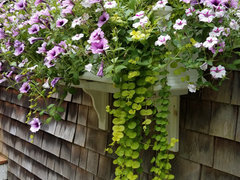
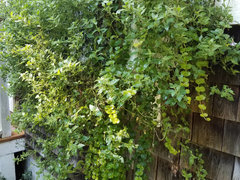
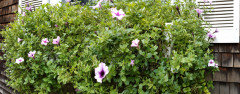
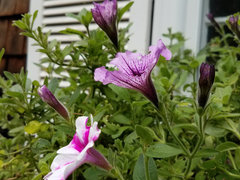
    I had some good luck with new window boxes, but gradually the flowers and leaves were chewed up (holes in leaves and flowers). It is late in the season so I thought I would experiment and spray them with an ammonia drench.


    Eventually you couldn't see the window box.


    Noticed first it looked like the flowers were chewed, then the leaves. We'll see how it works. Not much to lose at this time of the year - Jon

  • 6 years ago

    NHL, it was said Papua used a 30% solution (1 part ammonia to 2 parts water). I think 20% is overkill, but adds some more weak fertilizer as you soak the plants

  • 6 years ago

    New Hosta lady. Do you cut down your hosta in fall before you drench?

  • 6 years ago

    Jon, I didn't know that Papou used that kind of strong ammonia drench for his hosta. No wonder his hostas looked wonderful! I think larger sized slugs require a stronger formula. I find if I do a reasonable job of keeping the slugs in control (using pellets or ammonia drench), then I don't need that strong a concentration and don't have to worry about making a mistake and getting it on other plant leaves that may not tolerate the ammonia solution (because I spray to drench).

    Beverly, I prefer to use the ammonia drench in the spring. I have read several articles about using ammonia, but I don't recall any of them saying to use it later on in the season. I know a lot of hosta forum members do use the drench during the summer and at the end of the season, and there doesn't seem to be a problem. (I did drench this summer a couple of times.) So to answer to your question Beverly, I usually don't drench in the fall. I have occasionally though when I felt there was an infestation of slugs with a particular hosta like undulata.

    I believe it is safe to cut the leaves of the hosta off if you sterilize your cutting tools and it is late season. I prefer to pull them off. But if the leaves don't pull off and it is about mid October or later, then I start to cut off the larger hosta and the ones I thought were harboring slugs and use some ammonia. I have several knives from a thrift store and use them to cut the leaves off. Then I sterilize them and may cut off some more hosta leaves.

  • 6 years ago

    NHL, I've looked high and low for the article on Papou but it related how all his neighbors were having a horrible time with slugs. One of his neighbors went to visit him and was amazed at his Hosta. He shared how he sprayed them all with ammonia. There is a product called Debit that is recommended for cut worms on Petunias but it would have taken 5-6 days to get some and by then they would have been pretty far gone. I used a good 25% on them and, if anything, they have perked up. We'll see if that works. We have some good weather for a while so they should bounce back quick if the ammonia did any good. The advantage of ammonia over pellets is while the slugs eat the pellets and die the ammonia kills the slugs and their eggs. It is important to spray where they hide and where there eggs are hiding.

  • 6 years ago

    Thanks Jon for taking the time to look for the article on Papou and slugs. Sounds like an interesting article.

    Isn't it frustrating not to get the product you need for your plants! I have experienced the same. I hope the ammonia drench works. Aren't cutworms finished for the season and are moths at present?

  • 5 years ago

    NHL

    Well, No more additional holes in leaves or in flowers and the flowers are coming back.

    Next year when I first see holes I will douse with an ammonia mix (over 20% in this case). For some reason the hanging baskets are way behind (???). I didn't know if petunias being less tuff than a Hosta (my guess anyway) would handle the ammonia, but it worked. From now on I won't hesitate to spray some ammonia drench when I see insect or slug damage I'm going to spray away. It is effective, economical,, nature friendly and a mild fertilizer. Can't beat that. . - Jon

  • 5 years ago

    Jon-how do you think they would do with “rose slugs” on roses?

  • 5 years ago

    My guess is that it probably would work. Since ammonia is a very common fertilizer in agriculture I don't see why it wouldn't work. Both the window boxes I have are starting to fill in very nicely where they had zero flowers 2 weeks ago. I read up on rose slugs to be a little more educated before I answered. The non-chemical suggestion is insecticidal soap. The advantage on hosta slugs is ammonia not only kills the slug, it kills the eggs as well. Obviously I would have to say "I don't know about that" as it pertains to rose slug eggs. Honestly I wouldn't hesitate to try ammonia on any leaf eating pest. - Jon