Software
Houzz Logo Print
webuser_8633990645645082698169

Crawl Space Encapsulation - remove or replace existing R5 foam board?

6 years ago
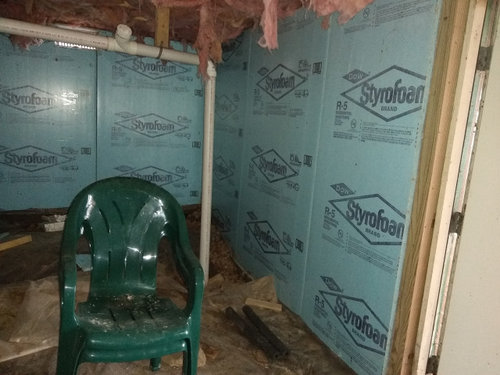
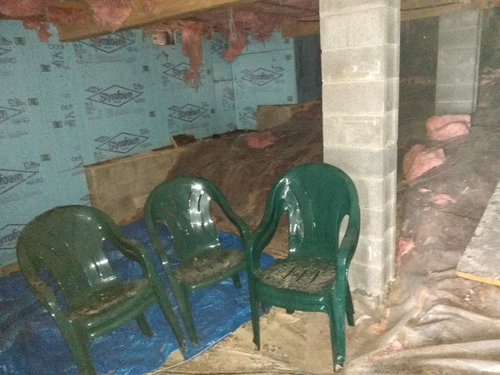
I recently purchased a 25 year old vacation home in Canaan Valley, WV. We removed soggy floor joist insulation in the crawlspace last month (we're only up there for about a week every month or two). There's no central system in the house, only baseboard electric heating and a whole house fan for the summer (some mid-80's days, winter can have single digit temps for many days at a time). I remotely monitor the home (cameras, temps, humidity, etc). The humidity in the living space stays near 70%. The crawlspace is muggy, 1 rim joist is history (adjacent deck/flashing issue) but not yet replaced. Only minimal visual evidence of mold/mildew otherwise in the crawlspace. The home is on a sloping lot, so the crawlspace goes from 2-3 feet in the back to 7-8 feet in the front - maybe 750 sq ft down there. There's (blue/Dow) R5 insulation panels on the walls in the crawlspace, dirt floor with torn visqueen w/happy salamanders, and open vents... no standing water.


What's the best approach for a crawlspace like this when the home has no central system?


Should I remove/replace or add to existing wall insulation? (With something like Bora Foam)


Should one of the vents be set up as an exhaust fan/vent due to radon or other soil gasses (never been tested).


I have Basement Systems coming out next month to give their opinion as well.


Comments (5)

  • 6 years ago

    If you're not planning to use the crawl for anything, encapsulate. If that's beyond the budget, at least seal the floor, so the mould feeding moisture doesn't rise into your living space.


  • 6 years ago

    In the home, there's limited space - a compact water heater under the stairs - small area. I'd like to consider relocating (to an encapsulated space) a regular size water heater and a water filtration/softening system... perhaps even a pressure booster.

  • 6 years ago

    You need to decide if you want conditioned (connected to the house) or unconditioned (vented outside) space. Most folks are now using conditioned crawlspaces for new construction.

    When we built our conditoned crawlspace last year we first put down about 4" of level stone, then a thick plastic vapor barrier on top, making sure it extended about 8-12" up the walls. On top of that we installed sheets of closed cell foam (4"?) and fully taped the seams. We made sure the foam was completely level, and then carefully cut 3/4" tongue and groove plywood to lay on top. It made a very level and stable "floor". We could have also tried pouring concrete instead of the plywood, but that would have been more complicated.

    We finished the crawlspace by having the side walls sprayed with open cell foam. We do not currently have active venting, but do have vents on each end that open to the adjacent basement to allow circulation. I have found vent fans designed to run 24/7, but not purchased one since the humidity seems to stay the same as the basement.

    If you want to use your crawl space for your water heater, you might need to have a conversation with your local building inspector. Any foam you use (sheets or spray) is supposed to have a flame barrier if its in habitable space. That barrier could be drywall, or there is also a special spray coating that is approved. However, the definition of habitable space is up to interpretation, since they routinely allow HVAC to be installed in a conditioned attic that has no flame barrier over the foam.

    Bruce

  • 6 years ago
    last modified: 6 years ago

    Thanks for the input Bruce. After speaking with a couple of contractors up there over the past several months - I get the feeling that Tucker County does not have much in the way of permitting/inspections... at least compared to how it is down here in central Florida (not even close... where permits and inspections really slow things down - I understand the good and bad regarding that though) !!

  • 6 years ago

    I just helped my friend who owns a cabin in the mountains which has a basement that one wall is at 50% undergrade and the other exposed wall, cinder block. Since mold comes from dirt 100% vapor barrier is crucially important to slowing down mold spores in the air. Though mold is everywhere exposed ground that does not receive mold killing UV sunlight grows uncontrolled.

    I would suggest never to put wood on top of the plastic because it will wick moisture considerably and rot. I reccomend slab pavers and float them next to each other. https://www.google.com/search?q=4+x4+ft+cement+pavers&sxsrf=ALeKk02V51mbSbLGF1xq4pOhQ9u3cpq95A:1599487146944&source=lnms&tbm=isch&sa=X&ved=2ahUKEwjqnt35mdfrAhWnlXIEHUgkBq4Q_AUoAnoECA0QBA&biw=1366&bih=657#imgrc=dIckdvbXW2X8QM

    Better choice pour a 4 inch floor but thats usually too costly.

    Get www.SensorPush.com ($50) Humidity device with gateway ($100) which will always show you your rooms humidity level.

    If not conditioning with AC that pushes 50% humidity air to keep air dry you would want fans that evaporate moisture.

    The biggest concern are critters...mice..chewing electric wires, in furniture...etc. Get www.MouseX.com to drive them away but not kill them so there dying in the walls of your home.


    I would REALLY stray away from spun insulation above head. Mice nest in this CONSIDERABLY then snakes hunt them as the snakes push and pull your insulation as seen in your pictures. Mice can chew through steel, concrete block and wood easily and any plastic...so the goal is to not give them a easy nesting place. Mice have really made some thouroughfairs in the header joists to previously get into the room. But no mold means no camel crickets or cockroaches which mice eat, no mice means no snakes. So lower humidity so wood beams are under 16% wood moisture content and they wont grow mold and shuts down thebentire food chain.


    Snakes enter the space from digging under the foundation and coming up right next to the foundation so sealing the plastic to the walls slows the critters down. Sealing the plastic is done best with pin nails shot from a .23 caliber pin nail gun NO MORE than 16 inches apart that keeps the plastic tight enough to keep out snakes. Keep the mice out keeps the snakes out.


    On top of the 3x3ft or 4x4 ft cement pavers you could put interlocking 3/4 in foam boards and cover with carpet or throw rugs.


    My friends neighbor works at Trane and got a DEEEAL on central air system system. : )


    tom thanked Matt Garrett