Software
Houzz Logo Print
sarah_mickelson28

Need Help! Landscape Tweaking

6 years ago
last modified: 6 years ago
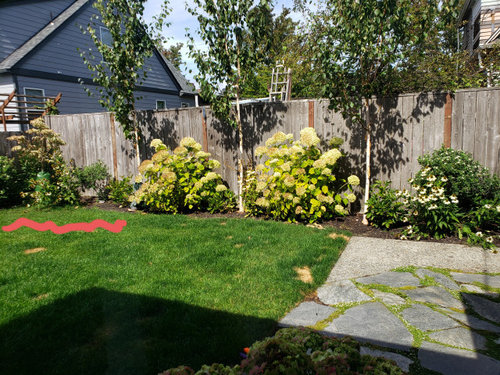
Last year we redid our backyard from scratch. It originally was 90% consumed by a deck. We tore everything out with plans for a cottage style vibe. We worked loosely with a local nursery that I love. They are very helpful and personable, but I find their advice can be hit or miss, even though they've been out to our place and know our growing conditions well. Now that we have had our second summer with our new yard, there are elements that I want to change before things start to establish more.

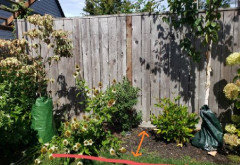
I've enclosed pictures below (it's hard to get the whole scope of our yard), that I hope will help give a visual. In the corner area of our bed (there's a picture that I've underlined the space in red), I am unhappy with how the plants are taking shape and look. I have a variegated Dogwood that I want to take out, he is not happy in the sun. I have an echinacea that I would love to keep, but I think he needs to be pushed back as he's taking over the lawn. I have a Daphne that has been weak from the start (my other two are thriving) that I want to remove. I also have two Peonies in this space one to the right of the Dogwood and one to the right of the echinacea. There is also a very large daisy behind the Dogwood (that needs to be cut back for the season). I also have a few peonies that I need to move around because my Incrediball Hydrangeas have engulfed them.


Basically, I'm perplexed with how to remedy this space. I have a few ideas, but honestly, my vision is all over the place. I've thought of going back to the nursery, but like I've said, they have been hit and miss with advice.

Here's a few scenarios I have:

Option 1:

Plant a different type of Dogwood (green leaves/white flowers) where the current one is, these don't seem to suffer as much in the sun

.

Replant the echinacea closer to the fence and towards the middle of the space where the weak Daphne currently is.

Plant a peony on either side of the echinacea.

Option 2:

Plant another birch tree where the current Dogwood is.

Plant another Incrediball Hydrangea in the space (remove the weak daphne, echinacea, peony).

Option 3:

Remove the current Dogwood, do not plant another tree to replace it.

Disperse the echinacea and Peonies in that area.

I would love any ideas you may have for this space. As I stated, I'm going for a cottage look. I also would love to salvage my echinacea and peonies if possible. I'm also open to other plants (flowers, possibly shrubs, different trees). My garden is a white garden, so keep that in mind. Also, please don't judge the state of the plants- we've had a very dry summer for the Pacific Northwest. If this is helpful, I am in Zone 8a.

Thank you!!!

Comments (13)

  • 6 years ago
    last modified: 6 years ago
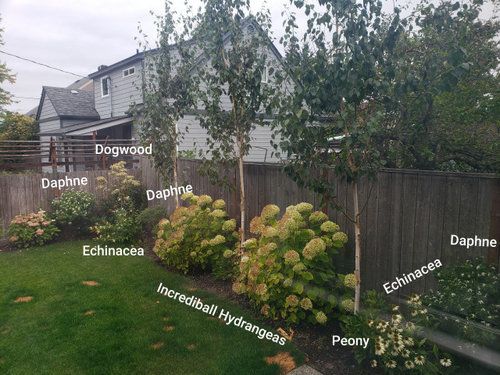
    The thing that first jumps out at me is that those birch are going to grow hugely larger that they are now, soon make it very difficult to grow all the other, smaller kinds of plants in that same space. (Unless and until the trees are spoiled by bronze birch borer). Otherwise maybe you should try looking for a garden coaching service that can come to your planting site, help you work through your reorganizing. And give you a different perspective from what you have been getting from the nursery up to this point.

    Sarah Mickelson thanked Embothrium
  • 6 years ago

    Do you think the Birch trees will take over everything? Again, I was guided by a nursery (who does landscaping design) to plant the trees in that exact space/spot. They came out to the yard and everything. The goal was to block our neighbor, who's yard/house is very rundown. Ugh, makes me nervous!

  • 6 years ago
    last modified: 6 years ago
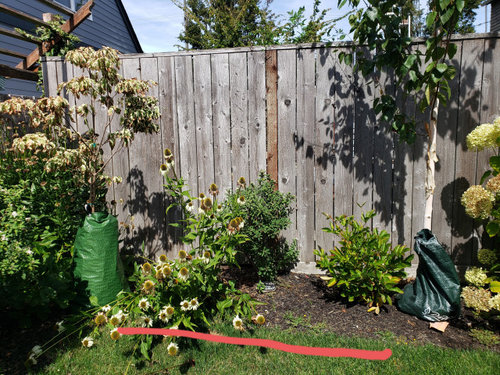
    They look like white Himalayan birch, which in time produces a full sized tree over 60' tall. But along with European birch this kind is now being hammered by bronze birch borer in the Pacific Northwest. It has been said the insect tends to focus on drought stressed or otherwise unhappy larger specimens so you may not see any problems with yours for some time. But around me here in the Seattle area it seems to be doing a very good job of finding and infesting pretty much all of the many European birch on local sites.

    If kept what your birch planting will probably first be noticed as doing is filling up the planting bed there with many small thirsty roots. So that the other plants start to struggle during the summer dry season.

    A summer dry season that is a normal occurrence in this region - any gardening involving keeping lawns green and plants of foreign origin with summer wet climates in their backgrounds looking good will involve diligent watering every year.

    Sarah Mickelson thanked Embothrium
  • 6 years ago

    I did a little dive and remembered the name is Jacquemontii, which seems to be a Himalayan birch. I am just feeling defeated at this point...not sure why we were recommended this tree now. By the way, I'm in Tacoma. If we were to replace them, do you have any recommendations. It's just frustrating because we've put a lot of time/money into this project.

  • 6 years ago
    last modified: 6 years ago
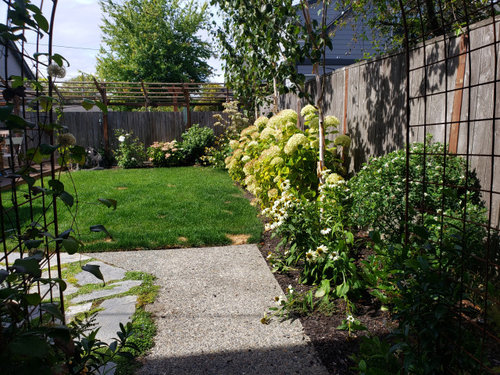
    Personally if I was trying to hide something I'd choose an evergreen kind of plant. But trying to fit a row of trees in that narrow bed is always going to be problematic - maybe what you need instead is a sufficiently high trellis added to the top of the fence - if possible - with climbing plants growing on it.

  • 6 years ago

    You should also consider time: both the time it takes plants to mature and choosing plants to provide four season interest.


    I planted a peony Bartzella six years ago. It is large and green, but I got one bloom last year and two this year. And, no, I didn't give it too much nitrogen. I'm hoping for more blooms next Spring. My point is, gardens take a long time to mature.


    How do camellias do in your area? That could provide evergreen interest with winter bloom, and they can take some shade as the trees grow. How about a fig tree?

  • 6 years ago

    A garden is an ongoing project. Don't feel bad that you want to make some adjustments.

    I'd like to know the measurement of the bed I marked in orange.

    It looks like most things were planted too close to the fence. In the future plant at least a eighteen inches out.

    Sarah Mickelson thanked emmarene9
  • 6 years ago

    The bed is just shy of 3' deep. It is a narrow space. We tried to space plants the best we could, again, using the guidance from the nursery. I almost feel like we tried to get too many plants in this space...the hydrangeas, daphne, and rose we have are filling out the space well, but that really doesn't leave space for other plants we incorporated like the coneflowers and peonies. But, again, we were advised that all of these plants could coexist in this size space.

  • 6 years ago

    I'll check out the book. Thanks for the recommendation.


    I will say, none of this was rushed into. I planned my vision for a year and then worked with a trusted nursery owner to plan out what would grow best in this space. I think my issue is I might have been directed to plant too much in this space. In regards to my trees, I was told they would grow more columnar and were the right trees for this space. Trust me, I wouldn't have just thrown in a bunch of trees that would take everything over, not intentionally anyway.


    Our whole home/yard has been a huge renovation project (1938 Tudor that needed a lot of love inside and out...with a front yard that was infested with junipers and a backyard that was consumed by a deck and not much else). We have put a lot of love and sweat into our place and hope to reside here until we can no longer walk up the stairs. This is a forever place for us and we are trying to do things intentionally.


    I feel a little defeated with the responses. I am all for constructive criticism, however, I am now stressing about trees that I loved prior to posting my original comment. My main objective was getting some insight for what to replant in that one space that didn't really come together well. I also understand that it takes time for things to fill in...if anything I'm shocked at how fast things have grown in two years!


  • 6 years ago

    Unfortunately, just being a nursery owner does not make one particularly adept at landscape design. Their ideas on plant selection and plant combinations may be fine for this area but putting them all together and with proper spacing and massing maybe way off.

    One of the most frequent comments made on the Landscape Design forum is about planting beds that are too narrow in depth (front to back). And 3 feet is just simply too skimpy to accommodate more than some smaller perennials or annuals. You need to pull that out to at least double the depth and more is better if you want to accommodate shrubs and trees.

    At this point you may be best served by hiring a local garden/landscape designer to help you work with what you have rather than ripping everything out and starting over. Many will offer consultation services that involve a site visit, evaluation of the problem and suggestions/sketches on ways to remedy and for a very affordable hourly fee. And while many ornamental birch trees ARE suffering in this area, infestation by BBB is not a foregone conclusion - the UW suggests that existing trees that receive plenty of water, fertilizer and mulch are most likely to survive, as are those planted in cool, moist, shaded areas. But if the birches do need to be replaced, we are not short of very sun tolerant, more compact growing choices :-)

  • 6 years ago

    I would be willing to sacrifice lawn space to keep the Echinacea.

  • 6 years ago

    Friends with a long established white Himalayan birch even experimented with paying to have it treated with pesticides considered suitable for excluding bronze birch borer and it was still decimated afterward. Even native stands of paper birch north of Everett are now displaying dead upper crown sections. Native as in growing where environmental conditions suit them to the extent that they are a spontaneous natural feature. And which in addition are examples of a North American species that - unlike European and Himalayan birches - has some natural resistance to this North American native insect.

Sponsored
High Point Cabinets
Average rating: 5 out of 5 stars21 Reviews
Columbus' Experienced Custom Cabinet Builder | 4x Best of Houzz Winner