Software
Houzz Logo Print
thriftyboho

What type of Senecio is this?

5 years ago
last modified: 5 years ago
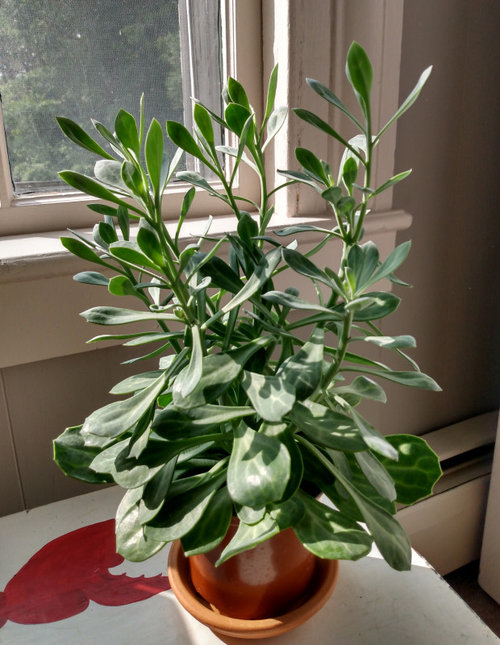
Purchased at a garden center near me, the label only said "Senecio." I've been googling around and it looks very close to a "Vertical Leaf Senecio" to me, but it has no purple edges. Do any of you know:

1. Could it be that it is Vertical Leaf but not purple because it is indoors and not out in the sun?

2. Is it a different type of Senecio altogether?

3. What is the Latin name?

Thanks in advance for any help!


Comments (29)

  • 5 years ago

    Try again with the picture


    thriftyboho thanked lisanti07028
  • 5 years ago

    The Latin name is Senecio crassissimus, and it needs full sun. The absence of purple color could definitely be from lack of sunlight.

  • 5 years ago
    last modified: 5 years ago
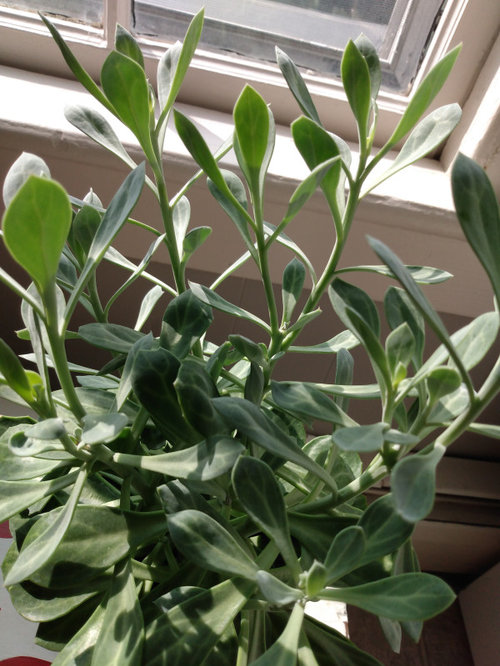
    I can’t find any images of that species with toothed, spatulate lower leaves and visible pale veins throughout. But whatever it is it’s starting to etiolate. Needs more light.

  • 5 years ago
    last modified: 5 years ago

    Thank you, all.

    I took the pictures in the morning when the sun was slanted, but it is in a south-facing window and gets sunlight as much as is possible here in Maine. I bought it because it's supposed to be "indestructible." I am sort of new to houseplants -- I had given up on keeping any because I lived in a very dark apartment in NYC for years, and the few plants I tried all died. That apartment got barely any light at all. Now, I'm in Maine and have light coming in from South, East, and North, so I bought a few plants. This Senecio has seemed pretty happy where it is, but I've only had it a few weeks.

    I don't know what "etiolate" means.

  • 5 years ago

    I suppose you could call the lower leaves toothed. I just did a search, and it seemed the plant, the OP mentioned, is the species assigned to, that purple tipped cultivar, (crassissmus). I know absolutely nothing about succulent Senecio. Yes, I agree it's in dire need of sunlight. I think I missed something here.😆 Are you thinking this isn't the right plant he/she ordered floral?🤔


  • 5 years ago
    last modified: 5 years ago

    OP didn’t say they ordered crassissimus. It was just labelled ‘Senecio’. No specific. OP was the one who guessed that. I also know nothing about Senecios but I was interested and checked images.

  • 5 years ago

    I've sent my pics to the garden center where I bought it. Hopefully, they will be able to answer my question. Many thanks to all of you.

  • 5 years ago

    And, since you ask nycdiane, here is definition of the word etoliated

    thriftyboho thanked windberry zone5a BCCanada
  • 5 years ago

    windberry, yes but check your spelling. A common thing I’ve done many times myself, unaware.

  • 5 years ago
    last modified: 5 years ago

    ‘I don't know what "etiolate" means.’

    The wonder of the internet is that it is the work of a moment to look new stuff up independently.

    (For a while I thought the word was eliolated because my biology teacher failed to cross a T on the blackboard.)

  • 5 years ago

    Thanks SoCal Stewart. Yes, I have to pay more attention when typing.

  • 5 years ago

    Until a very short time ago, and I’m talking mere months, I actually thought the word was “etoliated”. Learned something new that day. Trying to share with others.

  • 5 years ago
    last modified: 5 years ago

    So, I've asked the same question at another site and am awaiting an answer. I was just googling around and found another similar-looking Senecio - called Madagascar Senecio or Senecio decaryi. Could mine be a Senecio decaryi?

    See pics here:

    https://davesgarden.com/guides/pf/showimage/368425/

    and here:

    https://www.kuentz.com/bt/index.php?module=produit&prd_id=15006&keywords=Compositae&page=1

    Hmm.

  • 5 years ago
    last modified: 5 years ago

    I received an answer from the garden center where I bought this plant, but they could not identify it conclusively. Thought it might be cephalophorus, and told me they couldn't look it up because they use numerous growers. I then remembered I had saved the tag from another plant, which was the same grower, and checked out their website. They've got their catalog online and the only succulent Senecio listed in it is "Orange Flame," aka Coral Senecio or Senecio fulgens. Some images labeled "Senecio fulgens" that I've found show similar leaves to mine, but there seems to be a variety in this type (if the images are labeled correctly). Some are slightly "toothed," like my plant, while others are very jagged or almost oak leaf-shaped. Here are some pages with pictures of Senecio fulgens with slightly toothed leaves like mine:

    https://candidegardening.com/US/plants/eaabf98455d9bdfef9c454fdb2ec051b

    https://www.gardentags.com/profile/zepussycat/senecio-fulgens-syn-kleinia-fulgens/1024044

    https://davesgarden.com/guides/pf/go/1750/ (see second pic, with garden gnome)

    Any experts out there able to confirm that this is what it is?

  • 5 years ago

    I GOT AN ANSWER!!!


    It's a Senecio Obovatus (obviously the succulent type - there is a non-succulent plant known by the same name).


    See an example here: https://www.biologistgarden.com/shop/senecio-obovatus

  • 5 years ago

    Is there a photo or something depicting this non sucullent version with the same 'name' which is.......? (the name)

  • 5 years ago

    The non succulent one is now a Packera.

  • 5 years ago
    last modified: 5 years ago

    Looks like there is no such a thing as Senecio obovatus after renaming it to Packera obovata https://en.wikipedia.org/wiki/Senecio#Selected_species

  • 5 years ago
    last modified: 5 years ago

    Wikipedia can be edited by anyone and should not be considered reliable, other than as a jumping-off point for further research.

    The answer I received came from a consulting horticulturist at a university gardening center. Yes, pictures of both types of Senecio obovatus can be found online. The horticulturist said that my plant matches images of "plants labeled as Senecio obovatus."

    I don't think they can 100% confirm this just by looking at images, but the ones I've found of the succulent Senecio obovatus do have the same shape and lighter green "veining" that my plant has, and are more of a match than any other variety I've seen online.

    The horticulturist further stated, "Confusingly, there is a locally native plant relative that used to be classified as a Senecio which is now named Packera obovata. (When it was a Senecio, it was Senecio obovatus.) If you do a web image search with "Senecio obovatus" as the latin name, include "succulent" in the search terms to bring up the right images (you'll still get both plants showing up). No common name seems associated with the succulent species."

    I was also told that my plant looks to be "in good condition."

  • 5 years ago

    Re. Wikipedia: Every article in Wikipedia is created by the experts in that particular field and very closely scrutinized all the time. There is of course possibility of incorrect or incomplete information, but until proven to be such there is no reason to doubt it.

    Anyhow, if one follows your "horticulturist at a university gardening center" advice and does the Google search for "plants labeled as Senecio obovatus." it is what one gets: https://www.google.ca/search?q=plants+labeled+as+Senecio+obovatus.&sxsrf=ALeKk03JdjnPQBcYXX2-vk55MOE6WBHqVg:1600805322955&source=lnms&tbm=isch&sa=X&ved=2ahUKEwi1_YPFyP3rAhVxJzQIHbqQCDcQ_AUoAXoECA0QAw&biw=1527&bih=666 There are only a couple of what looks like sellers sites with a picture of a plant looking as the one in your link (strangely, they also say Out of stock).
    To conclude, I am not saying that the verdict by the "horticulturist at a university gardening center" is not right, what I am saying is that his/her arguments are unconvincing to me. But since you are happy with her/his answer . . .

  • 5 years ago
    last modified: 5 years ago

    Dear windberry,


    I've been a member and fairly active editor at Wikipedia for about 10 years. It's simply not true that "Every article in Wikipedia is created by the experts in that particular field and very closely scrutinized all the time." Anyone can create an article there, including people who are not members nor logged in. In fact, creating new articles is encouraged. They don't seek out experts to do this. Everything is voluntary, and the committees that argue about this or that aspect of an article, and whether or not something is true or worth including, are made up of any member who wants to participate. Sure, articles are reviewed and errors corrected but, again, by anyone who feels like correcting it. There's no schedule, though, and an article could be full of false statements for months or even years before someone notices and decides to fix it.


    You said, "There is of course possibility of incorrect or incomplete information, but until proven to be such there is no reason to doubt it."

    Unfortunately, there is every reason to doubt Wikipedia.


    The sources cited must be read fully to make sure they do indeed support the statements made. Many do not, and many citations lead to dead links.

    It is well known that Wikipedia articles are rife with inaccuracies, and frequently vandalized.


    Part of what we editors do, besides creating articles, making sure they adhere to Wiki standards of neutral objectivity, and correcting spelling, punctuation, and grammar, is to investigate and cite sources.


    When I was in college, all our profs warned everyone not to use Wikipedia as a primary source. It's a big no-no to present information found on Wikipedia as proof of something being true or valid. It cannot be trusted. Now, if a Wikipedia article cites a scholarly journal as a source, then that journal can be cited in one's research, but not the Wiki article.


    Back to my Senecio... I'm not saying obovatus is irrefutable, but when I search this term:


    "Senecio obovatus" +succulent


    ... I get way more images that look like my plant than any of the other varieties for which I searched, and so yes, I'm happy that the horticulturist named that variety and also happy that they said my plant looks in good shape. It was the most helpful answer I received after asking on four sites.

  • 5 years ago
    last modified: 5 years ago

    Senecio Obovata Amke

  • 5 years ago

    Indoor succulents becoming deformed by inadequate light is common and frequently seen in specimens asked about on Garden Web. With even a south facing window not being the same as when a plant is growing outdoors with full exposure in a desert or other hot sunny climate. So that artificial lighting may have to be employed in order to get normal growth from examples being kept as house plants. Same as is done with flowering house plants such as African violets and orchids.

    There's a Seattle area (another dark in winter northern location, like Maine) independent garden center with a house plant room in one corner of a warehouse sized sales area with a high ceiling. The south side of this room is pretty much all unshaded glass which reaches up some distance. All of the succulents on offer are displayed close to this wall of glass, with areas farther back being used to present foliage house plants and flowering house plants. With particular items in the latter category being placed under florescent tubes at least part of the time.


  • 5 years ago

    Senecio obovata (sic) would not be an allowed name; the endings don’t agree in latin. When a plant is reassigned to a different genus, the name cannot be used again in the original genus in any form.

  • 5 years ago

    Senecio Obovatus

  • 5 years ago

    The new name is apparently Packera obovata. The plant above does not resemble pics I am finding of P. obovata just as Floral and Winberry mentioned.

    Senecio are notoriously hard to ID without a flower.

  • 5 years ago
    last modified: 5 years ago

    Apparently, as mentioned upthread, the non-succulent plant which used to be called a senecio is now called packera. Mine is the succulent type, still called senecio.

  • 3 years ago
    last modified: 3 years ago

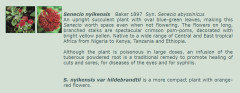
    I'm pretty sure that your plant is Senecio nyikensis var. hildebrandtii, which is a synonym for Kleinia abyssinica var. hildebrandtii.

    Senecio obovatus is indeed Packera obovata, and your plant is not Senecio obovatus. Each and every Senecio obovatus on the internet that looks like your plant is misidentified.

    An excerpt from https://succulent-plant.com/families/asteraceae.html:

    This here is Senecio (Kleinia) nyikensis, and this here is Senecio nyikensis var. hildebrandtii.

    I hope this helps.

Sponsored
Buckeye Basements, Inc.
Average rating: 5 out of 5 stars40 Reviews
Central Ohio's Basement Finishing ExpertsBest Of Houzz '13-'21