Software
Houzz Logo Print
b_cz10

Compost pile over winter?

5 years ago
last modified: 5 years ago

Wondering if anyone thinks starting a good size compost pile now on my property would be a good idea? I'm zone 5B, but not sure if winter stalls it and it wouldn't be ready to use in the spring? Or should it be useable by then? I get full sun till sunset in the one area I'm thinking.

Thanks for any tips! First time trying this

Comments (27)

  • 5 years ago
    last modified: 5 years ago

    Winter does stall it, but most people who manage their household and yard waste this way do it year round regardless. I'm in Maine and now is my most active time of year for gathering compostables. It's when I build instant piles made from everything I can get my hands on, but mostly leaves and grass clippings and pumpkins. I can get quite a bit of heat going right through Nov., then yes, everything stalls until spring. Space for a good-sized pile! I'm excited for you.

  • 5 years ago

    May not be useable at the start of spring but there is no reason not to get started, a compost pile is a continuous process. It's autumn, you can use the dead plants and fallen leaves, so start the pile.

  • 5 years ago

    Great, thank you both. I have so much yard "waste" that I hate to just toss into the woods. I'll get started today on building a pile. Would putting some old moving blankets over it until spring help it to keep decomposing? Or maybe thick black plastic with some holes cut in so it can breath?

  • 5 years ago

    I start my piles in October and November and don't cover them. I can get them up to about 150 degrees for a few weeks and then they stall out in December. I restart them in spring by turning and combining piles and mixing in fresh grass clippings and/or granular Urea and they heat right back up again.

    You want air to be able to get to them or they can get anaerobic.

    Bc _zone10b thanked LoneJack Zn 6a, KC
  • 5 years ago

    Sounds great @LoneJack Zn 6a, KC


    I was reading about importance of air in compost piles through winter. Somewhere recommended trying to keep a space open in the middle, so I was thinking of spending today building a cube or teepee shape about 3-4 ft high out of extra fencing material I have (thick plastic deer fencing)....and then an outer ring or box to hold the pile together. The middle shaped cage might help with air flow through winter and I can pile compost materials around middle shape, while outer fence ring keeps it in pile shape. Sound possible or waste of time?

  • 5 years ago

    Yes, do start it now and put your scraps in it over the winter. It might not do much in the cold, but you'll be all set when the weather warms up again!


    Don't forget to collect some leaves to be stored for next year. I ask friends for them, and harvest leaf bags that people leave out for collection so that I can add leaves to the compost bin throughout the year.


    Linda

    Bc _zone10b thanked labradogs
  • 5 years ago

    Your time could be better spent.


    Bc _zone10b thanked annpat
  • 5 years ago

    Just make a pile and keep adding stuff through the winter; compost piles don't need to be covered or protected - nature will take its course no matter what. As annpat said, use your time to clean up your garden, not build a compost protector. You will see that decomposition keeps working all winter.

    Bc _zone10b thanked lisanti07028
  • 5 years ago
    last modified: 5 years ago

    Thanks for all the tips, I'll just start a big pile out in my empty area today then. I have a lot of leaves in my front yard from my trees, but most of them have some kind of black spots on the leaves, I think maples? New house so I'm not sure. I probably shouldn't add any leaves with weird spots on them to the pile? Also read that I shouldn't use perennial clippings (from my biggest gardens) because they have seeds or weed seeds?

  • 5 years ago
    last modified: 5 years ago

    Agree with above. I used to put more effort into compost piles, now I just pile the stuff up and let it rip. I do try to add some slightly more woody material (leaves, cardboard, woodchips, sawdust) to kitchen scrap piles; partly this is that C/N balance thing, but also the bulkier/more structured stuff helps with air. Doesn't require any effort at all really.

    The pile will seem to not visibly decompose much in very cold temps (below say -10c). But then the weather warms up and it catches up quick, the freeze/thaw cycle sort of pre-chews it for the decomposing organisms. Plus a larger pile self-insulates somewhat.

    Bc _zone10b thanked armoured
  • 5 years ago

    Leaves with spots are just fine in the compost. Perennial clippings are also fine; you can cut off the seedheads from perennials and weeds if you like, or you can let them go through composting and see if they sprout next year.

  • 5 years ago

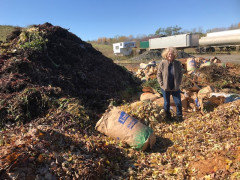
    I don't want to make you feel bad about yourself, but...do you have a truck?

    I feel like you're ripe for the picking. It's not often that a new composter says, "Wondering if anyone thinks starting a good size compost pile now on my property is a good idea?" Most beginners are hesitant and impose restrictions on the process. A lot of us compost just because "what else am I going to do with my refuse and because it's the only good way I know to manage an organic garden and I hate the contrived look of a McDonald's mulch" so that drives how we view the process. (The last part about ugly wood mulches might just be me.)

    The compost pile I grew up with was an uncontained pile, which works fine. My favorite bin now, by far, in my zone 5, is a hardware cloth cylinder. Chicken wire, or anything less stiff than hardware cloth, will not work well. I don't worry about oxygen; the gaping maws of my pumpkin contributions contain air and there's air around other rough contributions. I also am a flipper, so I introduce oxygen into my piles then. That said, you don't need to flip your pile ever---I just like to show off for the neighbors. I like to imagine the admiration they must feel when they see the steam pouring off my pile of what they call rotting garbage.

    Once you get your truck (Mine's for sale.) I'll discuss what you're seeing below.


    Bc _zone10b thanked annpat
  • 5 years ago

    Annpat, why do you say that my time could be better spent than collecting leaves to use in my composter over the summer?


    I know that I can simply toss things in there willy nilly and that they will eventually decompose. I have done that for years as a way to keep organics out of the landfill, yet rarely harvesting the finished compost. Now I have chicken manure to add to my compost, making it a more nutritious resource to add to my veggie garden. I want it to break down as fast and as completely as possible, so I am trying to orchestrate it the best I can by adding leaves, water, and the occasional handfull of soil (to introduce microbes which help it to break down).


    Linda

  • 5 years ago
    last modified: 5 years ago

    Oh! Sorry, Linda, I was answering B who asked if she should put a core bin into her larger bin or if she was wasting her time. Your plan, on the other hand, is brilliant.

    Have you heard anything about the Deep Litter Method of chicken management, by the way? It works well for me.

  • 5 years ago

    That's a relief Annpat!


    Yes I have heard of the Deep Litter Method, but we installed sand in the covered run when we built it, and the chickens also have an enclosed area outside. I'm not sure that I could supply enough materials to keep a DLM going, especially in the winter. I do have a poop board which keeps the coop pretty clean and that, of course, gets emptied into a compost bin. I use pine shavings on the coop floor.


    Linda

  • 5 years ago

    My bedding is a very deep mix of leaves and pine shavings---12 to 18 inches---and is cleaned out once, sometimes twice, a year. Besides the manure, there are other "green" contributions from their snacks---pumpkins, apple drops, seaweed, etc. When it's working correctly, there's very little odor and I once even got it cooking---in Jan.

  • 5 years ago

    Thanks @toxcrusadr ! Appreciate all these notes. Great to know about the microherd.


    I just started the pile today...lots of cardboard boxes, my kitchen scraps (veggies and banana peels), leaves and some leftover dirt I had from all my planting this past spring.


    I have lots of grass and weed clippings from all my yard work so I am just going to rake it all up after i clip/mow and add those too.


    I still have a lot of leaves that will end up falling. You think it's better to run them over with my mower to speed them up in the compost pile?


    @armoured - Sounds like my way of doing things. I never wanted to try this because every time I read up on compost pile building, it sounded like a lot of mathematical layering that could lead to problems if done wrong. But I'm also sick of wasting all my leftover gardens/yard waste and then all the cardboard and kitchen waste too. If this doesn't work out by next summer I will just stop and try to remove any cardboard that hasn't worked. It's at the edge of my wood line so hopefully it won't be the end of the world if I screw it up.


    @lisanti07028 - Great! Makes sense, I'll just throw it all in and let nature go


    @annpat - I don't have a truck! But I'm starting to want one more and more :)

    Just a large wheelbarrow that I roll around my property for now and the biggest shovels I could find. I'm going to try to flip it in the spring...or maybe before if it's recommended through winter? Don't have as much as your picture hah, but that's one of my goals! I'm tired of ugly store bought mulch and overpriced compost too. Maybe I'll still end up having to buy it, but if I can get this to work, and eventually get a woodchipper for all the trees I need to work on, I can feel better about recycling the material here


    I'd love to get some chickens or rabbits to raise here and get fresh manure from...but I'm still not sure how I'd keep them safe from coyotes and predators. Good ideas though, appreciate it.


    I have a lot of extra alfalfa pellets from my local farm store that was on bulk sale...organic no additives. Made some alfalfa tea for my new roses this spring/summer but still tons left over in my garage. Any way I can throw some of that in the compost pile? Or will it just bring the bunnies to eat my pile and then gardens?


  • 5 years ago

    No, it'll be a lovely addition.

    Another question: Do you have a car that you're willing to treat like a truck?

    Bc _zone10b thanked annpat
  • 5 years ago

    Honestly (personal opinion only) I don't think it's worth the 'mathematical layering' for kitchen scraps and the like, and hurrying doesn't usually work. Don't know if you have the space but I find easier to have separate piles for 'mulchable' stuff, and the kitchen scraps compost pile gets dug out once in a while. The leaves, wood chips, yard clippings that aren't left in place, whatever else I come across from time to time - I pile it up and use it when I need it. Some of it's more composted, some less - but it's all stuff that can be used more or less direct as mulch. Even some 'new' stuff like wood chips I'll just use direct as a mulch - so if you don't have space for more piles of stuff, get what you can and apply directly.

    Bc _zone10b thanked armoured
  • 5 years ago

    @annpat - Great, I will dump some alfalfa pellets into the middle tomorrow. I do have a car that I treat like a dumpster/truck. It's my go to for carting plants and soil/rocks/whatever around for now :)


    @armoured Thanks for these ideas, makes sense. Maybe tomorrow I will go out and clear an area next to this pile to keep some of the extra stuff I have. Good way to not have a giant, tall heap all at once and have it be impossible to turn. Plus I'll probably have more leaves/grass this time of year now compared to cardboard/paper/kitchen scraps

  • 5 years ago

    And a lot of towns have a municipal compost site that you can rob from like the one above.

    Bc _zone10b thanked annpat
  • 5 years ago

    I have a compost hole.

  • 5 years ago

    I have a city that delivers truck loads of leaves that they vacuum off the curbs and streets. All it takes is a phone call or e-mail to have them bringing me 2-3 truck load(small semi-trailers for free.) Eight or ten is all I need, about 250-300 cubic yards/year. Some years they bring a front-end loader/backhoe with them and put it where I direct. That's why I like to be home when it's delivered.

  • 5 years ago

    Wow, that's a lot of leaves. Is this for a field or a very large yard?

  • 5 years ago

    Large yard (3/4 acre). It all rots and I mulch mow too. Garden wherever.

  • 5 years ago

    I was interested so I did some math on steve2416's plot. It's a tiny bit geeky so i won't go into details unless someone asks.

    But it's a good example of why I'm skeptical of the claims that "too much compost" is a clear and present danger. @steve brought a huge amount of leaves onto his property - which is big but not enormous.

    I mean, eight-ten truckloads - not pickup trucks - 250-300 cubic yards a year.

    But assuming his 3/4ths of an acre is all yard and spread evenly, that HUGE amount of leaves works out to ... about two inches of leaf mulch.

    I don't think anyone would claim two inches of leaf mulch (or any mulch or compost really) would be too much. Maybe really dense, heavy, 'green' compost, over a very long period of time, but even then probably not, and would still probably need to be much more, plus fertilizer, or some form of manure that's far more enriched than just 'compost'.

    The math for volumes means HUGE amounts of a dense, nutrient rich compost, not just mulch, would be needed. Year after year after year.

    So I think this 'too much compost' so-called myth debunking is silly. Sure, it's possible - too much is too much by definition. But if just mulch/compost, it would require major effort. It would have to be enormous volumes, which for most is unlikely. (Yes though if you pile up manure on a small bed for decades or fill an aboveground bed with just compost, that's the wrong approach.)

    separately there are interesting topics that come up - soil specific, what your compost is actually composed of (heavy green vs stuff like leaves and wood chips), etc.

    I spend some time reading for fun about cation exchange capacity, and I wish I understood it better, but the short form is adding compost/mulch/organic matter substantially increases the capacity of soil to absorb / buffer nutrients. So in reality, yes, adding compost/mulch may somewhat increase the nutrient load, but that may be more than compensated for by the capacity of the OM-amended soil to hold those nutrients. (But I admit not a chemist and it's not so simple)

    On a more simple basis: I have a reasonable sized yard, trees, etc. I bring in a bit of leaves and wood chips and occasional other stuff from time to time, opportunistically basically. Our kitchen compost pile is mostly stuff from 'off site' (purchased food). And even so, MAXIMUM I'm perhaps adding 2-5 cubic metres a year (probalby much less, that would be a big year). That's two inches deep for a 10m by 10m plot, and my yard's much bigger. (I'm assuming - possibly incorrectly - that OM that's generated on the plot itself doesn't matter much, no big long-term net gain, and I'm also not accounting for eg wood from my plot that I burn.) Every time I go for some finished compost, I think 'great', but it turns out to not be all that much once it's spread out.

    This too much compost thing is mostly a myth.