Software
Houzz Logo Print
whip1_gw

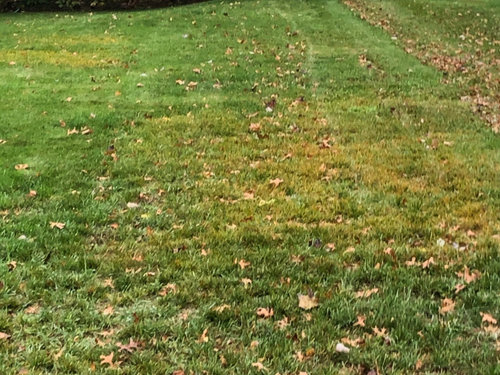
Yellowing grass cause

It was a very dry year, and I don’t water the lawn. This area went dormant. I’ve fertilized and we’ve had plenty of rain. Any ideas?


Comments (12)

  • 5 years ago

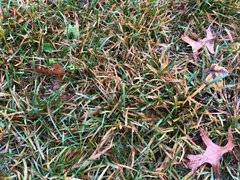
    Sorry it took a while to reply. My work schedule doesn’t always allow outside pictures this time of year. Hope this helps.


  • 5 years ago

    No biggie, I understand completely about busy schedules. And fortunately, the problem is no biggie either and didn't get worse for waiting.


    That's rust, which is pretty normal on northern lawns in fall. It's a minor fungus that disappears when temperatures get cold. Although it can cause damage, the infection has to be really severe to do so. That's not really severe, it just looks terrible. Post some rainfall, I have it myself in the areas where I normally get it. My response? Ignore it. It looks a lot like yours.


    Feed the lawn normally with a high-nitrogen fertilizer when growth stops (probably shortly now), and that'll help it overcome the damage and spring back fine in...well, spring. :-) Even if you don't, it'll be OK, it just may be a little delayed in spring from having to overgrow a little damage.

  • 5 years ago

    That’s good to hear. I was hoping it wasn’t anything serious. I planned on fertilizing next weekend assuming the weather cooperates.

  • 5 years ago

    When did you fertilize? I usually fertilize 3 times in fall. Have gotten in two. The lawn is as green as can be. I may skip application #3 if the moisture remains. We've had the 3rd highest rain totals for October in our area. If it's not insufficient fertilizer, I'd check for grubs. It can make your lawn appear drought stressed. I agree it can be rust also.

  • 5 years ago

    It's...most definitely not grubs, although grubs could certainly be present in this case as well. Grubs don't cause rust, although they sure could be a separate issue.


    If you do have have them, don't bother treating if you have less than ten per square foot. And actually, treating in November is tough to do anyway. I'd wait until April at this point as so many have already gone dormant.

  • 5 years ago
    last modified: 5 years ago

    Mishmosh, I fertilized in mid to late September when we started getting some rain. We’ve had some decent rain lately. I haven’t noticed any major grub issues.

  • 5 years ago

    For most northern lawns, fertilizing twice in fall is best--September and at the end of the season (or as close as you can realistically get, as it's always guesswork anyway).

    Some of us go above and beyond and feed, well, more than that. In my case, four times in fall. It isn't strictly necessary, but does help with lawn density and thickness, and we tend to cut back amounts a bit and vary what we're using. Mine's three shots of organic feeding and one synthetic, most years.

    This year was odd, it worked out as two organic, two synthetic, and a bonus synthetic.


    So hitting that end of year feeding will certainly help you out. Then you're good to go until late May, at which point it'll want another feed (avoid feeding any earlier or you'll set off spring growth, tap carbs in the roots, and leave your lawn open for summer damage, which you don't want).

  • 5 years ago

    I’ve always done a fertilizer with crab grass preventer in mid April. Are you saying that’s a bad idea?

  • 5 years ago

    Quite. In terms of "didn't check the toilet paper before entering" and "lit the car on fire just for fun" it's much closer to the former, though.

    Fertilization in mid-April accelerates the lush, heavy growth on the lawn. On the surface (pardon the pun) it sounds great, but what it does is tap all the energy out of the roots, which just went through a hard winter and don't have a lot of energy left. They're trying to grow like gangbusters already to set seed in June, and just got a ton of nitrogen dropped on them. That's like a gift, and not reliable in nature. So they spend the energy in their roots, leaving them with far less to survive summer--relying more on their seed to carry on the species, since they just got one heck of a boost in that direction.

    You'll tend to notice a lot of those wheat-like seed heads if you do that (in as much as your lawn produces them--I just had a banner year for those on my lawn, but it was a nearly perfect spring for those). And you'll tend to notice the lawn burns comparatively easily in dry weather as compared to neighbors who feed correctly in late May.

    Survival rates do go down, as noted above, and while a borderline thing it does add up over some years and tends to wear away at the grass quality. Fertilizing properly adds to your grass quality and it just keeps getting better.

    Overall, I'd split the crab grass preventer and fertilization steps; apply the CG preventer if you want in April (it'll prevent plenty of weeds in April and May even if CG doesn't sprout until June most of the time).

    Fertilize synthetically in late May, around Memorial Day in Ohio (it's really the same for northern lawns across the vast majority of the country and our audience in Canada; it might edge a little later in parts of Maine and across some parts of the Dakotas and Montana and the Prairie Provinces, a bit earlier in the extreme southern transitional zone, but that's about it and those people already know to adjust their dates).

    Organics are much more loosey-goosey, but I still wouldn't deliver too much significant protein before May 5th.


    Then feed on Labor Day (pretty much everywhere), October 1, and when growth stops (if that's November 1 or later). Organics, again, you can slip in an additional feeding on August 1 or thereabouts if you want--don't do that with synthetics, it's a burn risk to the lawn.

    Right now, I fed around October first, and the lawn is clearly still running on that. I'm waiting for growth to stop (it's stuttering as temperatures rise and fall, and we're about to get a severe thunderstorm as temps rise once again). Once they finally fall--it looks like next week--I'll feed for the last time.

    My lawn's growth never really stops and it'll actually need a mow by March (it's green in February, the only one in the area), but it's close enough. And close enough is good enough in this case.

  • 5 years ago

    That makes sense. What do you recommend for crab grass control that doesn't have fertilizer?


    I mulched the leaves yesterday and applied a winterizer fertilizer when I was done.

  • 5 years ago

    You can usually source the same preventative you use without the fert. Dimension comes as 0-0-7, so with just a little potassium (while a weak fertilizer, that's OK, and I'd actually be OK with anything up to about 0.2 pounds of nitrogen per thousand as well--it's not really enough to matter).

    Prodiamine is sprayed, and that's the one I use--I put it in my sprayer and, in my case, apply in fall (I use a rotated schedule and apply at the 9 month rate of protection, but that's another story and in use for another reason).

    You can also source Prodiamine as Barricade in granular form, and it works great on crabgrass and plenty of other weeds.

    Really, anything listed as covering crabgrass and without fertilizer is not going to be an issue. Just mind the length of coverage if you plan to overseed in fall. In my case, the Prodiamine coverage doesn't really drop until almost a year has passed (winter doesn't count so much, so 9 months in PA really equals a year of full weed coverage). Choose something that will run out before August 15th and seeding dates start coming due.