Software
Houzz Logo Print
webuser_23336155

What is wrong with my magnolia tree?

5 years ago
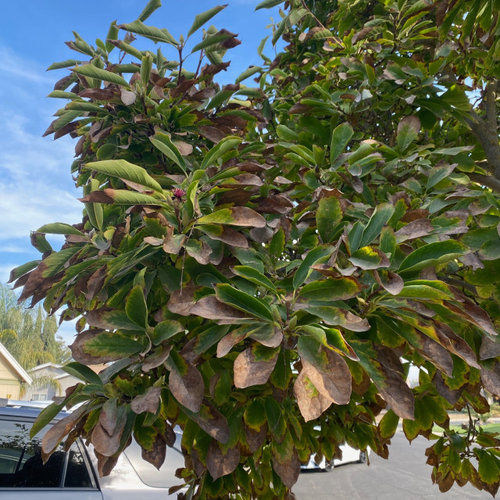
Hello everyone!

Can anyone tell me what is going on with my magnolia tree? I live in Northern California and my tree is covered in crunchy brown tipped leaves. We had some extremely hot weather this summer which may have affected the tree. Does my tree have an infection and is it beyond repair? What can I do to help the tree bloom for Spring.. I really don't want to lose this tree! :(


Comments (24)

  • 5 years ago
    last modified: 5 years ago

    It looks physiological, as though caused by the harsh weather. Or mineral salts - if the latter then salt deposits will be forming lines where the green and brown portions meet.

  • 5 years ago

    not really enough info ...


    when and how planted.. pic of the whole ... how watered .. how bad was the drought ... etc ... is it surrounded by pavement ..


    ken

  • 5 years ago

    ...and where do you live? I assume you live in the central California bay area. What part? (I have a more geographical sense of northern, southern, and central than the local lingo. To me, Redding is the southern part of northern Cal.)

  • 5 years ago

    The best resource for you would be contacting your Master Gardener extension, for example PA it's through Penn State University. Just give it a Google they are excellent. And volunteers, in Pennsylvania they actually come out and help and plant trees all sorts of things, workshops. Your state may also have an organization similar to tree tenders, ours is run by the Pennsylvania horticulture society I'm sure you have something like that too they also come out and volunteer.

  • 5 years ago

    As first stated by Embothrium, this is a physiological issue, not pathological or insect related. So the soapy water or 3 in 1 spray will have no effect.

    Deep and infrequent irrigation during times of drought until fully established and during any periods of extended high heat.......like what was experienced earlier this summer.

  • 5 years ago
    last modified: 5 years ago

    Never apply pesticides without being certain that a particular pest is present and causing an unacceptable level of damage beforehand. And that the specific product being used is one expected to produce the desired level of improvement. Critical involved factors are

    1. What the pest is

    2. If the active ingredient is one that will kill that pest at any time

    3. If the mixed spray has the right proportions to do the job

    4. If the timing is right - for instance various scale insects are generally only vulnerable during the time of the year when they are in what is called the crawler stage

  • 5 years ago

    Except maybe soapy water. That'll simply eject any pests and tell them to go find a new home (or kill soft-bodied ones). If they're not present, it just washes off and slightly loosens the soil a touch. The sodium inherent in one minor application of soap is not significant (provable mathematically if necessary).


    1 tsp of liquid (not an antibacterial soap) in 1 gal water sprayed on the tree certainly wouldn't do any harm and might help if pests were present, but it does seem to be environmental damage. It would also help increase water penetrance into the soil as well as it drips off onto the soil (soap makes water wetter) temporarily, so...


    So even if you don't have pests, it'll have several positive effects. Soap actually does have several uses in the garden and I apply it two to five times yearly for other reasons.


    If you choose to do it to confound possible insects, be sure to hit every leaf surface and wear glasses; dripping water is soapy and may sting a bit. Just for water penetrance, simply spray a bit around the tree and call it a day; you don't need to touch the leaves at all and your target amount is only about 2 ounces of soap per thousand square feet in whatever dilution is convenient (you can ignore the above). Then irrigate it in whenever you want.


  • 5 years ago

    Can't see the point in spraying soap on a tree that looks like it has physiological damage from hot dry summer winds or other cause. And again, it is not a good idea to mix up a solution and spray it on a plant in case there might be any pests present, without knowing for sure beforehand.

    Waste of time if nothing else. In addition there is the problem of beneficial kinds like predator insects and spiders being messed with when blanket applications are made. With these not bouncing back afterward as rapidly as pest species.

  • 5 years ago

    The other issue is that various insecticidal sprays - including insecticidal soap and homemade versions - can create phytotoxic reactions, especially when sprayed if the plant is under stress from heat, drought, recent transplanting or is particularly sensitive, as certain species are.

    And since these type of insecticides are almost entirely contact driven, not sure what anyone hopes to accomplish by random spraying when no pests are present or by spraying on the ground.

  • 5 years ago
    last modified: 5 years ago

    I might suggest actually reading what I wrote as far as ground spraying if tree spraying with common soap somehow seems too "toxic."

    ETA: I'm sure the OP got the point and can make her own decision. Have a delightful day, but please take the toxicity to somebody who cares.

  • 5 years ago

    "Can't see the point in spraying soap on a tree that looks like it has physiological damage from hot dry summer winds or other cause. And again, it is not a good idea to mix up a solution and spray it on a plant in case there might be any pests present, without knowing for sure beforehand."


    Hence the "maybe." If an inspection shows insects taking advantage, maybe. If not, then also maybe just to be sure. Drip from that will enhance water penetrance just due to altering the water's surface tension, plus open the soil's pores a bit (we use it quite a lot as a recommendation on...other forums...with a formula we came up with...it's not using this particular soap, but it's good enough).

    One app won't do much, but let's take what we can get, eh?

    Spiders and other hard-bodied insects are not often killed by soap; only soft-bodied ones are damaged, such as aphids and the like. Hard body insects simply sit there and look at you, annoyed, until you go away, and are not at risk from common soap. Even insecticidal soap is not fatal to spiders and other hard-bodied insects. Chitin equals effective immunity from soap--or at least a high level of resistance.

    This is a minor issue in that predatory mites are killed by soap, so that's one consideration where one may not wish to use soap or insecticidal soap.


    Leaves, of course, are not damaged by soap; there's a world of difference between oil and wax.

  • 5 years ago

    Spiders and other hard-bodied insects

    ?

  • 5 years ago

    ?


    !

  • 5 years ago

    This reply has little to do with magnolia trees, but I use several versions of alkaline sprays to kill insects like ants, cockroaches, and spiders. The sprays include 409, Totally Awesome's Bang, and Super Clean. These seem to be varying strengths of sodium hydroxide. I'm not sure if they fall into the soap category, but they are generally used for cleaning around the house and garage. Super Clean works the fastest on all the insects, but each insect has a different life expectancy once sprayed. Spiders might live for a minute, roaches live for about 30 seconds, and ants die in about 20 seconds. These sprays are also good for taking flies and mosquitoes right out of the air. I have not tried spraying plants with these products.

  • 5 years ago

    "Leaves, of course, are not damaged by soap; there's a world of difference between oil and wax."

    Very easy to research and see what leaves are indeed damaged by soap - entire treatises are written about the effects of phytotoxicity specifically related to insecticidal soaps and their homemade counterparts (which are arguably more dangerous due to added ingredients). There are published lists of plants on which application of insecticidal soaps are not recommended and most prepared formulations will include instructions for testing before a widespread application to avoid leaf damage.

  • 5 years ago

    It's very easy to test beforehand as well to see if a leaf will be damaged by the very minimal amount of soap I'm suggesting, which is far below the concentration of any insecticidal soap. Hint: it won't be, and the amount is far below phytotoxicity as well. The protective covering won't be penetrated and the magnolia won't notice.

    As mentioned many, many times, but does seem to keep slipping many people's minds, I do have a background in surfactants. In this case, I actually understand the difference between an "insecticidal" soap and their homemade counterparts. There's a reason I usually simply recommend making the homemade ones.

    It's the concentration I took into account when I made the statement and, frankly, I think we can end this particular sub-conversation here. It's not particularly edifying as I'm sure it'll keep slipping many people's minds and it's extremely nitpicky, pardon the pun. I have other things I need to be doing.

  • 5 years ago

    "The sprays include 409, Totally Awesome's Bang, and Super Clean. These seem to be varying strengths of sodium hydroxide. I'm not sure if they fall into the soap category, but they are generally used for cleaning around the house and garage."


    Yeah, that will work! Again OT, so I'll be brief-ish.

    Sodium hydroxide is lye (not a chemical name as lye can be NaOH, KOH, and a few oddballs like potassium carbonate, calcium carbonate sometimes, and so on). Soaps are the salts of fatty acids, so things like sodium oleate, potassium stearate, and the like. Soap is also not technically a chemical name, but instead a chemical definition.

    Soap is what happens when you combine lye with a fatty acid.


    Concentration matters, but if it can kill a chitin-plated insect that fast, and can clean a garage floor, offhand I'd advise against spraying a plant with it. If you feel you must, test it on one leaf, wait a few days, and watch it die before trying it wholesale and damaging or killing the plant. :-)

  • 5 years ago
    last modified: 5 years ago

    insects like ants, cockroaches, and spiders

    More erroneous taxonomic placement. That is relevant because in relation to garden plant health spiders are significant beneficial predators. And not something to be lumped in the mind with nuisance insects, routinely killed off.

    Same as chimps - which are very closely related to humans - are not monkeys. And porpoises are not fish.

  • 5 years ago

    Embothrium, it's hard to use a simple taxonomy when describing the variety of "bugs" one might find in the house and garden. My point was that the household alkaline cleaning sprays are an alternative to the highly poisonous oils found in wasp and hornet spray, ant spray, roach spray, etc. I suppose Windex would work if I lived in a Greek household.

  • 5 years ago

    Spraying alkaline cleaning sprays onto plant leaves to kill insects is counterproductive...it may indeed kill insects but it's not doing any favors to the plants. Totally Awesome's Bang for example has a pH of 11-12 and a selection of ingredients w/o any documented insecticidal properties...you might as well spray your plants with bleach straight out of the bottle (same pH). For someone concerned about the ingredients in insect sprays, your off-label use of high pH household cleaners strikes me as ironic.


    Stick with insecticidal soap solutions which are mostly 'potassium salts of fatty acids' which in layman's terms is a low concentration spray of traditional soap, not one of the modern detergents.


    Windex btw, has a pH of 8 which isn't going to kill insects. If Windex is killing insects, it's because of one of these ingredients....2-Hexoxyethanol, Isopropanolamine, Ammonium Hydroxide, Lauryl Dimethyl Amine Oxide, and Sodium Dodecylbenzene Sulfonate

  • 5 years ago

    "Embothrium, it's hard to use a simple taxonomy when describing the variety of "bugs" one might find in the house and garden."

    Not hard at all:

    Spiders = Arachnids

    Ants and Cockroaches = Insects

    Bugs = None of the above.

  • 5 years ago

    Embrotheum, here's the sentence, I use several versions of alkaline sprays to kill insects like ants, cockroaches, and spiders. Help me rebuild it without sounding awkward. I could add "...and arachnids, like spiders."

    Smivies: I was not talking about spraying these materials on plants, although with this being a plant forum, I can forgive the misunderstanding.

    You said, Totally Awesome's Bang for example has a pH of 11-12 and a selection of ingredients w/o any documented insecticidal properties...you might as well spray your plants with bleach straight out of the bottle (same pH). Again, not on plants, but your note about documented insecticidal properties was my point. Sometimes you do not have to automatically go to documented poisons. I don't have a large scale, randomized, double blind, placebo controlled, peer reviewed published study showing that spraying "bugs" with household cleaners works, but I do have a few years of anecdotal evidence of success to present to my similarly uneducated peers here in these forums. If you have one of the listed products in your home, you can try it yourself. You can even experiment in the garden, but I'm not quite there yet.

    Windex btw,... That was a movie reference. Apparently you are not of Greek descent.

  • 5 years ago

    I am aware of the movie reference...the Windex was a comedic gag, albeit something that Nia Vardalos's father may actually have done.


    It is ill advised to liberally spray caustic liquid cleaners onto anything other then the surface being cleaned. That's my PSA. You're going to get the same results spraying undiluted bleach (same pH as your cleaner) on insects and I'm hoping the health concerns of spraying bleach concern you somewhat...and if not, damage to your clothes might?