Software
Houzz Logo Print
tamar_fuhrer

Range PLUS Oven? Or Just a Range?

6 years ago

We are doing a full kitchen renovation. I both cook and bake a ton (cook all but one meal a week, bake about 4-5x/week). The kitchen will have 3 counter surfaces - against one wall is the range/fridge, then the island which has the sink. On the far wall is the “baking area” which has butcher block and will also house my mixer/baking tools.

We were waffling between a gas or dual fuel range. I know electric is better for baking, but I also roast/broil most of our veggies, which I believe gas ovens are better for. In doing so, we also realize that the baking area could theoretically hold a single oven in place of one of the lower cabinets. If we did that, we could put an electric oven in the baking area, and then have an all gas range. It seems like the cost is fairly similar (the delta between the dual fuel and gas ranges we are looking at are about the cost of a built in oven by same brand). We would lose some cabinet space from the missing lower, but gain some efficiency of being able to go from baking prep area directly into oven. I may have illusions of GBBO grandeur ;-).

I have seen dual ovens and range tops, and then ranges. Any thoughts of having a range PLUS an oven? Or is that overkill and we should just go dual fuel range? FWIW we plan to live in our house for the long haul (we’ve been here 6 years and are renovating based on our lifestyle) but also want to be smart about our decisions. To date, we had a poorly designed kitchen with hand-me-down appliances and I cooked a ton, so whatever we do will be a huge improvement.

Comments (21)

  • 6 years ago

    It sounds like you really want the separate oven and the range because you'd use them both.

  • 6 years ago
    last modified: 6 years ago

    You sound somewhat similar to us. In our prior kitchen remodel (12 years ago) we went with; 36" Wolf gas range w/ 12" griddle, Miele Masterchef electric wall oven, GE Advantium Fastbake and Miele warming drawer. Overall this worked quite well for us.

    We largely replicated it in our new kitchen except a larger griddle (flattop) and steam oven; 48" Bluestar RNB Range w/ 24" griddle, Miele electric wall oven (w/ moisture control), Advantium, and Miele combi steam XXL.

    For us having both gas and electric ovens is important. Gas is best for breads, roasting and other things. Electric for cakes, etc.

    Bread generally does best in a gas oven because of the moisture. We're just starting to have time to play w/ doing breads in the two Miele electric ovens that can both do moisture that theoretically replicates that from gas combustion. So far the gas RNB oven is still the winner but time will tell. There may be some other aspect of gas combustion that benefits breads (low CO2? Nigh NOx?).

    And FWIW, I can't imagine not having these ovens, particularly for more complicated meals or entertaining when being able to have different ovens at different temps for different items helps immensely in reducing stress :-)

    BTW, why the butcher block?

  • 6 years ago

    This isn’t entirely responsive, but a double oven in your range may be helpful whether or not you go with the additional oven. There are a number of 30 inch double oven ranges available, and I think they’re a great option.

  • 6 years ago

    @opaone - how did you like the Wolf Range (the 36” range with griddle is exactly what we are considering!). Incidentally, also considering a Miele oven since the local Scratch & Dent spot gets a lot of those. I’m guessing your new kitchen is much larger than ours, and that sounds like a total dream. Out of curiosity - what fridge worked well with your mix of appliances (in both old and new house)?

    The island will be quartz, but the butcher block against the back wall was two fold - I love it for kneading bread (we are living in an ADU right now with butcher block and it’s been a game changer!), but also it’s more cost effective than quartz throughout.

    @Muriel - we had asked the contractor about double wall oven, but given the layout of our space it wouldn’t really work (and would jeopardize the work triangle flow). I do love those in larger kitchens! I am more curious about having both a gas and electric oven capability, which could only be accomplished by a range plus oven.

  • 6 years ago

    I think Muriel was referring to the ranges with double ovens, not wall ovens.


    What size is your kitchen? I have a galley kitchen with my stand mixer opposite my sink. When baking (less frequently than you do) I find myself pivoting to wash my hands or wash fruit, etc. Will you have a separate sink or be able to access the island sink from both sides? I wouldn't want to walk around an island to get to the sink.

  • 6 years ago

    My dream was to have two ovens. I had a range for awhile with the little oven in the top. It was handy because it was also a toaster and was good with pizza but in mine the element was too close to bake anything with sugar in it for very long. I could do small muffins by over heating it and then a short bake time so the heating element wouldn’t cycle on and burn them. Now I have a range and wall oven and use them both. With 2, you have a lot more space, can use different temperatures and two different fuels would be good too.

    Both of mine are electric ovens but there are some benefits to having both fuels. What type of oven do you have now? Have you used both fuels?


    I know it has been taught in the past ”gas is moist heat” and there is water released as a product of combustion so the fuel source contributes moisture but you have to look at the oven as a whole. The structure of the oven and the fact the large amounts of moisture can be released from the food cooking are what determine the amount of moisture present in the oven, gas or electric. The instruction book from Gaggena‘a combi oven talks about how much moisture is given off in food cooking without adding any additional moisture to the oven. Nathan Myhrvold, who used to be Chief Technology Officer for Microsoft and is the principal author of Modernist Cuisine has also written about how much moisture is in ovens from food cooking.


    Gas roasts well because it has a lot more ventilation to vent the products of combustion including water. This allows quicker superficial drying so the surface temperature of what you are cooking goes up and allows the chemical reactions that brown food to take place. To some extent, the convection fan in an electric oven will do this too but the browning may be more on the side facing the fan. Some ovens use baffles, dual fans or reversing fans to reduce that effect of a convection fan. Gas ovens put a lot more heat and moisture from the food and combustion into your kitchen.


    There are some aspects to electric ovens that are better for baking. Electric ovens have a dry heat source but very little ventilation. They hold onto moisture from food cooking. This is thread that talks a bout that and probably more noticeable for people who are used to gas.

    https://www.houzz.com/discussions/5448894/excessive-steam-in-ge-monogram-wall-oven#n=5

    They will also hold onto more added moisture, as in adding steam at the beginning of baking bread if you do that. It can be done in a gas oven but is more difficult because of the big vents. Some people use lava rock in a skillet or a cloche to keep it steamy. Without adding steam, increased moisture in an electric oven, allows increased starch gelatinization which can give you a better rise. If you have convection, you can flip it on to brown towards the end and open the door to let moisture out. I do this for cakes if I think of it after reading about a baker who does this.


    One thing I don’t like about electric ovens now is the hidden bake element. You lose the radiant heat which makes a difference to me in how brown the bottoms of pies get. It also is very hard on the bottom of the oven because the heat builds up under the floor of the oven. I have one of my favorite recipes, an upside down caramel apple pie that just will not bake in my current ovens because the dough stays raw on the bottom.

  • 6 years ago
    last modified: 6 years ago

    I bet if you posted your different floor plan options (one with range only and one with range + oven) you'd get some excellent feedback. Ultimately it depends on what you have to give up to get another oven. Ideally I would like a range top or cooktop and separately two wall ovens. If I'm cooking for guests, I find I could use a second oven. Additionally if I'm cooking something on the stove and my husband wants to put something in the oven, we're getting in the way of one another. But unfortunately my current kitchen isn't getting remodeled so I'll have to hope for the opportunity in the future. Hope that helps.

  • 6 years ago

    @Tee F, our Wolf was the older w/ the semi-open burners. The newer sealed burners are not very good thus our, like many on here, getting a Bluestar.

    Same SZ frig in both (frig over 2 freezer drawers) that keeps food much fresher than other makes. As with our old house we also have 2 Whirlpool frig/freezers in our garage (both can be switched to either full frig or full freezer though we often keep on set to each).

    Marble is much better for working with dough (and candies) as it pulls some of the heat from it while your working with it which is why our island is thick marble (the thicker the better it works).

  • 6 years ago

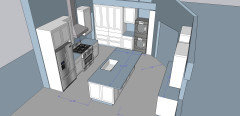
    Thanks! Here’s a couple of renderings. The back wall parallel to the range, where there’s no appliance right now (not the one with W/D) is where we are considering an oven below the counter.

  • 6 years ago

    It's a great idea.. It's really no different than those of us who have a cooktop + double ovens.

    One thing, I would not get a built-in MW over the wall oven. Instead, create an alcove above the oven and put a countertop MW inside the alcove. Countertop MWs are much less expensive than built-ins and if the MW dies you're not stuck having to buy another expensive built-in MW. Adding a pullout shelf beneath the MW alcove would be a useful touch as well.

    Just an FYI...wall ovens mounted under the counter are much, much closer to the floor than ovens in a range. You would be better off with it in a tall oven cabinet. Before finalizing your layout, find one that is installed under the counter and try working with it, including lifting heavy items out of the oven as well as items on the bottom rack at the lowest position. If you are quite short, it will probably be OK, but for anyone average height, it probably won't be OK, and for anyone over 5'7" or so, it will definitely not be! (Experience speaking...we considered mounting a wall oven under the counter, but our KD took us to see/try one, and we vetoed it immediately after trying to use it!)

  • 6 years ago

    @opaone - thank you for the feedback - super helpful!

  • 6 years ago
    last modified: 6 years ago

    Is that 4' b/w the edge of the seating overhang & the counter behind it? Or is it cabinet-to-cabinet? (Aisles are measured to/from the items that stick out into the aisle the farthest -- appliance handles, counter overhangs, etc. Most cabinet sales people and Contractors do not understand this and mistakenly incorrectly measure cabinet-to-cabinet. But cabinet measurements only include the boxes, not the doors/drawer fronts and counter overhangs.

    Either way, I would think twice about an oven there with so little space behind the seats. Remember that when you open an oven, very hot air rushes out. If someone is sitting there, it could be a safety hazard -- especially if that seating overhang is less than 15" of clear leg/knee space (if it is, people will be sticking even farther into the aisle than if it's the minimum recommended 15"). Is that a busy path?

    The minimum recommended aisle b/w seating and work space is 54".

    Edited to add:

    Case in point...the aisle b/w the refrigerator wall & island is mis-measured. That 4'2-5/8" aisle is really:

    50.625"

    - 1.5" counter overhang on island

    - 6" for refrigerator doors & handles

    =============

    43.125" (43-1/8")

    I.e., that's only a 43" aisle...and you have all three primary work aisles crammed into that small space. The minimum recommended aisle width is 42" if there is NEVER more than one person working on the aisle (prepping, cooking, cleaning up, loading/unloading the DW). 48" is the minimum if there is EVER more than one person working on the aisle.


  • 6 years ago

    Go with the range and wall oven(s). When we re-did our kitchen last year I opted for a 36" induction range, GE French Door oven and an GE Advantium oven. There are many days where I use all 3 ovens. Last year it made the holidays so much less stressful as I did not have to deal with oven usage logistics.

    Also if you have two or more cooks in the kitchen you do not have to deal with taking turns using the oven. LOL

  • 6 years ago

    If you are looking @Wolf 36”, avoid the dual fuel because it has the blue interior that chips. Wolf has had this issue for well over 10 years and can’t seem to resolve. This is what I have. It chipped @ 4.5 years and it is not under warranty. They won’t tell me how much to fix it and will only guarantee the new liner for a year. There was someone posting just recently who has been through a liner and two new ranges all chipping. Anything they make with a blue liner has this issue. The all gas does not have the blue liner.


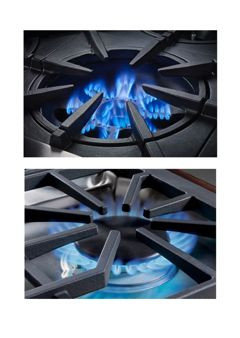
    If you are looking at all gas, consider BlueStar RNB. It has star shaped uncapped burners which can be beneficial depending on the type of cooking and cookware(cast iron, enameled cast iron, steel, some stainless steel) that you have. BS, top. Wolf bottom. Those metals tend to hot spot more.


    The old Wolf burners called semi open referred to the tray. The burner itself was capped.

    old Wolf burner


    The difference now is that the burner is stacked so the heat on the simmer is dispersed over a greater area. Capped burners have more flare as you turn them up, which some people don’t like. I like the flare because I use high heat on wider pans. I also use copper, some aluminum or other heat conductive pans so don’t have to rely on the burner to disperse the heat. On BS as you turn the heat up, the flame stays more in the same area.


    The cleaning is different because the BS has an open burner tray.

    The oven also holds a full commercial sheet pan or two half sheets, Wolf does not.


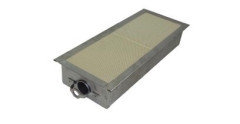
    The griddle is better on the Wolf because it has an infrared burner. It also has 1/2” rolled steel and BS has half that thickness.

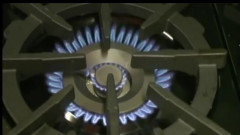
    BlueStar has this


    I would also consider an overlay griddle vs a fixed griddle.

    You can choose the metal for its ability to conduct heat. Heavy aluminum will conduct heat much more evenly than steel. The heat adjusts much more quickly up and down. Even with the infrared heat, the Wolf has areas that are warmer and cooler. They address this in the instruction book. You can have a steel overlay too if you want to.


    An overlay can have up to 50% more cooking area over 2 burners.


    You have a lot more flexibility in your burners if you can put the griddle away. This is more important in a 36” range.


    You have a lot more heat available. The total BTUs on a built in are 15K. With an add on it is at least double that. You can turn one end down or off for holding.


    You can bring it to the sink to clean.


    The advantage to Wolf or BS is that it is thermostatically controlled so that you turn it to a temperature and you get that repeatable temperature. The overelay is more like controlling a big pan.


    This is what I have, the 15”x23”.

    You can put it in the 36” oven if you want to. it comes in the bare metal which does season over time or coated, nonstick.

    http://royalindustriesinc.com/index.php?main_page=index&cPath=4_22_48


    Chef King makes these out of steel. They are heavier.

    https://www.dvorsons.com/ChefKing/Griddles.htm


  • 6 years ago

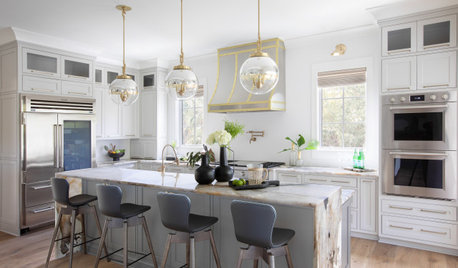
    Very handsome kitchen, @Sabrina Alfin Interiors.

  • 6 years ago

    I may have illusions of GBBO grandeur ;-).

    Speaking of The Great British Baking Show: What I really covet is the oven itself, which isn’t available here. I’m hoping someone like Miele or Bosch will license the pocket/flipper oven door technology from Neff.

  • PRO
    6 years ago

    Thanks, @Sammy!

  • 6 years ago
    last modified: 6 years ago

    Other comments...

    • Don't center the sink on the island as that robs you of useful counterspace in your Prep Zone (the non-DW side of the sink). Instead, offset it so you maximize your prep workspace. While 36" is the bare minimum needed/recommended, 42" to 60" is much, much better!
    • Don't have the DW open in front of the range.
    • Deep cabinets under a seating overhang are not very functional/useful since you have to lean over and reach under to access the contents. Stick to cabinets no deeper than 15" or so. Drawers and roll out tray shelves (ROTS) are not useful above about halfway from the floor since the overhang will block access to drawers and ROTSs.
    • All drawers in base cabinets! They are much more functional than both stationary shelves and ROTSs.
  • 6 years ago

    @Sammy - yes I’d love the Neff oven, but alas, I doubt I can deal with all the complexities of importing. I can’t believe no one here has considered making it yet.

  • 6 years ago

    Thanks, @Buehl. We do have architectural plans / this is more of a quick mock-up for visualization. We are not intending to have deep cabinets under seating overhang for that exact reason.