Software
Houzz Logo Print
brandiatl

Tub Leveling: Mud vs Self-Leveling?

5 years ago
last modified: 5 years ago


Professional Plumbers/Tub Installers/Bathroom Remodelers

Project:

Tub installation prep to ensure level tub

Issue:

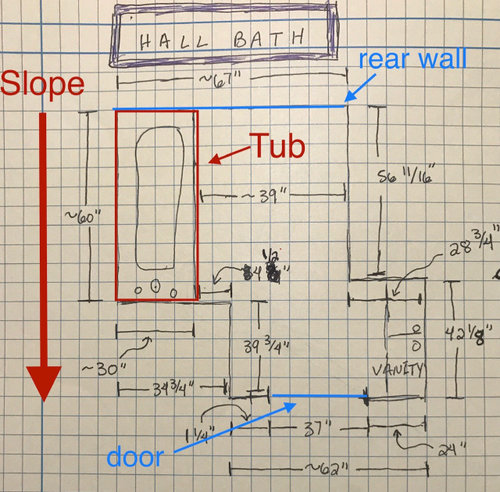
~35 sqft secondary bathroom’s OSB subfloor is both flat and level from left to right across the bathroom if standing in doorway; although from the rear wall to the door, the subfloor is flat but not level.

Insight:
I planned to address the slope beneath the tub by increasing the thickness of the mud on the drain/left side to ensure that the tub will be level. While researching, I have come across individuals using self-leveling to completely resolve the sloping. I am both familiar and comfortable with required prep before using self-leveling but have found that there are generally not many self-leveling options that are OSB-compatible - especially lightweight items beyond Custom Building Products’ LevelLite (and recommended primer).

Question:

  1. For those who have used self-leveling over OSB: what product (manufacturer and name) was used?
  2. What mud product (manufacturer and name) was used over the self-leveling?
  3. Would you simply recommend that I stick with using a thicker mudd bed to ensure tub will be level? In other words, would use of self-leveling be overkill?

Note:

  1. The tub’s alcove is on the left side of the bathroom if standing in the doorway.
  2. The replacement tub will be a left-drain alcove tub made of acrylic; mud will be used to set the tub given it will be acrylic.
  3. Given the slope, the drain (left) side of the tub will be lower than the right side if the slope is not addressed: the right side of the tub will butt against the rear wall.
  4. I do not intend to level the entire OSB subfloor, but rather only intend to address the area beneath the tub.
  5. Subject bathroom is on a third floor above grade.
  6. The floor joists are generally 16 o.c., some are actually closer.
  7. OSB subfloor is single-panel (no stacking) and nominally 3/4” thick.
  8. The rear wall is actually a “party wall” between my interior townhome and another townhome.
  9. There are no structural issues, just standard settling.

Comments (9)

  • PRO
    5 years ago

    Thinset morter, as the name implies is THIN set and is NOT recommended for leveling. Any bed over 3/16" inch is too thick....it will crack. A "mud bed" or "mason mix" is ideal for leveling a tub. I have also seen expanding foam used for this .....

  • 5 years ago

    I used standard type s masons mix when I did my tub. It turned out fine but I think I mixed it too stiff, which made it hard to settle into place. In retrospect, in addition to mixing more fluid, I would trial fit the tub and add some "feet" to the bottom integral rails to make the tub level. Then, as it settles into the mud, it will stop where it should. I hope your floor is not so far out of level that your flooring won't cover the gap created when leveling.

  • 5 years ago
    last modified: 5 years ago

    @Avant I am well aware that thinset is not what should be used. I am referring to the standard mud bed. Modified original post to reflect "mud" provided I misspoke/mistyped. A matter of semantics keeping in mind that many tub manufacturers refer to the mud bed as a mortar bed or mortar bed mix.

  • 5 years ago
    last modified: 5 years ago

    @Avant Sounds like I may need to level the subfloor; although, Kohler recommends 1-2" thickness. All material that I've read for multiple acrylic tubs generally recommend the same so I'm a bit surprised to see the 3/16" thickness noted.

  • 5 years ago
    last modified: 5 years ago

    @Seabornman Build up of flooring should cover the gap whether I choose to use 1/8" or 1/4" underlayment. My tile alone will be 0.4” thick.

  • PRO
    5 years ago

    Again, Mason Mix or "brick morter" works well for this. If you mix traditional floor mud, you should add a bit of lime to the mix. You now have what is referred to as "Fat Mud," which is used to fabricate curbs.

  • 5 years ago

    @Avanti Have you used self-leveling over OSB? If so, what brand? Assuming (maybe incorrectly) you are referring to a 4-to-1 mix as “Mason Mix”, what brand was used over the chosen self-leveling? I’m asking so that I can research any recommendations.

  • PRO
    5 years ago

    Certainly, "self leveling" as is available from Home Depot can be used, BUT, we are talking about a "bedding Material" for the tub. The 4 to 1 I use for making shower pans....but that is not what you need. For setting the tub, use brick morter or mason mix (same stuff) and mix it up like peanut butter consistency...but a bit "looser."


    Drop the tub in and fil it about 3/4 full of water and let it set for a day or so. From there, you should be good to go....

  • 5 years ago
    last modified: 5 years ago

    @Avanti Respectfully, you have missed part of my inquiry. Per my three questions posed in the original post, I am considering using self-leveling to address the slope in the floor before setting the tub. Therefore, again, have you used self-leveling over OSB, and if so, what brand did you explicitly use? I am seeking alternatives to afford myself multiple options. If the answer is “No”, that’s fine. Although, please let's stay on topic We're getting further away from my original post when I am also not requesting instructions (see original post) but rather recommendations for alternative products (explicit brand names) based on one own’s experience that are OSB-friendly - provided options seem limited.
    Note: As mentioned in my original post, the only lightweight OSB-compatible self-leveling that I could identify - whether at Home Depot or otherwise given I have searched brands sold at Big Box stores, smaller local or regional retailers, and online-based retailers - including brands like Laticrete - and even communicated with an array of manufacturing reps - is by Custom Building Products.