Software
Houzz Logo Print
blakrab

A Pinnate Vine?

5 years ago
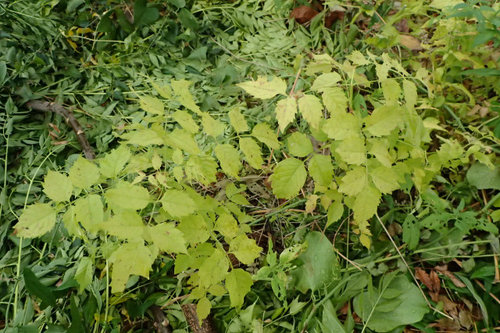
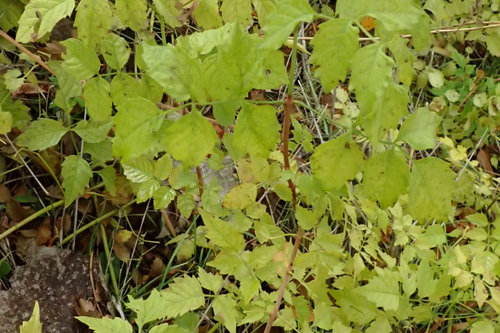
This vine is growing all over a disturbed site near a river. Its jagged leaves are around an inch long. What is it?


Comments (18)

  • 5 years ago

    That’s what it looks like to me.

    blakrab Centex thanked floral_uk z.8/9 SW UK
  • 5 years ago
    last modified: 5 years ago

    Another vote that it’s that horror. They’re taking over our state parks and other natural areas. The Fort Worth Nature Center has been hit hard — we saw them covering oak trees everywhere our last visit.

    blakrab Centex thanked Jilly
  • 5 years ago

    Yes, this is very hard to get rid of. Even Roundup won't kill all the extensive roots, and it will keep sprouting up all over the place.

  • 5 years ago
    last modified: 5 years ago

    Looks like it may have a percentage of leaves with too many divisions for Campsis. Also not sure the ragged leaflet margins and slender leaflet tips this one has are ever right for Campsis - but I haven't checked.

  • 5 years ago

    You're right. I thought something was amiss, hence the《?.》. There's only 3 divisions instead of 6 and the leaf tips aren't narrow like usual. What else could it be? Is it really a vine? Can't clearly see the stems and nodes.

    blakrab Centex thanked Jay 6a Chicago
  • 5 years ago
    last modified: 5 years ago

    Yea, also I've seen zero seedpods like on Trumpet Creeper...which they should be full of right now?!


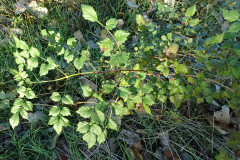
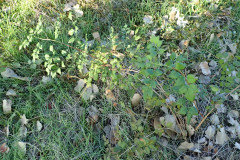
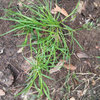
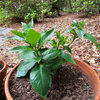
    Here's some more shots, if it helps...


  • 5 years ago
    last modified: 5 years ago

    The picture of the Campsis radicans, at the end of the article, has leaves similar to yours. Your plant looks too small to be ready to bloom. A clear close up of a stem node would've helped. 99.9 percent of google photos show Campsis with longer leaves, narrower tips, and more divisions?

    https://sharonsflorida.com/plants-page/native-vines/trumpet-vine/

    blakrab Centex thanked Jay 6a Chicago
  • 5 years ago

    Looks like Campsis in these last shots. Because the leaves do not branch (have more divisions).

    blakrab Centex thanked Embothrium
  • 5 years ago

    Glyphosate will kill Campsis radicans. Cut to about an inch aboveground. Then apply gly concentrate to exposed stem. If any others come up nearby repeat the process.

    I've killed it easily this way. And any other stubborn woody vine, shrub or tree.

  • 5 years ago

    I've mixed a quarter rate Glyphosate with water in a small disposable screw-on plastic jar (you sure don't want to ever drink out of it again, so it's one that lives in the garage and is clearly marked), then thread the vine into the top of the bottle's cap that I've punched a hole into, submerging leaves into the solution. The plant absorbs the solution slowly, too slowly to rapid-kill the leaves in the solution...but it does kill the vine in about 2 weeks.

    And the roots generally don't survive, so I use this method on tough rooted species.

    It works on difficult vines, sweet gum saplings (notoriously difficult to zap around here for some reason), and just about everything else you can imagine.

  • 5 years ago
    last modified: 5 years ago

    Hmm, yea, so it could be a whole field full of young Trumpet Creeper, that just isn't old enough to bloom and go to seed yet?

    "The trumpet vine (Campsis radicans) is a woody vine that produces orange to reddish, trumpet-shaped flowers. After planting, trumpet vines often don’t bloom for 3 to 5 years. The trumpet vine has to grow and mature before it is capable of flowering. There is nothing that can be done to force the vine to flower. Eventually, the trumpet vine will bloom."

    Yikes, well this plot is literally entirely covered in this stuff right now...and if it IS Trumpet Creeper...is gonna be one helluva vine jungle in a few years! :o

    Also, I only garden organically...and do NOT use glyphosate.

    "New EPA finding: Glyphosate harms 93 percent of endangered species

    Over 93 percent of endangered species and 96 percent of their habitats are likely to be harmed by glyphosate, the ubiquitous and controversial herbicide, the Environmental Protection Agency (EPA) reported in a draft evaluation released last week."

    But even if I did, it would still be a futile endeavor against an entire field of this stuff, all with thin stems about ~1/8" thick. That would be like trying to trim and paint 5,000 little matchsticks...

    I'm still not 100% sure it IS Trumpet Creeper, though...because how would an entire site get so evenly seeded? With no big mother vine in sight? However, the leaves do look like Trumpet Creeper and I don't know what else it could be?

  • 5 years ago

    You could pull it out repeatedly. As it regrows from scraps of root, keep repulling as soon as you notice it until it finally gives up the ghost. That could, if you miss the window before roots re-grow...well, it might never disappear. But it should get a lot better and if you keep at it regularly, it'll go away.

    There may be other suggestions from horticultural (20%) vinegar (I don't recommend this as it sounds "organic" and "safe" except back-spray will sear your cornea and the acid is terrible for the soil and destroys every part of the microbiome it touches). I find recommendations of this stuff to be completely irresponsible but can't blame those who do; they don't have any background in simple chemistry.

    Regular vinegar is OK, but ineffective against a lot of things. Again, wear eye protection and try it--it works best in summer and against Trumpet Creeper? Well...good luck.

    Other recommendations one occasionally sees include things up to and including borax solutions that occasionally rear their ugly heads around here. Don't do that, if you get the boron levels high enough to kill the vine, they're also high enough to render the soil sterile for years.


    Honestly, pulling it would be the most organic method and just do your best. It's back-breaking. (Shrug) Any creative chemistry simply wouldn't be organic at all and would have a cost in terms of soil or biome damage. There's no way around that.

  • 5 years ago
    last modified: 5 years ago

    ^ Well, the main area is very roughly, probably about a 400' X 100' plot...so roughly an acre. And I would also very roughly guesstimate that maybe about a third of that is covered in this vine. So, we're talking about maybe about 1/3 acre of this stuff!

    I am nearly done removing many dozens of invasive Chinaberry trees there after almost a month...but I'm not even going to try to remove this vine. I just don't even think it'd even be possible with that sheer amount of separate plants... Although if it IS the dreaded Trumpet Creeper, maybe I'll give it a test go just to try?

    I mean, if it was just a few plants, no problem. But how many separate little plants must there be in 1/3 acre???

    And ya, I have tried the 20% vinegar before on Poison Ivy. It burned the leaves, but didn't totally kill it. The only organic way I've found that really works is manual removal...which I try to use mechanical means for.

  • 5 years ago

    That or a Weed Hound. :-) If you do use 20% vinegar, just please make sure to wear eye guards and latex or, better yet, rip-proof nitrile gloves. That stuff is no joke. I've seen plenty of people do severe damage with "weak" acids or "weak" bases because they mistake the chemical definition of "weak" to mean they're physically weak.

    It might be possible here to thoroughly grind and turn the soil but...again, total soil disruption where you might as well just have bitten the bullet and used glyphosate for all the damage you just did.

    Boiling water is the only other suggested "herbicide" suggested, which also opens the door for solarization under clear plastic in summer. That might take it out but with Trumpet Creeper...I'm not a hundred percent sure. It would depend on the seal around the plastic and how much you can drain the root systems by the end of summer. Even so, it's going to seed back in.

    At least solarization bothers me a bit less even though it's going to sterilize the soil to about one to three inches depending on how well that goes. Again, it's biome Armageddon for every microbe and insect up top.

    Solarizing a third of an acre would be...difficult.

  • 5 years ago

    ^ Well I just checked out older Google Street Views of the area...and it was originally wooded, but recently bulldozed for constructing something nearby (I guess). So, that could possibly explain how it had gotten so evenly seeded with this vine...if there was originally this vine all throughout the woods to begin with. Then after getting cleared, it could have resprouted from the leftover roots or seeds.


    Well, I just hope it's not actually Trumpet Creeper (although it probably is), because I can't really do any large-scale operations like solarizing or pouring boiling water on 1/3 acre, lol... I'll probably just try pulling a few up to see how easy it is...and if it's really easy, then I may start pulling some just to at least scale it back a bit.

  • 4 years ago

    BTW, this was confirmed to be Trumpet Creeper (Campsis radicans)...just not quite mature enough to flower yet in most places. But, in some places nearby, it did.


    So uh, yea...a long term plan would be to slowly grow enough trees in this area to eventually shade it out, lol.

  • 4 years ago

    You are wise to decide to just let it be. Fighting it is a losing battle.

Sponsored
Peabody Landscape Group
Average rating: 3.5 out of 5 stars8 Reviews
Franklin County's Reliable Landscape Design & Contracting