Software
Houzz Logo Print
lee_richmond

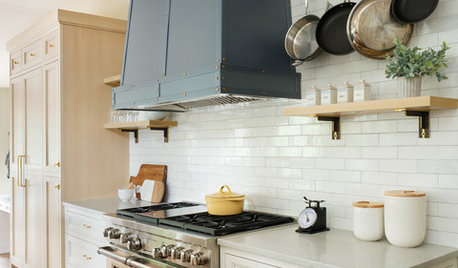
we need a more powerful range hood.

5 years ago

How do we go figure out what will be powerful enough/what will work in the space/and what we can do in our budget. How do we choose?

Comment (1)

  • 5 years ago

    The short answer is to perform a long process -- to read a lot of material on the subject. Many threads on this subject here can help you out. Most are too long for me to restate here in any degree of completeness. So first some platitudes, and then some hints in the form of recommendations.

    One thing worth recognizing is that in general one can pick only two of the three factors of Performance, Affordability, and Aesthetics. One often must perform trades among these factors to end up with an acceptable solution.

    Second, what constitutes acceptable Performance, Affordability, and Aesthetics are between 'somewhat' and 'totally' a matter of personal circumstance. For example, there is no legal requirement on how poorly one's hood must perform its fundamental tasks of cooking plume capture and containment. There are rules of thumb or suggestions consistent with much that is written here -- see below -- that I think are necessary, but meeting them might exceed one's budget even without any consideration of aesthetics.

    So ..., what is going on when one uses a hood of sufficient performance to deal with cooking effluent, rising in one or more plumes from pots and pans? The first step is capture. In this step, the rising hot greasy and moist plumes, if sufficiently energetic, are only weakly affected by the hood air flow until only a few inches away from the hood. As the plumes approach the hood, they rise into the hood enclosure that is bounded by the aperture at the base of a hood. This requires that the hood aperture extend widely and deeply (front-to-back) to encompass the rising and expanding plumes that may be present.

    Recommendation: Hood should be a few inches wider and deeper than the cooktop.

    Next, the cooking plumes momentum will cause them to reflect out of the hood reservoir into the kitchen unless the hood air flow is sufficient to entrain them to pass into the baffle filters (or in some cases mesh filters). Once past the baffles, the only place the plume content can go is out of the hood via the hood duct to the outside.

    Recommendation: Hood entry air velocity should be at least 90 ft/min, which is equivalent to 90 CFM per square foot of hood entry aperture.

    The volumetric air flow rate (CFM) is determined by the hood system blower power. (The blower can be in the hood, in the duct, or outside.) All relevant blowers have a flow rate that decreases with flow restriction -- measured as a pressure loss (inches of water column in US practice). It may be sufficient to estimate sufficient compensation for this loss rather than carefully analyze it due to lack of complete information -- particularly of hood pressure loss with flow rate.

    Recommendation: Multiply the required/desired CFM by a factor of 1.5 to find the rated CFM of a suitable blower.

    Then there is the duct. One wants the velocity of the air plus effluent in the duct to be neither too low nor too high, as this affects grease accumulation in the duct, either by condensation or impingement. Duct velocity at full power between 1000 and 2000 ft/min is appropriate.

    Recommendation: Select a duct diameter to achieve a flow velocity towards the lower end of this range based on the required/desired CFM.

    But wait, there's more. No air leaves the kitchen that won't be replaced. Hence a means of make-up air (MUA) is needed for the blower to achieve its required/desired flow rate. But there are additional considerations in that even slight pressure drops in the house interior might back-draft other combustion appliances, so the quality and quantity of the MUA must be based on building codes and safety considerations. Details of this may be found in other threads here, and can be elaborated upon once the hood system is defined.

    Among the many hood system and MUA system threads here is the somewhat disorganized FAQ started by @opaone and myself at https://www.houzz.com/discussions/5161173/hood-faq#n=67.

    Another point worth understanding is that hood efficiency is of great importance in commercial kitchens, and their hood designs are the result of many years of refinement. The more a residential hood (and some things that probably shouldn't be called a hood) deviates from these commercial designs the less likely that they will be good at their intended function. For an overview of the ventilation issue from a commercial point of view, read the first dozen or so pages of this paper: https://www.tagengineering.ca/wp-content/uploads/2015/02/KVSApplDesign_catalog.pdf.