Software
Houzz Logo Print
webuser_308015103

Should I grow Live oak in a container?

5 years ago

I always loved live oaks and I want one in my future house and because I know live oaks take a really long time to get to their final stage 50 -75 years I want to start growing one as soon as possible. So I thought about planting one in a container and then plat it in the ground. So my question is, If I do plant it in a container will it affect the tree's maximum size after I plant it and also what is the the maximum time It can be stay in a container without affecting its growth because I want it to grow as big as it can.

Comments (15)

  • 5 years ago

    Look at nursery stock. You can buy these in 60" boxes and they are massive. So yes, you can do it. It will not affect the tree's ultimate size. It can stay in a container for years. I've grown them from seed to #15's with no problems at all.

  • 5 years ago

    Main thing with oaks in pots is allowing for the tap root.

  • 5 years ago

    ANY tree can be grown in a container indefinitely. But they will all also need periodic root pruning and repotting and refreshing of potting soil. They also need more attention with respect to watering and fertilizing than do inground trees.

    Development of tap root - or not - in containerized trees is typically a non-issue. The container culture limits the development and encourages more lateral root development. The tap root is not essential to the life and health of the tree.

  • 5 years ago

    Oaks send them right down to the bottom of the pot and out any openings early in the process so a plan to deal with this needs to be present.

  • 5 years ago

    From TAMU: Acorns initially may be sown in flats in the greenhouse to be planted later, sown outside in nursery seedbeds, or seeded directly in nursery rows. A well-drained growing medium is preferred for germination in flats. Flats should be at least 6 inches deep. Covering the bottom of the flat with copper wire mesh promotes an extensive, well-developed root system. Seedling tap roots are killed when they touch the mesh, and lateral branching is encouraged. This type of root system is deal for continued growth in 1- and 3-gallon containers. Seedlings may be moved to containers during the spring following fall germination.


    Other wholesale growers of containerized oaks recommend pruning off the tap root early in the seedling development.

  • 5 years ago

    they are not houseplants ... do you have the ability to grow them outdoors??


    pots are ok.. if you understand the most important thing in the pot is not the plant..... but the media .. trees like a drink.. then full complete drainage .... and almost drying before the next sip ... do not use a houseplant media .. nor water them like you might water .. water loving plants ...


    where are you .. big city name.. if you want help figuring out how to do it outdoors ... you might want to use winter sowing .. since that is what the squirrels have been doing all fall ... be the squirrel ... lol ...


    ken

  • 5 years ago

    "they are not houseplants"

    True. But people can and do grow them as bonsai if you want to learn the art.

    I never did. I prefer the much older hachi no ki ("the bowl's tree" or "the potted tree"), which some people consider "undeveloped" bonsai, a compromise, or outdated. Some people lack souls.

    Take a look online for the art; it's a bit obscure, but much easier to do, far less constraining, and you'll find it's far more forgiving than bonsai. Lots of people have been doing it for decades without realizing they've been doing so, just not to hachi no ki principles. :-)

    Enjoy your tree.

  • 5 years ago

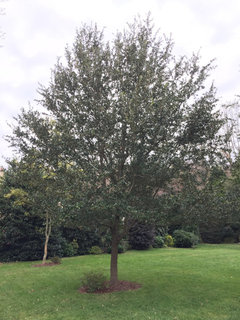
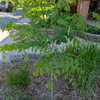
    Acorns should be started in October. Now is probably too late to find viable ones. Sure you can grow them in a large container. Depending on where you live, they can grow quite fast. Ten years will give you a nice-sized tree. This one is probably ten years from an acorn. Northern VA. It would grow faster a few hours to the South.


    HU-308015103 thanked Dave in NoVA • N. Virginia • zone 7A
  • 5 years ago

    can you clarify how long it might be before you actually have land to plant in???


    there would be no harm in playing around growing some in pots.. to learn about young oaks .... learn how to deal with pots and media for trees .. etc ... you would learn a lot of worthwhile info ...


    but im not sure you will accomplish your goal.. unless land ownership is not more than 2 or 3 years in thefuture ...


    imo ... a tap root is irrelevant ... its a root to anchor the acorn/seed to the ground for that first year or two of growth .. but after that.. its just another root ... and once the babe starts putting out other roots.. it isnt really needed for the anchoring ... frankly.. in the trade ... no matter where you get a 3 to 5 foot specimen tree.. it wont have a tap root .. as it was either balled and burlapped after being field grown.. or root pruned as it was up potted over the years ...


    contrary to myth ... most oaks are actually pretty fast growing ... after the first year or two ... they can easily start growing at least a couple feet per year .. and that is a lot of repotting and media... to be redoing it every year or two ... [media is not cheap when you need a lot]


    ken

    HU-308015103 thanked ken_adrian Adrian MI cold Z5
  • 5 years ago

    Are you talking about the specific tree called a Live Oak?


    What state do you live in? I used to live in Mississippi where I fell in love with Live Oaks. We lived near 2 of the oldest living things in the U.S.. One was over 500 years old and the other was over 750 years old, and that was at least 20 years ago. They take up a lot of space if you are talking about Live Oaks and not an oak that is alive. I think another one has been found that is over 800 years old.


    We moved to Oklahoma, and planted a 10 ft one in our yard. It lived about 4-5 years, but one year it did not survive the winter.


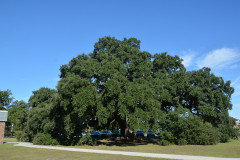
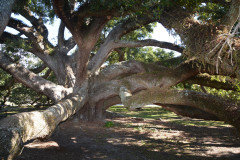
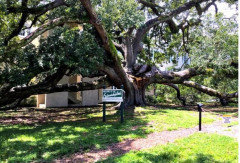
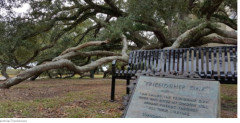
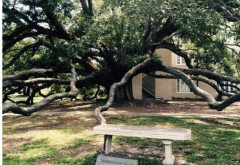
    In 1998, this Live Oak had a circumference of over 29 ft and a diameter of over 9 ft. The spread is over 161 ft. The branches are so heavy that they had to had guide wires attached to them for support. Sometimes the branches go all the way to the ground, then start going up again. Beautiful trees, especially with Spanish moss draping the branches!


    The picture below is on the Gulf Coast campus of the University of Southern Mississippi. It is only 533 years old. It was growing before Columbus sailed the ocean blue! It is not as large as the first tree.


    Hopefully, you want just an oak that is a live tree, not a Live Oak.

  • 5 years ago

    There are lots of species of live oak. "live oak" only means that it is an evergreen species. So the tree in question could be any one of 30 or so species that retain their foliage through winter. Not all will be winter hardy and not all will grow to a massive size.

  • 5 years ago

    Ah! The one we bought only said Live Oak and said how large it would grow. We thought they were all the same. So, Live Oak is actually an evergreen tree! Interesting...

  • 5 years ago
    last modified: 5 years ago

    When the average person in the Southern US refers to 'live oak', it's almost certainly Quercus virginiana, Southern Live Oak.

    Yes, there are many other types of evergreen oaks that go by 'live oak' :

    • Escarpment live oak (Quercus fusiformis)
    • Coast live oak (Quercus agrifolia)
    • Sand live oak (Quercus geminata)
    • Dwarf live oak (Quercus minima)
    • Shrub live oak (Quercus turbinella)
    • Canyon live oak (Quercus chrysolepis)
    • Interior live oak (Quercus wislizeni)


    and so on.


    But are they as well known? Maybe not. The live oak you are familiar with may be dependent upon where you live.

  • 3 years ago

    Quercus Geminata is the Sand Live Oak that you see along the coast that is very windy but somewhat stunted, not growing as large correct? I’ve been wondering if the ones on the coast were Quercus Virginiana that are just stunted due to being near the coast, but then I stumbled across the Sand Live oak.