Software
Houzz Logo Print
johnnybees

Zone Dampers leakage

5 years ago

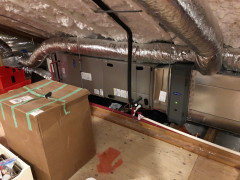
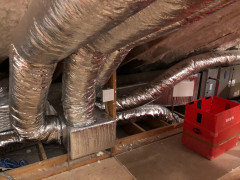
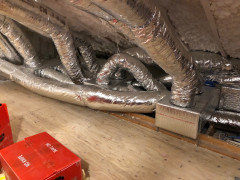
I have a 4 zone Carrier Infinity 26 Heat Pump/AC. Its the most efficient system they make. The issue i have is when the system is trying to operate for zones that are downstairs, my two upstairs zones are grossly being overheated. The short and annoying answer i got from my HVAC person is "heat rises, upstairs will always be hotter" but that answer was quickly squashed when it still happened with the doors closed. I then realized the zones were still getting air despite their dampers being fully closed. I then asked about that and was told "dampers arent air tight and air will always leak into closed zones". I feel that answer is also BS. Why have zones and pay extra to have zones if they arent going to be independent. I understand if the upstairs is a degree or two higher than downstairs but 5 degrees in unacceptable. I have all zones upstairs and downstairs set to 71F but because downstairs needs to more air to be heated, the system operates for those zones but heat comes out of the vents in the two upstairs zones which causes the temp to rise to 76F which is way to hot when trying to sleep with a comforter. He also said my issue is because my house is very well insulated (hardie siding, zip sheathing, 1” rigid foam, and 2x6 rockwool) so a “normal” house would be colder and the air small amount of coming into those zones wouldn’t be enough to raise the temperature.

1. Zones are there for a reason, to allow for different temps in different areas. If i was a cold sleeper (tstat set below 68) i'd be hating life right now.

2. I shouldn’t have a problem because my house was built better than the norm.


Should i have him replace the dampers with airtight ones?

Also, why wouldnt they be airtight to begin with?

Comments (14)

  • 5 years ago
    last modified: 5 years ago

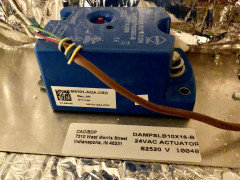
    The company installed the entire system. How can i check which dampers i have? Would they be labeled? If the propers dampers are installed, should i feel any air coming out of vents in the zones that shouldnt be operating? I would think no. I do feel air when the Zone Position is reading 0, which means its fully closed, it also say has a 0 for CFM. Thats my issue. Albeit a small amount but heat is heat espeically when the house it tight. I also have triple pane windows. I know my way around the Service (Hat turns Green) settings so feel free to ask me anything about the set up. Seems off the servo motor is failing or zoning control handlers would need to be changed given the system is only 2 months old.


  • 5 years ago

    Contact the business owner and tell him/her you are dissatisfied with the system's performance and the responses of the servicing technician.

  • 5 years ago

    Of course, i just want to be armed with the proper info in case i get more dumb responses. In order to mitigate the excess heat, i set the downstairs zones so Continuous Fan is set to High. My thinking was those zones would be calling for air circulation which means the hot air thats upstairs will get pulled into the return which is also upstairs and that air can be used to maintain the downstairs zones at temperature. Seems to work when the downstairs remains at temp (ie outside doors arent being constantly opened). I also set an airflow limit of 800 CFM. My thinking there was to limit the volume of air in the system which would limit the amount leaking into unwanted zones.

  • 5 years ago

    You are going to have a large electric bill if you are running the fan continuously on high. This is a short term solution for now. The installer should tell you the model numbers of the dampers he installed.

    This appears to be an installation problem that needs to be fixed. You spent a lot of money on this HVAC and it should be working much better than what you have described.

  • 5 years ago

    Please confirm that with the right dampers there shouldnt be any air going to zones that arent calling for it.

  • 5 years ago

    I would expect some leakage, but not to the extent you are describing. That would be the case if you had a single stage heat pump, where the air flow is always at maximum regardless of how many zones are calling for heat. However you have a Infinity Greenspeed heat pump which can modulate air flow from 25% - 100%. I would expect the air flow to slow down when one or more zones are not calling for heat. The air handler itself could also be contributing to the problem.

  • PRO
    5 years ago

    Upstairs will always be hotter. Heat does rise. However when it comes to zoning... especially with Carrier high end systems usually zoning is done with proprietary Carrier zoning products.


    Because of the way Carrier high end systems are designed (proprietary communications) there is no good way out of that box.


    When a system is designed it's capable of roughly 400 cfm of air per ton of air conditioning / heating is similar in that realm, but can be slower depending on the system.


    So say you have a 4 ton system, that needs roughly 1600 cfm of air. If you only call for 1 zone, maybe that zone needs only 800 cfm of air. Where does that other 800 cfm of air go?


    If that other 800 cfm of air has no where to go... it can damage equipment, blow duct work apart and so on. There are a myriad of ways to address this 'too much air problem' for Carrier I believe it is to crack all zones open slightly to relieve this pressure.


    So essentially you're probably stuck, when it comes to this system you bought. (It's by design, your system is proprietary so options are few.)

  • 5 years ago
    last modified: 5 years ago

    The heat pump is a Carrier 24VNA6 which If i am not mistaken is an inverter type design. If the system is installed properly shouldn't the condenser be operating at a lower capacity with a lower air flow if only one zone is calling for heat? If this is possible, then the dampers don't need to be partially open to relieve pressure.

  • 5 years ago

    Austin Air: The system is designed so that it definitely does not run at the full 1600 CFM when only one or two zones need air. Either way I also limited the heating airflow to 800 CFM so it will never move more air than 800 CFMs. I did this for two reasons. 1. i didnt want the noise of 1200+ CFMs and 2. I was trying to limit the amount of air going into "closed" zones. I'd find it hard to believe the system is purposely letting air into other zones to relieve pressure. Wouldnt that defeat the purpose of even having zones if zones that dont need heat are getting heat.


    mike_home: Yes, the system, both condenser and air handler operate are variable speeds. I agree 100% that its shouldnt be allowing air in other zones. I dont see how it is since those zones are all reading Zone Status's of 0 while the zones calling for heat are fully open at Zone Status 15.

  • PRO
    5 years ago

    Austin Air: The system is designed so that it definitely does not run at the full 1600 CFM when only one or two zones need air. Either way I also limited the heating airflow to 800 CFM so it will never move more air than 800 CFMs. I did this for two reasons. 1. i didnt want the noise of 1200+ CFMs and 2. I was trying to limit the amount of air going into "closed" zones. I'd find it hard to believe the system is purposely letting air into other zones to relieve pressure. Wouldnt that defeat the purpose of even having zones if zones that dont need heat are getting heat.


    yeah I know... but typically HVAC systems of this caliber start off slow and ramp up. Usually based on amount of run time. Some ways mfg.'s are different from one another but at the end of the day there are similarities. Say it's 8 minutes of run time. If the call isn't settled typically that passage of time tells the system the call is still coming you're not producing enough and begins to ramp.


    There isn't something there I don't believe telling it "two zones are closed, do not ramp up."


    In a perfect world of 800 cfm ramp down, or limit when zones are closed: but yet you posted here with a problem?


    The 800 cfm ramp down or limit as it were didn't fix it. Otherwise why post?


    One ducted zone system using proprietary controls vs 3 other ducted zone systems using non proprietary controls?


    What's the difference they are all zone controls? Design, design, design. It's why I don't like proprietary controls. They exist primarily to eliminate competition. It's not about giving you what you think you are buying. (You don't have to believe me, I could dump 25 lbs of sugar on this subject it wouldn't make a bit of difference.)


    You can fiddle faddle all you want, design problems are not fixed with fiddle faddle. How do I know it's a design problem? #1. You posted after fiddle faddle.


    #2. Conditions: much of the USA is under extreme climate conditions: climate change, global warming --- what ever you wish to call it. Cold man winter etc. Deep freeze which means systems have much longer run time than usual.


    #3. If a design is lacking: every problem with the design will be magnified under these conditions. No amount of fiddle faddle will fix it.


    #4. It could be worse: not enough heat. But that is not the case right? Which again is design, all day everyday.

  • 5 years ago

    Spoke to my HVAC person again and asked about damper leakage. He insisted there arent dampers that are air tight. He really didnt have an answer for when i asked "how do i keep my bedroom at 68F?". He said to lower the thermostat to 68. I did. I has never gone below 71. He also said Carrier doesnt make air tight dampers? Is that true? I told him i would call Carrier and ask them.


    Here's the damper control.


  • PRO
    5 years ago

    Spoke to my HVAC person again and asked about damper leakage. He insisted there arent dampers that are air tight.


    Well there are, but you have to understand that zone dampers get a work out because when a zone or zones finish the call all dampers start open on most zone systems. It takes a good 15 seconds or so for my dampers to close in zones not calling.


    So when a zone calls you can get air thru zones that aren't calling until those dampers close (speaking of a zone system that closes zones off from opposing calls, with no bleed thru -- it still bleeds thru as zones start the call, but we're talking 15 sec or so until the dampers close.)


    The systems that bleed air thru non calling zones (all the time whether calling or not) are typically those like yours. They do this to alleviate air pressure. There is no way around it because of the way these systems are designed.


    They design them this way because of problems associated with bypass dampers. A bypass damper is used to dump excess air back into the return of the system. Problems that arise from this method are complicated. My system uses a bypass, only because I understand what's necessary to make this work.


    The smallest zone is often what causes the trouble. So by eliminating the bypass they dumb down the system and just bleed thru air into all the other zones. Air takes the path of least resistance. So once pressure builds, more air finds its way into zones that aren't calling. Most of the time this isn't a problem except under extreme climate conditions and factors like hot air rises causing temperature disparities... especially if it's a two or 3 story structure using one HVAC system to accomplish both levels via zoning.


    Carrier says: "Turn to the Experts"... your daily dose of irony.


    So your thought might be to just add a bypass damper. Welcome to new problems if you attempt that.... not to mention they probably void your warranty.

  • 5 years ago

    Your zoning is not working well. Whether it is due to leaking dampers or something else the contractor needs to determine what is the problem and fix it. You can call Carrier and they will tell you to speak to your installer. HVAC manufacturers do not get involved in bad installations.